Tag Archives: #upstatenewyork

Shapiro Publishes There Goes My Heart

On September 3, 2016, , I launched my first book, There Goes My Heart. This article was published in the Jewish World News. Ten years later, I am about to publish Book Five: Never Forget: Stories of Jewish Sacrifice, Survival, and Strength. Who ever thought this girl from Keeseville, who wrote her first short story when she was 16, would ever be published??

Marilyn Cohen Shapiro of Poinciana has announced the publication of “There Goes My Heart,” a collection of personal memoirs. The collection of over 40 personal essays captures special moments in a lifetime spent in Upstate New York, Florida, Colorado, and beyond. Her Amazon author page states, “Readers will empathize with these true stories of dating, marriage, raising children, and caring for elderly parents through the author’s wit edged with appreciation and love of family and friends.” The book is available on Amazon in both paperback and Kindle e-reader format. A graduate of University of Albany, Shapiro was employed for over 25 years at the Capital District Educational Opportunity Center, a division of Hudson Valley Community College, Troy, New York, first as an adult educator and later as Coordinator of Program Development and Research. Since 2013, Shapiro has been a regular contributor to The Jewish World, a Schenectady, New York,-based bi-weekly newspaper. Shapiro and her husband Larry moved to Poinciana in 2015. They are members of Congregation Shalom Aleichem in Kissimmee. Shapiro is a lifetime member of Hadassah and a recipient of a Hadassah leadership award. She is a 2008 recipient of the State University of New York Chancellor’s Award for Public Service. This is Shapiro’s first book.

Cover created by Mia Crews

Holding on tight to my Jewish roots….

Since the year that we met, my husband Larry and I have attended Rosh Hashanah—the Jewish New Year—services. We hear the shofar, listen to melodies that we only hear on the High Holy Days, and greet our friendswith L’Shana Tova—Have a good year!

Attending High Holy Day services as an adult is different from my experiences as a child growing up in Keeseville, a small upstate town of two thousand people about ninety minutes south of Montreal. My uncle Paul had opened Pearl’s, one of a chain of small department stores he had established in Vermont and Upstate New York. He hired my father to manage it. Although my parents had both grown up in New York City in Jewish neighborhoods, they had lived most of their married life in overwhelmingly Christian communities. In 1952, however, they found themselves in a town where they were the only Jewish family except for a childless couple, a lawyer and his wife. The next Jewish family didn’t move in until the mid-sixties. 

To offset the effects of our non-Jewish environment, my parents immediately joined Congregation Beth Shalom, a Reform temple in Plattsburgh. We attended High Holy Day services and, depending on the weather conditions for the fifteen-mile drive, Shabbat services on Friday night. Saturday services were only held for the boys’ bar mitzvahs; all the girls were confirmed at age sixteen.

In addition to attending services, my parents were insistent on their children getting a Jewish education. For a span of twenty years, our father made the trip up Route 9 every Sunday with whatever number of his children between the ages of five to sixteen were taking religious school lessons. We would arrive in Plattsburgh a half hour early. Then Dad would take us to the newsstand across the street from the temple on Oak Street. He purchased the New York Times for himself and comic books for us, our perk for going to Sunday School. My brother Jay chose Superman; Laura and Bobbie, Archie and Richie Rich; and I, Classics Illustrated. Dad would then wait for us in his idling car —It got cold in that parking lot in the winter—reading the paper and smoking Kents. Over the years, all of us learned Jewish history, customs, and ethics. Jay learned Hebrew for his bar mitzvah. The three of us girls’ Hebrew education was limited to the six-word Shema and blessings over bread, candles and wine. When we got home from school, Mom would have an elaborate dinner waiting for us—brisket, roasted potatoes, candied carrots, pickles, and delicious spiced apples from a jar—another perk for our going to Sunday school. 

As residents of Keeseville and members of a temple in Plattsburgh, we were caught between two worlds. As we did not live in Plattsburgh, we often viewed ourselves as outsiders at Temple Beth Israel. My mother, in particular, did not feel comfortable with many of the congregants.  A daughter of poor Russian immigrants, she often felt inferior to those who were third or fourth generation German Jews who historically regarded themselves as more educated and refined than those from the shtetls—the small towns with large Jewish populations which existed in Central and Eastern Europe before the Holocaust.

The residents of Keeseville were generally welcoming to our family, and we rarely experienced anti-Semitism. There were moments, however, that are etched in my memory. My parents were usually included, but there were occasional “lost” invitations to events, and we knew some viewed us as different. On rare occasions, the insults were more direct. When I was around six years old, I was playing on my front lawn with my doll. A teenaged boy who lived up the street came by and, giving the Nazi goose salute, yelled “Heil Hitler!” I ran inside crying. Jay, four years older than I, ran out of the house to chase him down and punch him in the nose. When Jay was in high school, the local priest advised his young female parishioners that it was best not to date “Hebrews.” Obviously, this did not help Jay’s social life.

The High Holy Days emphasized this “otherness” even more strongly. We did not attend school on Rosh Hashanah and Yom Kippur.  My father closed the store, an event worthy of coverage in the Essex County Republican. Jay, who played football for Keeseville Central, missed every game that fell on the two major fall holidays, again newsworthy enough to make the local paper. 

Everyone in Keeseville knew that the Cohens celebrated their Jewish High Holy Days, but I was still sensitive to our being the only children missing school. One Rosh Hashanah, I was pushing my doll carriage in front of the house when I was overcome with embarrassment. What if someone saw me and wondered if I were playing hooky? I went inside to avoid the potential scrutiny and a visit from the truancy officer. 

My feeling of “otherness” continued as the seasons changed. Beginning in November,  I often had to explain that Chanukah was not the “Jewish Christmas,” and no, we didn’t have a Christmas tree or a  Chanukah bush. As soon as we returned to school from the Thanksgiving break, the music classes I attended and, later, the choruses I joined in junior senior high, were filled with Christmas music. I could handle “Little Town of Bethlehem” and “Deck the Halls.” When it came to the line in “Silent Night” which stated “Christ the Savior is born,” however, I would just mouth the words. The token inclusion of the song “I Had a Little Dreidel” didn’t make me feel that the school was sensitive to my religion and culture

Other events brought their challenges. Passover often fell around Easter, and I watched my Christian friends devour bunny shaped chocolate eggs and jelly beans while I nibbled on my dry matzoh and butter. Once again, I felt different. In high school, my World History textbook reduced the Holocaust to the iconic 1943 picture from the Warsaw Ghetto of a German soldier pointing his machine gun at a little boy, clad in a coat with the yellow star, holding up his hands in terror. I can still remember looking down and crying silent tears while the teacher quietly and sympathetically moved on to the next topic. I understood clearly that the horror of the persecution of the Jews was diminished by this negligible treatment of the Holocaust in our textbook.

For many years, I saw other Jewish children mostly at Sunday School. As I got older, I joined a Jewish youth group and finally had Jewish friends. For the most part, however, our friends were our Christian classmates from Keeseville. We all dated in high school, but my parents pressed upon us their wish we would leave Keeseville after we graduated and make our lives in settings with more Jewish people. 

In part because of my desire to be with other Jews, I enrolled in University of Albany in 1968. While at college, I attended High Holy Day services at Congregation Beth Emeth, but that was the extent of my Jewish participation until I met my future husband in 1973.

Larry and I attended High Holy Day services at Congregation Shaara TFille, the then-Orthodox shul—synagogue—in Saratoga to which his family belonged. What a dramatic difference for me! Men sat in the center pews, and the women, although not behind a mehitzah, (a curtain which separated the men from the women), sat in the back or on the sides. Most of the service was in Hebrew, and everyone prayed at what seemed to be lightning speed. Page numbers that were displayed on a chart on the bima provided my only means of following along with the prayer book. The services were much longer than those at Temple Beth Israel, and even the rabbis, with their black beards, payots (side curls), and yarmulkes (skull caps), were strange to me. In many ways, it was as foreign to me as the churches I had attended on occasion with my Christian friends.

After Larry and I were married, we bought a home in Clifton Park, a suburb of Albany, New York, in part because we knew that a synagogue had recently been built in the community. We joined in 1983, and we found that the Conservative service was a good compromise between Larry’s Orthodox shul and my Reform temple. Ten years later, I celebrated my own bat mitzvah on my father’s eightieth birthday, my way of honoring his commitment to our Jewish education. 

Throughout my life, people assume that I, like many Jews, was brought up “downstate,” in New York City or Long Island. When I tell them about growing up in Keeseville, they comment, “That must have been hard!”

It had its challenges, but it also offered wonderful opportunities. I grew up in a loving, close knit family, developed lifelong friendships, and enjoyed the beauty of Lake Champlain and the Adirondacks. I proudly identify myself as an Upstate New Yorker, with roots still entwined in that tiny town an hour south of the Canadian border. 

Because of my unique upbringing, rather than losing my Jewish identity, my faith grew stronger. I could never take being a Jew for granted. And having a faith I had to hold on so tightly to maintain makes each High Holy Day, each Jewish milestone, even sweeter.

A version of this story was published in The Jewish World, August 29, 2013. I am finally posting it on my blog eleven years later!

Marilyn and Larry Rosh Hashanah 1973 (Shh! We were engaged but didn’t tell anyone yet!)

Pressing Questions

When one is looking for a home in today’s market, one of the featured perks is the laundry room. Multi-functioning washing machines and dryers, fancy cabinetry,  shining stainless steel sinks, and granite countertops appear to make Wash Day a joy. What a contrast to the way my mother handled the laundry in Upstate New York in the 1950s!

In 1952, my family moved into a two-story house in Keeseville that had been built at the turn of the century. Compared to the 1200 hundred square foot “box” we had lived in Potsdam, the four bedroom Victorian with its large living and dining rooms, ancient but large kitchen, office, a large unfinished room off the kitchen, and three (!) porches must have felt like a castle. 

Our laundry room, however, was more like a dungeon. Out of necessity, the the wringer washer had to be set up in the basement, a dark, damp room with dirt floors, old stone walls, and a small window that looked out to the crawl space under one of the porches. A single hanging bulb provided the only light. 

With two adults, three children —including one in cloth diapers—and lots of company, my mother had plenty of laundry. The wonders of polyester and wash and wear were still several years away. Either clothes were dry cleaned or “put through the ringer.” After a scare when my older sister Laura got her arm caught in the wringer mechanism,  the old machine was replaced with a more modern top loading model. My mother must have thought she was in the lap of luxury. 

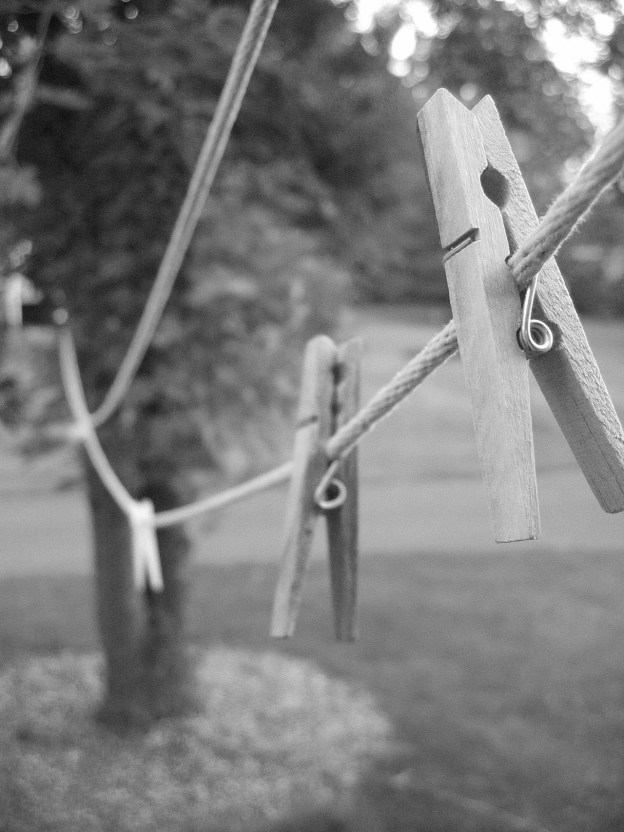
Electric dryers had not yet found their way to Upstate New York, so all the wash had to be hung to dry. Mom carried the wet laundry up the steep basement stairs, walked through the kitchen and through the door to the back of the unfinished storage room. She opened a large window and hung the clothes from a thirty-foot clothes line that was attached by a pulley system. One end was attached to the house and the other end to oak tree that marked the far right corner of our property.

During the good weather, sunshine and warm breezes would quickly dry the sheets, pillow cases, towels, diapers, shirts, pants, dresses, and underwear that hung ten feet above our backyard.  If an unexpected rain storm came through, Mom would have to quickly pull everything off the line and hang them over available chairs and radiators to finish the process. During the long winter months, cold air poured into the unheated room as Mom, fingers red and raw, pinned the laundry to the line with the wooden pins. If the snow was too frequent, she resorted to hanging the laundry in the basement.

On the good days, Mom pulled the line of dry clothes towards the house, unpinned  the items, and piled them into waiting laundry baskets. The cotton fabrics would smell like fresh air and sunshine but would feel more like stiff boards of wrinkled matzoh. 

As a result, almost everything had to be ironed. Mom filled an empty soda bottle with water and stuck an aluminum and cork sprinkling head into the top. She lay out each item of clothing on the kitchen table, sprinkled the material well, rolled it up, and placed it in a laundry basket. She let all the dampened clothes sit awhile so the moisture would be well distributed. If she was afraid of mildew, she stuck the clothing into the large freezer chest that was housed in the shed.

When she and the clothes were ready, Mom set up the ironing board in the kitchen, plugged in the iron, automatically licked her index finger on her tongue, quickly touch its wet tip to the bottom of the iron to check the temperature, and then pressed the steaming metal plate into the fabric. Taking each damp, rolled piece out of the laundry basket, she ironed for hours while listening to the songs of Frank Sinatra, Patti Page, and Tennessee Ernie Ford on WEAV-AM out of Plattsburgh. The kitchen would be filled with the sound of sizzling clothes and the smell of hot metal against the damp cotton.

The laundry increased with my sister Bobbie’s arrival three years after our move. By the time she was out of diapers, my parents had purchased a clothes dryer. Her lap of luxury had grown.  Pink boxes of Dreft and plastic bottles of Clorox sat on a brown metal table between the two appliances, along with yellow bars of Fels Naptha soap, stray buttons, and assorted painless missing socks. 

The clothes line was only used on beautiful summer days as Mom still loved the smell of sunshine and fresh air smell on the sheets.

There was still a great deal to be ironed, so my mother gave her children pressing lessons lessons at an early age. Starting with relatively easy handkerchiefs and pillow cases, we soon progressed to pants (“Make sure the seams are straight!”) to shirts and blouses (“Start with the back and progress to the front and sleeves.”) to dresses.(“First do the bottom skirt, pushing the iron gently but firmly up to the waistband.”)

I don’t recall my father never helping with laundry his entire life, but Larry has been by my soapy side since our apartment laundry room days. Once we moved into a house in Clifton Park, we set up an ironing board next to our washing machine and dryer in our basement/laundry area.  To this day, he washes our bedding every week  and does most of the laundry, including a weekly sheets and towel load.(Another reason I love him!)

Our Yes!-We’re Retired! Florida wardrobe doesn’t require extensive pressing. No matter, at least twice a month, I  pull out the steam iron and the  twenty-year-old ironing board. I spread our shirts and blouses and pants and handkerchiefs one by one on the ironing board. I wet each item with distilled water from a plastic spray bottle, automatically lick my index finger on my tongue, quickly touch its wet tip to the bottom of the iron to check the temperature, and then press the steaming metal plate into the fabric. I hear the familiar sizzle, and I breathe in the distinct aroma of cloth and water and and heat and traces of laundry detergent. I am happy knowing that our clothes will be pressed and ready to wear—just like my mother taught me sixty-five years ago. 

Photo by Michael Jastremski courtesy of Wikimedia Commons.

A version of this story was originally published in The Jewish World in July 2017. As it fell throuugh the cracks, I have added it to my blog seven years later.

Wandering, wandering!–Where do we settle?

A version of this article originally appeared in the June 18, 2015, issue of the Jewish World News. I am publishing this blog post as we celebrate nine years in our “new” home.

This year marks the fortieth year Larry and I have celebrated Passover as a married couple. Unlike the Israelites, we have not exactly spent it wandering in a desert wilderness. It has been a fruitful, productive life spent in the Capital District. For us, next year will not be in Jerusalem, but in Florida.

A real upstate girl, born in St. Lawrence County and raised in in Essex County (Since when is Westchester County upstate?),relocating to Albany for college in 1968. Larry also had spent all but his college years in Saratoga County. We met in Albany, married, moved to Clifton Park, raised two children, made wonderful friends, and spent holidays with our families.

When did the desire to live someplace else begin? The germ was planted twenty years ago when our parents spent six to eight months a year in Florida. Our circle began to expand geographically: our children moved to California and Colorado; my sister moved to Arizona; an aunt moved to South Carolina; a niece moved to Virginia; and a number of friends and family started living two to four months in warmer climates. Other friends were spending time with their own children, who were scattered over the country and the world. We began a nomadic life, visiting friends and family and traveling on our own to Germany, Peru, England, Greece. Although we enjoyed our numerous trips, we felt finding “our spot,” a place that fit all our criteria, would keep us more grounded.

Every place we visited raised the question, “Could we live here?” We did some California dreaming, but the high prices of real estate and the high possibilities of earthquakes ruled it out. Julie and Sam live at 9000 feet in Colorado, truly a Rocky Mountain high. Summit County is beautiful in the summer, but the winters last nine months, and you think Boston gets snow? Try twelve feet a year, every year. Other places in Colorado offered warmer temperatures, but the homes we viewed were close together, and we would still need our snow shovels.We also Arizona would be out of the mix: The desert can be lovely, but no manna—and little rain—fell from the heavens, and we were always happy to get back to “green” and water on the East Coast. Ever the English major, I  even fell in love with the small villages in England, but we knew that would never be where we settled. 

Once we retired four years ago, our interest in relocating intensified. The long winters and grey skies hadn’t bothered us when we were working, but once we were home all day, the weather became a factor. Our friends and family changed from asking, “Have you any trips planned?” to “Where are you going next?” And after forty years, Larry and I were ready for our next adventure. 

This fall, everything fell into place. Julie told us over Thanksgiving that, after eight years of marriage, she and Sam were expecting our first grandchild in July 2015. After I stopped jumping up and down with joy, Larry and I made the decision that we would like to spend our summers in Colorado and the rest of the year someplace warm. We found that warm spot on a rainy December day in Florida, when we checked out an active adult  community where we were staying near Orlando. From the moment we drove in, Larry and I were impressed with the tranquil setting and the amount of green space and lakes. We fell in love with an immaculate home for sale on a lovely piece of land overlooking a pond and bordering a wildlife preserve. The community itself offered all we were looking for: indoor and outdoor pools, Hadassah chapter, book clubs, a writing club, bike paths, pickle ball courts, movies and shows, and exercise classes.It was close to world class entertainment and an international airport with direct flights to all major cities in the country.

We came back to Albany, to grey skies, piles of snow, and sub-zero temperatures. Even with the miserable weather, we still needed time. After much research, thought, discussion, and several sleepless nights, we decided to purchase the home in Florida and spend two to three months in Colorado. So, after forty years of New York Passovers, next year we will be celebrating with the Shalom Club in our new neighborhood.  

If physically packing up the house is a challenge, emotionally leaving behind family, friends, and years and years of memories will be even more difficult. For the last twenty years, I have had the following framed quote hanging in our home, “Come my love and we shall wander, just to see what we can find. If we only find each other, still the journey is worth the time.” Like our Israeli ancestors, Larry and I will be wandering far from the home we have known to begin our next adventure. 

I am a Cryptoquote addict

Hello. My name is Marilyn, and I am a Cryptoquote addict. The addiction actually snuck up on me.

 For years I had done the daily crossword puzzle in Schenectady, New York’s, Daily Gazette,when I got to it before Larry. An English major in college and a reading and writing teacher as an adult, I have enjoyed a sense of satisfaction and contentment to find the exact word to fit into the correct boxes.

Crossword puzzles, however, had never become addictive. I have never dwelled upon the fact that I don’t know a Stanley Donen movie (“Deep in My Heart”), a phrase for being stuck (in a rut), a six-letter word for crown (diadem) or the 1967 and 1968 Super Bowl MVP (Starr). I am not ashamed of resorting to online crossword puzzle solvers if I can’t figure it out. I defer to Larry for most sports questions, as he defers to me for arts and literature. I have even quit and tossed them, unfinished, into the recycling bin.

But Cryptoquotes were/are different. After years of seeing Larry’s handwriting in black felt tip pen under the AXYDLBAAXR is LONGFELLOW hint, I decided around 1992 to find out the attraction of decoding a nonsensical jumble of letters into a meaningful statement. It was love at first attempt.

Not only did it satisfy the reading teacher in me (recognizing those two-and three-letter consonant blends such as “th,” “sh,” and “ght” often unlocked the puzzle), but I also was intrigued by the messages that the Cryptoquote revealed. Some needed explanation—Who is Morpheus, and why should I care about his hand?— but others were humorous or prophetic enough to type into my Favorite Quotes journal I keep on my computer. 

Larry graciously gave me full right to the Gazette until our move. As our Orlando paper doesn’t carry it, my dear husband found an on-line source that he prints out for me daily.

Unlike many crypto puzzles whose solutions are puns or, for me, just too simple, the King Features Syndicate Cryptoquote finds sometimes lengthy quotes from notable people, many whom I admire. I solved the following only two days after Ruth Bader Ginsberg’s death on September 18, 2020: “My mother told me to be a lady.  and for her, that meant be your own person, be independent.” Other solutions offered me insights that I continue to carry with me. Since decrypting Plato’s words, “Wise men talk because they have something to say; fools talk because they have to say something,” I have often thought twice before blurting out something just to fill the void. 

For twenty-two years I have been given words of wisdom —and some laughs—from individuals ranging from Abraham to Zachariah, from Chaucer to Cookie Monster, and from Shakespeare to Shakira, as well as the prolific Anonymous and Source Unknown. 

Larry and I have a routine. Sitting next to each other on the couch in the den, Larry hands me one of the two crossword puzzles he has printed out that morning. Sometimes we each finish it alone; other times, one of us asks, “Do you want to start working on it together?” 

 The minute I am finished—or have given up—I immediately dive into my Cryptoquote. Most of the time, I work through it quickly. There are nights when I don’t go to bed until I can figure it out. When I get desperate, I ask Larry for a hint. (“Is the third letter in the first word an ‘e’?). He consults the online solution and provides the clue.

And, yes, there are days that I cannot solve it. The next day, I usually have to kick myself for missing the obvious. Not figuring out the words Merry Christmas in a holiday greeting from “Your Cryptoquote Friends” on a December 24th puzzle embarrassed me as did not realizing the author was the Notorious RBG herself. I have worked on those with whom I cannot easily break the code on long car rides, in doctors’ offices and, admittedly, boring group ZOOM calls.

I knew I was truly addicted when, two years into my doing the puzzle, the Cryptoquote was not in its usual page in the Gazette. I began flipping rapidly through the classifieds and then through the entire D Section. Nothing. Frantically, I began searching through the entire paper, thinking . . . hoping . . . that maybe the powers that be had decided to move the heart of the paper to a more prominent section. On the Op-Ed page? Next to Ann Landers? In the obituaries?

“Larry,” I yelled to my husband. “I can’t find the Cryptoquote.”

“Are you sure?” he asked. He began a search, calmer, less hurried, but no more fruitful.

Not fooling around, I called the paper. to the source. Hi,” I said to the Gazette operator. “I don’t know if you guys are aware of this, but . . . The Cryptoquote is missing!”

On the other end of the line, there was a brief moment of silence. Then a tired voice said, “Yes, we are aware of the situation. We will publish two Cryptoquotes tomorrow, unless you want to come to Maxon Road for a copy today.”

I quickly calculated the time it would take for the round trip to Schenectady. Forty minutes; with GE traffic, maybe an hour. I declined the offer. I can wait until tomorrow, I thought. It will be hard, but I can wait.

There was something in the operator’s tone, however, that made me quickly realize that I was not the first to call.

“Have you gotten other complaints?” I asked.

“Dozens” she said wearily. “The phone began ringing off the hook at 6:30 a.m. and hasn’t stopped since.”

“Were most as nice as me?” I asked tentatively.

“No,” she said. “There were a lot of angry callers demanding to know why they hadn’t been published.”

I expressed my sympathies, thanked her for her help, and hung up, breathing a sigh of relief. Tomorrow . . . less than 16 hours from then, I would have two puzzles to solve. Furthermore, I could come out of the closet and join the ranks of those who are addicted.

My name is Marilyn, and I am a Cryptoquote addict.

Versions of this blog post were published in The Jewish World and the Heritage Florida Jewish News.

Misplacing items, but holding on to the important stuff—I am no Sherlock Holmes

I have spent  half my life looking for things I’ve misplaced. I have spent the other half finding things for Larry that he claims I lost to make his life more difficult.

Recently I was visiting my daughter Julie, her husband Sam, and my granddaughter Sylvie in Colorado. That morning, I had unplugged my charging cord for my phone from the power strip next to my bed. I was sure that I had plugged it into a kitchen outlet. Later in the morning, however, the  only charger, looking mysteriously larger than mine,was connected to Julie and Sam’s iPad.

“Sam, are you using my plug to charge your iPad?” I asked.

“No,” said Sam. “That one is mine.”

I spent a good chunk of the next few hours looking for my missing cord. I looked in my traveling charger case, my pocket book, my suitcase. I rechecked the outlet next to my bed and every other outlet in the house. After we returned from a walk and lunch on  Main Street, I rechecked the outlet, my charger bag, the pocketbook, the suitcase. Then I pulled off all the bedding (maybe it got tangled in the sheets when I was making the bed?) MIA. Julie just rolled her eyes. Mom has lost something- AGAIN.

Misplacing something is part of my personality. Keys.Cell phone. Favorite water bottle. Sun glasses. Larry has grudgingly accepted that every time we head out, we have to allow enough time for me to make one more frantic trip into the house to search for my frequently lost or left behind items (which I refer to as FLI’s)

I know that my misplacing things is not tied to cognitive impairment, a concern as I work my way through my sixties. I have not yet found my cell phone in the freezer or my keys in the microwave. Thankfully, my losses are usually a result of multitasking or not giving myself enough time to put the item in its proper spot in the first place.

To compensate, I have established assigned places for the FLIs. My keys go on the key rack next to the door. The cell phone goes on the kitchen counter, plugged into the permanent charger. My favorite water bottle gets rinsed and put back into the refrigerator. On my good days, the system works.

I’ve given up on the sunglasses. After several last minute scrambles,I finally purchased several additional pairs for my pocketbook, each car, the beach bag, the lanai. This system also works—on my good days.

Larry, on the other hand, rarely loses anything. His keys, his wallet, the checkbook, even his clothes, are organized in such a way that he can find them quickly and without angst. He even has a system for items on his desk, where he can locate exactly what he needs from the piles that totally defy my sense of order.

Unfortunately, as we share the same house, our lives—and stuff—intersect. For example, we share laundry duty, but it is usually on my watch that one of his socks goes missing.

“What did you do with my Smart Wool?” he demands.

“You’re missing one?” I respond. And the search begins. The washing machine. The dryer. Then the rest of the laundry to see if it got stuck to a recalcitrant tee shirt or pair of shorts. The loss is yet to be permanent.

The second most FLI is the checkbook. Larry has a particular Spot for it. There are times, however, that I need it. Invariably, I either don’t put it back in the Spot fast enough or I don’t put it exactly where it belongs. Then, the scenario begins.

“MAR-i-lyn! Where is the checkbook?” The situation is quickly resolved. (EXCEPT when we moved into our Florida house, and one of us put the checkbook in a “safe place” before we left for a long trip to Colorado. If anyone has any suggestions as to where our “safe” place was, please contact me! Two years later, and the checks are still missing.)

Remember I said that Larry rarely  loses anything? Let me relate the Famous Missing Fleece Incident.

While still living in Upstate New York, our son Adam came home in July for a visit. One surprisingly cool morning, the three of us went on a bike ride. Larry had Adam use his road bike, and he took his hybrid.

A couple of weeks after Adam left, Larry asked me what I had done with the University of Rochester fleece he had worn on the bike ride.

“I have no idea,” I said. I probably washed it and put it in your closet.”

“Well, it’s missing,” Larry said.

Thus began a three-month intermittent search. I checked our closet and every other closet and dresser in the house. I called Adam and asked if he had taken it back with him to California. Nada.

“Maybe you gave it to the Salvation Army,” Larry said. “I can’t believe you would give away my favorite fleece.”

At the end of October, Larry and I decided to go on a bike ride. The roads were wet from a recent rain, so we took our hybrid bikes for better traction. Halfway through the ride, it began to rain again. Larry paused to put his phone, which was in a case on the handlebar, into the saddle bag to better protect it.

“Hey! Look what I found!” Larry exclaimed. “It’s my missing fleece! I must have put it in there in July when it began to warm up on our bike ride with Adam!”

“YOU misplaced it!” I said. “Don’t you feel badly for accusing ME of losing it?”

“No, that’s okay,” said Larry. “All’s well that ends well.”

And the charging cord I “lost” in Colorado? Turns out that Sam had rolled it up and put it into a canister where he and Julie stash all their extra cords. So I actually wasn’t at fault that time either.

Elizabeth Bishop wrote: “The art of losing isn’t hard to master; /so many things seem filled with the intent /to be lost that their loss is no disaster.” In my world, losing “stuff” may be a problem.” As long as I keep what is important—my family, my friends, my memories—it will just be small stuff.

A version of this article originally appeared in the Jewish World News, a bi-weekly subscription-based newspaper in upstate New York.

I am a pickleball putz

I am a proud pickleball dropout. After a brief attempt to learn the game from my husband Larry, I realized that being interested in something and having enough talent to play on the most basic level are two different things.

What? You haven’t heard of pickleball? Have you been living under a marinated mushroom? According to the 2022 Sports & Fitness Industry Association (SFIA), there are 4.8 million people who play the game in the United States alone. It is the fasting growing sport in the country. 

Until Larry and I retired, I myself had never heard about pickleball. Larry had been involved in sports his entire life—basketball, baseball, and track in his youth and running and cycling as an adult. When he turned 65, we both joined the local YMCA. While I took classes and swam laps in the Olympic-sized pool, Larry started playing the game with friends from Congregation Beth Shalom and other members of the Y. 

Both competitive and athletic, Larry fell in love with the game immediately. He found camaraderie as well as the ability—to quote Jimmy Buffet—“to grow older but not up.”

When we moved to Florida, one of the conditions for where we would live was contingent upon having aerobic classes and a lap pool for me and having pickleball courts for Larry. We both found what we were looking for in our 55+ active adult community. Larry joined the Smashers and found players at his level. To make his life even better, Larry found the Summit County Pickleball Club, (“We play with altitude”) near where we rent in Colorado every summer.

Pickleball not only provided Larry with a great form of exercise but it also provided a social outlet. In Florida, the Smashers had dances and breakfasts; in Colorado, the players had picnics and cocktail parties.

As a matter of fact, it was the social aspect of “pb’ing” at 9100 feet that got my interest. Larry was playing the game at least four mornings a week, and he was meeting lots of people. I, on the other hand, spent my mornings either hiking by myself or with my granddog or, occasionally, swimming lonely laps in a pool that accepted Silver Sneakers. Maybe learning the game would help me become part of a community.

So one day, at my request, I asked Larry to take me onto the Colorado courts during a time set aside for beginners interested in trying the game. After giving me some of the basic rules, Larry gently lobbed me a ball; I hit it. Hey! This wasn’t so bad! Slow lob, hit. Slow lob.”I got this!” I thought

When he started hitting the balls to me at the normal rate of speed, however, I could barely hit it. Only 30 minutes into my private lessons, a slim, athletic couple came onto the court.

“We’d love some lessons, too!” they said. Larry quickly repeated some of the basics, and the two of them took to it like “white on rice.” At that point, they told us they had been playing tennis their whole lives, so this was an easy transition.Larry then suggested the four of us play a game together. 

Now it was a completely different game. Fast lob, Marilyn miss. Fast lob, Marilyn miss. Soon Larry was covering both sides of our court to cover for me. 

You have to understand that I wasn’t even close to hitting the ball. My lifetime lack of hand-eye coordination, exacerbated by vision problems brought on by age, resulted in my swinging at lots of air. The ball was usually two feet above or two feet below my pathetic paddle.

So I did what any normal, mature adult would do in that situation. I told Larry I didn’t want to play anymore, went back to our car, sat in the front seat, and cried.

“I can’t do it,” I told Larry after he finished his session with the two tennis pros. “I hate it! I can’t see the ball. I can’t hit the ball. I can’t even move in time. I’m done.”

I was. And I am. I am in the eighth decade of my life. Up until now, I had proven myself lousy at tennis and baseball and racketball and squash, I have now proved myself to be lousy at pickleball. The benefits of being part of a large group—there are at least 1000 members of Smashers—are totally outweighed by how much I hate trying to hit a stupid ball with a stupid paddle that may result in my breaking a stupid bone.

“You should try playing with us,” some friends have told me. “None of us play that well, and we won’t care if you’re not great at it.”

“No thanks,” I tell them. “I’d rather walk or swim or bike or do an exercise class.” 

And after hearing about all my friends with pickleball-related injuries, I am happy to stick to what I am doing.None of them require hand/eye coordination. None of them are competitive, so I don’t have to always lose. Better yet, I won’t be the player that no one wants on their team. Yes, my short stint as a pickleball putz is over! From now on, my only pickle of choice is a Kosher one in a jar.

A version of this article originally appeared in the Jewish World News, a bi-weekly subscription-based newspaper in upstate New York.

Close Encounters of the Moose Kind

As 2021 comes to a close, I have much for which to be thankful. The armadillo that took up residency under our house decided that we charged too much rent and moved out on its own before we had to call in an exterminator. Despite inflation pushing up the cost 25%, I still had the means to buy a 23 pound turkey for Thanksgiving at the supermarket, not necessitating my shooting one of the wild ones that wander our yard. And I am grateful that our close encounters of the wild kind have ended well for both us and the animals.

As Upstate New Yorkers, Larry and I rarely encountered threatening animals. Yes, we watched out for rattlesnakes while hiking the eponymous trail in Lake George. And, yes, our cats’ frequent skirmishes with skunks showed us the stinky scent of nature. But the closest I had come for most of my life to seeing “animals gone wild” was when we woke up to the sight of a herd of cows that had somehow escaped from a nearby farm grazing on the lawn of my parents’ cottage on Lake Champlain. When we opened the door to take a closer look, our Irish setter ran out and started barking at them, triggering a mini-stampede. At that very moment, our neighbor opened up her drapes to see a bunch of berserk bovines charging towards her sliding glass door. Local lore is that her screams still can be heard echoing throughout Willsboro Bay.

My first encounter with more dangerous beasts came in a 2012 trip to Florida. While Larry and I were waiting for the guided tour tram to take us through the Shark River section of the Everglades, I spotted a huge alligator less than 10 feet away. Naive—make that stupid!—me insisted Larry take my picture while I was kneeling near its tail. When I proudly showed the picture to one of the guides a short time later, she warned me against a repeat performance. “Alligators may look slow, but they can move quickly,” she said. “You were lucky you weren’t bitten.” 

After that encounter combined with research and “alligators in the news” stories, I now have a much deeper appreciation of these ancient reptiles. We usually have at least one alligator in the pond in our backyard, either sunning itself on its bank or floating just below the surface. It is not unusual to see one crossing the road or even lounging in a doorway or an open garage. Just this morning, a neighbor posted on our Next “Please be careful. There is a large gator is crossing the road on its way to Glendora Lakes.” We have learned to live by side with them by maintaining a healthy distance when walking near water and encouraging our guests to do the same.

Ever since her move to Colorado in 2003, our daughter Julie has shared with us her frequent close encounters with Rocky Mountain wildlife. In her first month there, she had to detour to avoid a brown bear who was helping itself to an unlatched garbage bin. Stories of other unexpected meet-ups with more bears, as well as elk, moose, fox, and coyotes, have always been part of our conversations with our daughter, her husband Sam, and since she could talk, our granddaughter. 

Julie and her Sam are both experienced backpackers and outdoors people. When they are hiking, they can recognize the presence of animals by their hoof prints as well as their scat (poop).They also know what to do when they encounter an animal, whether it be on the trail or in their backyard. Like alligators, the best approach is to distance oneself from any wild animal to avoid a confrontation. And they are sharing that knowledge with their daughter. 

Despite all their experiences, Larry and I had only seen wildlife from a safe distance. That changed this summer. We hiked up a popular trail and made our usual left turn only to find a huge moose less than 25 feet away. We quickly and quietly turned around and headed down the same trail. 

I shared the news with several friends on social media, many whose first question was, “Did you get a picture?”

“No,” I responded. “We just got the hell out of there!”

After waiting 18 years for our “Close Encounter of the Wild Kind,” I was not expecting to see another moose until 2039. However, less than three months later, on an early November before-the-snow-falls trip, my granddog Neva and I took a hike up to Rainbow Lake, my favorite spot in the world. On the way down, with only a slight pull on Neva’s leash as a warning, I caught sight of the back end of a moose in the trees about 10 yards in front of us. Now the seasoned moose-avoider, I quickly got us “the hell out of there.”

 While winding our way down a longer but hopefully safer trail, Neva pulled hard on the leash, straining to run after something. “Oh no!” I thought. “not another moose!” No, it was just a squirrel, which our granddog obviously rated higher on the “wildlife-of-interest” scale than a unpredictable half ton mammal. So much for feeling safer when hiking with my granddog!

Moose sitings continued. Later that day, when Larry and I avoided stepping in the piles of moose scat that adorned awns and sidewalks in the neighborhood. We learned later that soon after trick or treaters had headed home with their junk food stash, the moose had moved in and devoured all the Halloween pumpkins. 

The next morning, we were woken up to the sounds of our granddaughter clambering down the steps to the guest bedroom and her yelling, “Moose alert! Moose alert! A mommy and her two calves are in our front yard!”

Larry and I are now back in Florida, but we need to remain on the lookout. Oh well. At least alligators don’t leave scat. 

A version of this article originally appeared in the Jewish World News, a bi-weekly subscription-based newspaper in upstate New York.
A Family of Stores

Before 23andme.com DNA kits, before genetic testing, before people poured through old census and courthouse records, our family had the best tool to connect with our ancestors—our parents, Fran and Bill Cohen.

Bill Cohen claimed he could sniff out family from ten feet or from 200 years away. According to Dad, we were related to Sir Moses Montefiore, a nineteenth century British financier and philanthropist; Stubby Kaye , American actor and comedian most famous for his role as Nicely-Nicely in Guys and Dolls; and Madeline Kunin, the former governor of Vermont. 

Dad didn’t regard fame as the only criteria to be considered mishpachah (Yiddish for a Jewish family or social unit including close and distant relatives ). If one had any Jewish connection, Dad would find some link no matter how obscure and embrace them as one of our own .

While my father connected, my mother, Frances Cohen, kept a more reliable account of our family tree. Even into her nineties, my mother could share the convoluted genealogical history of our huge family. To add to the complexity, my father’s grandfather married my mother’s great-aunt, first cousins married first cousins; and two sisters from Vermont married two brothers from Toronto.That is not only a great deal of mishpachah but a great deal of mishagas (confusion)! My brother Jay would listen for hours, jotting down rough drafts of the convoluted branches on yellow legal pads that he filed away for “later.”

Jay also spent a great deal of time talking to our parents about the chain of family run department stores that are intrinsically entwined into our family’s history.

Pearl’s Department Stores began in the early 1900s, when our maternal great-uncle Paul Osovitz, unable to continue in the New York City sweat shops because of respiratory problems, was given money by his older sister Lillian to start a business in Vermont. Initially living with his uncle Archic Perelman in Burlington, Paul peddled wares he carried on his back throughout the rural parts of Vermont and Upstate New York.He saved enough to purchase a horse and cart. As his business grew, he invited his brother Joe to join him. 

Paul and Joe opened up their first store in Alburg, Vermont. As people knew them as the “Perelman Boys,” they chose the name of “Pearl’s Department Store.” To make the moniker even more accurate, they and most of the family changed their surname to Pearl. They opened a second store in Swanton, Vermont. Joe eventually went back to New York City. Paul began building a small dynasty of over 20 stores, employing his relatives as managers and clerks. Our father, Bill Cohen, was one of those relatives, spending most of his life managing one of Uncle Paul’s stores in Keeseville, New York.

By the late 1980s, however, big box stores and highway systems like the Northway, rang the death knell for small-town family run businesses. Pearl’s closed its last store in 1988, only remembered through those that worked or shopped there and dusty records.

In 2015, my brother Jay, retired and always loving “minutia and trivia,” began researching the history of each of the stores and the families involved. He Googled the internet for news stories, advertisements, and pictures. He contacted historians in the stores’ towns. He reached out to the descendants of the relatives that managed or worked in Paul’s stores. He then expanded his research to include stores and businesses owned by mishpachah that were not connected to Pearls, including paternal relatives and my in-laws, who owned Shapiros of Schuylerville in Upstate New York.

Jay incorporated all his findings into a website he called afamilyofstores.com. “If you grew up in upstate New York (‘the North Country’) or in northern Vermont anywhere from the 1930s through the 1980s you probably remember a Pearl’s Department Store in your hometown,” Jay wrote on the site’s home page. “You went there with your mom or your friends. You bought your Wrangler jeans and your school clothes or a Christmas gift. A Pearl’s store was there before the Kmart’s, Ames, and Walmart’s and the Northway.”

The ongoing project, which Jay calls a “labor of love,” also drew on his interest in genealogy. His two sons began hounding him. “Learning about Pearl’s is fine,” they said. “But when are you going to pull out all those yellow legal pads you have stuffed in a drawer and create a family tree for posterity?” It took a pandemic to motivate Jay to dig them out.

Early in the COVID lockdown, my three siblings and I connected with our paternal first cousins through weekly Zoom sessions. As we continued to shelter in place, our group of seven expanded to include over 22 cousins, their spouses, and even their children. 

Each meeting was consumed by the question, “How are we all related?” Jay, who had screen shared his afamilyofstores.com website, offered to pull it all together. 

Using a template from ancestry.com, Mom’s notes, his website, and updated information he gathered from the Tuesday Zooms, Jay  meticulously created the framework of a family tree that will document both paternal and maternal sides of  our ever expanding family. When finished, it will include everyone from Moses Montifiore (Dad was right, as he was about Stubby Kaye and Madeline Kunin) to my nine-month old grandson, a span of over 200 years. Thanks to Jay’s efforts, we not only know our roots but also our far-flung branches.

Why don’t we all submit our DNA to one of the popular ancestry sites to learn more? Two reasons. First, our entire family history goes back to the shtetl in Eastern European. Those of us who have had tests done show us as 98% Ashkenazi (Jews with roots in Eastern Europe). No surprises there. The second reason is that—well— we have more relatives than we can handle! Jay said that he expects to connect the family tree to over 1000 people. 

And if we finally cave in, send a sample of our saliva to a testing site, and find even more? Bring them on! After all, we are Bill and Fran Cohen’s children. And we love our family…all of them. 

A version of this article originally appeared in the Jewish World News, a bi-weekly subscription-based newspaper in upstate New York in the January 7, 2020, issue.

My Sister: A Pioneer as a Teacher in Special Education

As a child, I was in awe of my big sister. Eight years my senior, Laura wore the best clothes (big skirts with tons of crinolines); listened to the best songs (No to Elvis; Yes to Pat Boone and Johnny Mathis); and exuded a confidence that I lacked. It wasn’t until I was an adult, working with Special Olympic athletes, that I gained a greater appreciation for her true gift-her career as a special education teacher. Through the efforts of pioneers like Laura Cohen Appel, the world has become more inclusive and more understanding towards the education of all. The improvements have been massive over many years, as can be seen by these global education statistics here.

A Career Choice
In 1958, Laura, a junior at Keeseville Central High School in upstate New York, was thinking about her future. She knew that she wanted to become a teacher, but she didn’t want to teach “regular” kids. Somehow she knew that she wanted to work with what was then called “the mentally retarded.”

Every April, selected 11th and 12th grade students were given the opportunity to participate in “Student Teacher Day.” She requested to be placed with Alice Benoit, who taught a life skill class for low functioning students. That experience and conversations with Benoit confirmed her career choice.

On the recommendation of Dan Meagan, the guidance counselor, she applied to Geneseo State, a small college located in the Finger Lakes region, and only one of two in the state system offering a degree in special education.

In addition, Geneseo was progressive. According to SUNY Geneseo: From Normal School to Public Ivy, 1871-2007,James V. Sturges, the principal of the Geneseo Normal School, created a special education program as early as 1922. A 1920 act of the New York State Legislature stated that “[e]very school with ten or more ‘subnormal’ or ‘unusually retarded’ children was to provide a specially prepared teacher.” As a result, Sturges included special education in his teacher training curriculum.

Father Uncomfortable
Reflecting his generation’s “unease” with the stigma of “special needs” children, our father Bill Cohen was uncomfortable about her decision. “Why do you want to teach those students?” he questioned. “Why don’t you just want to be a teacher of regular students? (Interestingly, our father later served on the local school board for many years, and he was a proponent of special education programs, thanks in part to his daughter’s work in that field.)

While Laura was junior in college, President John F. Kennedy, whose sister Rosemary had intellectual disabilities, created the President’s Panel on Mental Retardation, which heralded the beginning of federal involvement and fiscal aid to states. His sister, Eunice Shriver, founded the Special Olympics in honor of Rosemary, who had been hidden by her parents in private schools and, then after a lobotomy to “fix her,” placed in an institution for the remainder of her life.

Spring semester of her senior year, Laura was assigned to do her student teaching in Rochester, N.Y. Her first assignment was in a fourth grade “regular” classroom, an experience so horrible that Laura almost quit. My parents insisted she stick it out. Her second assignment in a special education class with a wonderful teacher and mentor again confirmed her career choice.

“A New World”
After she graduated in 1964, Laura took teaching position in Spring Valley, New York. During that first year of her teaching, special education classes were not held in regular school building. Instead, Laura taught classes in an activities building for a nearby summer camp. A second building held the classes for the physically handicapped as well as a food service program that made student and faculty lunches every day.

Laura and her fellow teachers, left very much on their own, made the decision to divide the classes not by ages, but by abilities, thereby allowing children with similar skills to progress together. For some children, education focused on basic life skills-eating, dressing and bathing, as well as other daily living skills like shopping, banking, phone use and housekeeping. Others showing greater ability were taught skills that were part of a more standard curriculum, including reading, math, history and science.

Teaching special education was a whole new world. Before 1961, the United States did not publicly educate any children with any disabilities. If a child had cognitive or emotional disabilities, deafness, blindness or needed speech therapy, parents had to educate their children at home or pay for private education.

Thankfully attitudes to special education have come a long way since those early days, and now, children can receive help and support to overcome various issues related to speech and communication. Some of these vital services can even be provided at the home of the child. For example, check out infinitetherapysolutions.org to learn more about in home speech therapy in NJ.

Ultimately, parents began the process of securing public education by creating advocacy groups for their children. They met with teachers and politicians. It was not until 1965, when Laura was in her first year of teaching, that President Lyndon B. Johnson began signing off on acts designed to expand public education and its funding purposes.

Changes
Laura continued teaching special education in New York and, after her marriage, in Connecticut. In 1971, she left the classroom to become a stay-at-home mom. Five years later, the family relocated to Phoenixville, Penn., a suburb of Philadelphia.

Changes, meanwhile, were happening in special education As late as 1970, United States schools educated only one in five children with disabilities, and many states had laws excluding certain students, including children who were deaf, blind, emotionally disturbed, or “mentally retarded.” In 1975, however, with the passage of the Education for All Handicapped Children Act, the United States voted to ensure that all children, regardless of their differences, should have access to free public school education. This act helped to bring federal funds into schools to help them create special education for children who did not learn the same way as general education students. The law also gave parents a right to have more of a say in their child’s education. The passage of the law opened the gates for more emphasis on special education.

Inclusion- The New Goal
In 1978, with both of her children in school full-time, Laura began teaching special education in the Phoenixville Area School District, first in the regional educational service agency and eventually in the middle school as a seventh grade resource room teacher.

Embracing new findings that special needs students did better when mainstreamed into classes with non-disabled students, Laura worked with teachers in her team and the administration to transition the students from her stand-alone classroom to general education classrooms during specific time periods based on their skills.

Laura said that children still experienced prejudice not only from the “regular” students but also from some of the old-school educators who believed that “retarded” children didn’t belong in their classroom. As the years progressed, however, Laura has been encouraged to see that many teachers fully embrace the idea of inclusion.

The Education of All Handicapped Children Act continually underwent change and grew into the more expansive Individuals with Disabilities Education Act of 2004. This has become the model of public education that continues today. By the time Laura retired in 2006, most children with intellectual disabilities had been placed in inclusive classrooms where children of all abilities could learn from and with each other. “As a result,” said Laura, “students with special needs feel much less stigma for being in a learning support class.”

The United States has come a long way from locking away students with special needs into institutions, private schools and isolated classrooms. “I feel a great sense of pride that I was part of the generation of educators who helped take students with intellectual disabilities out of the closets, institutions, and isolated classrooms, and put them alongside their non-disabled peers,” Laura said. She indicated that these changes have fostered greater understanding, tolerance, and compassion not only in the classroom but also in the greater society.

Marilyn Shapiro, formerly of Clifton Park, is now a resident of Kissimmee, Fla. A compilation of articles printed in The Jewish WorldThere Goes My Heart, is available. Marilyn Shapiro’s blog is theregoesmyheart.me.

A version of this article originally appeared in the Jewish World News, a bi-weekly subscription-based newspaper in upstate New York.