After thirty five years in education, I have retired and am free to pursue my lifelong dream of becoming a freelance writer. Inspired by my mother, who was the family historian, I am writing down my family stories as well as publishing stories my mother wrote down throughout her life. Please feel free to comment and share.
I am proud to announce that my three part story about Harry Oshinsky, a World War I Jewish immigrant, was published in The Forward, one of the most influential American Jewish publications.
Over fifty years ago, the Forverts published a series of stories in Yiddish by Chonie “Harry” Oshinsky, describing his childhood in a shtetl in Lomza Gubernia, his two-year trek to Brooklyn and his life in “di goldene medine,” the golden land.
Many years later, Oshinsky’s son, Lenny Oshins, brought an English translation of the story to me, his friend and a writer, for a potential article. Using the manuscript as a basis, I retold his story in three chapters, including details I discovered during my own research that help shed light on the history surrounding Harry’s extraordinary life.
The three articles were originally published in The Jewish World, a bi-weekly subscription based newspaper located in upstate New York. The original article may be found on the web at https://jewishworldnews.org. I appreciate all the support Laurie and Jim Clevenson of The Jewish World has given me and my writing over the years.I also appreciate the help of Rukhl Schaechter, the editor of the Yiddish Forverts, in preparing the story for publication in The Forward.
Here are the links to the article as published in The Forward:
To read Part One: “From Bialystok to Brooklyn: A Jewish immigrant’s trek across three continents,” click here.
To read Part Two: “Two Jewish teenagers escaping Bialystok arrive in Harbin, China,” click here.
To read Part Three: “A Jewish teen from Bialystok lands in a Chinese prison,” click here.
More about Marilyn: Since retiring from a career in adult education and relocating with my husband Larry from Upstate NewYork to Solivita, I is now writing down my own family stories as well as the accounts of ordinary people with extraordinary lives. I have been a regular contributor to the bi-weekly publication, The Jewish World (Capital Region, New York), since 2013. My articles have also been published in Heritage Florida Jewish News and several websites including the Union of Reform Judaism, Jewish War Veterans of the United States of America, Growing Bolder, the Memorial Scrolls Trust (England), and Jewish Women of Words (Australia). I am the author of two compilations of my stories,There Goes My Heart (2016), Tikkun Olam: Stories of Repairing an Unkind World.(2018), and Fradel’s Story, (2021) a collection of essays co-written with my late mother, Frances Cohen. All three books are available in paperback and e-book format on Amazon. My fourth book, which will be published in late 2022, is entitled Keep Calm and Bake Challah: Surviving the Pandemic, Politics, and Other Life’s Problems. I am also working on a fifth book, Under the Shelter of Butterfly Wings: Stories of Jewish Sacrifice, Survival, and Strength.
More about The Forward: Founded in 1897 as a Yiddish-language daily newspaper, The Forward is considered one of the most influential American Jewish publications. I, along with many of my friends and family with Jewish heritage, remember my own maternal grandparents reading Forverts, the original daily Yiddish paper, when I visited them in Coney Island in the 1950s and 1960s. In 1990, an English-language weekly offshoot began publication; in 2019, it became an online newspaper. A more detailed description of The Forward may be found on Wikipedia.
Outside the window of grandparents’ apartment on Coney Island Avenue, the subway zipped past. I watched it as it sped away, wishing it was taking me to the bus station and back to our home 300 miles north on the Canadian border.
I was fifteen years old, and my mother Fran, my sister Bobbie, and I were in the middle of our annual summer visit to our maternal grandparents. Grandma Ethel and Grandpa Joe were in their mid 80’s, old by my teenage standards. They were Lithuanian Jewish immigrants, and they had both had hard lives. They conversed with each other and my mother, their “Fradel,” in Yiddish, their English passable but unmistakably foreign to American ears. Grandma Ethel was short and soft and wore baggy house dresses and support hose rolled down to her orthopedic shoes. Grandpa Joe was just as short, with stooped shoulders and a scratchy beard. He smelled like a combination of pickled herring, old clothes, and dried urine.
I had just gotten off the phone with a girlfriend, who told me she was having a party that Saturday. Would I be home?
We were scheduled to leave on Sunday, but I begged my mother to leave two days early. A typical teenager, I loved my friends more than my family.
At first my mother refused to change her plans. Grandpa Joe had been increasingly more disoriented and forgetful, showing the first signs of dementia. Grandma Ethel, who had a history of heart problems, seemed particularly frail. In the end, my mother acquiesced to my selfish demands, and the three of us left early Friday morning.
We got back to the North Country in plenty of time for the party. But plans had fallen through, and it had been cancelled. “I guess we could have stayed longer,” I told my mom. Mom only shrugged her shoulders.
Late one evening three weeks after we returned. Mom got the phone call she had been dreading. Grandma Ethel had prepared a Shabbos dinner, put the covered challah on the table, lit the two candles in their silver holders, and then sat down for a minute to take a short nap. She never woke up.
My mother flew down to New York the next morning, her first plane ride. When she got there, Grandpa was bereft. “The paramedics hadn’t tried hard enough to save her, Fradel!” he cried bitterly. All my mother’s attempts to explain that any effort to revive her 83-year-old damaged heart would fail did not heal my grandfather’s pain.
Right after the funeral, my parents packed up the remnants of my grandparents’ life into the trunk of our station wagon: Grandma Ethel’s good china, the Sabbath candlesticks, some photos, and Grandpa’s personal belongings. Everything else was given to relatives and friends. We then drove the back to the North Country.
With my two older siblings in college, my mother moved Grandpa into my brother Jay’s room. Consumed with grief, Grandpa Joe was a sad figure. He spent most of the day sitting on our living room couch, weeping. His only two forms of solace were the car rides on which my mother took him several times a week and my playing Yiddish songs for him on our piano.
For the most part, however, I resented my grandfather’s presence. He was old, sad, frequently unshaven, and “smelled funny.” One of my most regrettable memories: He was walking around the block to my father’s store, and I intentionally walked on the other side of the street as I did not want to be associated with him.
Within a year after Grandma Ethel’s death, Grandpa Joe’s cognitive abilities had further declined. We had to keep the front door locked after he walked out of the house in the middle of a cold winter’s night in his pajamas.His continuing physical decline also made it difficult for my mother to continue as caregiver. Grandpa Joe was moved into a nursing home less than a half mile from our home, where his grief and unhappiness only increased. A few months later, he passed away, I am sure happy to be reunited with the love of his life.
As I write this story, my husband Larry and I am in California meeting my six week old granddaughter, who is named after my beloved mother. and reuniting with our son Adam, daughter-in-law Sarah, and our two year-old grandson. We soon will be flying out to Colorado to spend time with our daughter Julie, son-in-law Sam, and seven-year old granddaughter. All three of our beautiful grandchildren are young—too young to be more interested in friends than in family. They are hopefully years away from being teenagers who are embarrassed by grandparents who will at that point be not that much younger than Grandma Ethel and Grandpa Joe.
Larry and I pride ourselves in being “young” septuagenarian. We can still walk around with our infant granddaughter on our shoulders to help her burp, play on the floor with our San Francisco Kid as he pushes his multiple trucks, and hike with our Mountain Girl up trails close to their Rocky Mountain home. But will they ever look at us in the same way I saw my own grandparents?
Recently, I had a conversation with one of our Special Olympic athletes.
“I am THIRTEEN,” he said proudly.
“That’s wonderful,” I said, “I am a little older than you. I am 71.”
“That is SO sad,” he replied. “Don’t you wish you were young again?”
“No,” I told him. “I love this age. I have children and grandchildren. I have a lifetime of good memories with plans to make many more.”
This brief conversation brought home to me the fact that in the eyes of my grandchildren and yes, even children, we are old. At least six years ago, my niece shared with me her and her husband’s concerns regarding the future of “taking care of” her recently widowed mother-in-law as well as her own parents, who are a few years older than us. I told her how glad I was that my own children did not need to have this conversation. “Don’t kid yourself, Aunt Marilyn,” she told me. “All of us first cousins worry about all of you older people.” Ouch!
I have already made Larry promise me that no matter where life takes us, he will make sure that the long hairs that grow my chin are plucked and I never smell like urine. Meanwhile, I hope that our three grandchildren love us despite how we look or smell or talk. And no matter what, I will love them and their parents to the moon and back.
A version of this article originally appeared in theJewish World News, a bi-weekly subscription-based newspaper in upstate New York.
I have spent half my life looking for things I’ve misplaced. I have spent the other half finding things for Larry that he claims I lost to make his life more difficult.
Recently I was visiting my daughter Julie, her husband Sam, and my granddaughter Sylvie in Colorado. That morning, I had unplugged my charging cord for my phone from the power strip next to my bed. I was sure that I had plugged it into a kitchen outlet. Later in the morning, however, the only charger, looking mysteriously larger than mine,was connected to Julie and Sam’s iPad.
“Sam, are you using my plug to charge your iPad?” I asked.
“No,” said Sam. “That one is mine.”
I spent a good chunk of the next few hours looking for my missing cord. I looked in my traveling charger case, my pocket book, my suitcase. I rechecked the outlet next to my bed and every other outlet in the house. After we returned from a walk and lunch on Main Street, I rechecked the outlet, my charger bag, the pocketbook, the suitcase. Then I pulled off all the bedding (maybe it got tangled in the sheets when I was making the bed?) MIA. Julie just rolled her eyes. Mom has lost something- AGAIN.
Misplacing something is part of my personality. Keys.Cell phone. Favorite water bottle. Sun glasses. Larry has grudgingly accepted that every time we head out, we have to allow enough time for me to make one more frantic trip into the house to search for my frequently lost or left behind items (which I refer to as FLI’s)
I know that my misplacing things is not tied to cognitive impairment, a concern as I work my way through my sixties. I have not yet found my cell phone in the freezer or my keys in the microwave. Thankfully, my losses are usually a result of multitasking or not giving myself enough time to put the item in its proper spot in the first place.
To compensate, I have established assigned places for the FLIs. My keys go on the key rack next to the door. The cell phone goes on the kitchen counter, plugged into the permanent charger. My favorite water bottle gets rinsed and put back into the refrigerator. On my good days, the system works.
I’ve given up on the sunglasses. After several last minute scrambles,I finally purchased several additional pairs for my pocketbook, each car, the beach bag, the lanai. This system also works—on my good days.
Larry, on the other hand, rarely loses anything. His keys, his wallet, the checkbook, even his clothes, are organized in such a way that he can find them quickly and without angst. He even has a system for items on his desk, where he can locate exactly what he needs from the piles that totally defy my sense of order.
Unfortunately, as we share the same house, our lives—and stuff—intersect. For example, we share laundry duty, but it is usually on my watch that one of his socks goes missing.
“What did you do with my Smart Wool?” he demands.
“You’re missing one?” I respond. And the search begins. The washing machine. The dryer. Then the rest of the laundry to see if it got stuck to a recalcitrant tee shirt or pair of shorts. The loss is yet to be permanent.
The second most FLI is the checkbook. Larry has a particular Spot for it. There are times, however, that I need it. Invariably, I either don’t put it back in the Spot fast enough or I don’t put it exactly where it belongs. Then, the scenario begins.
“MAR-i-lyn! Where is the checkbook?” The situation is quickly resolved. (EXCEPT when we moved into our Florida house, and one of us put the checkbook in a “safe place” before we left for a long trip to Colorado. If anyone has any suggestions as to where our “safe” place was, please contact me! Two years later, and the checks are still missing.)
Remember I said that Larry rarely loses anything? Let me relate the Famous Missing Fleece Incident.
While still living in Upstate New York, our son Adam came home in July for a visit. One surprisingly cool morning, the three of us went on a bike ride. Larry had Adam use his road bike, and he took his hybrid.
A couple of weeks after Adam left, Larry asked me what I had done with the University of Rochester fleece he had worn on the bike ride.
“I have no idea,” I said. I probably washed it and put it in your closet.”
“Well, it’s missing,” Larry said.
Thus began a three-month intermittent search. I checked our closet and every other closet and dresser in the house. I called Adam and asked if he had taken it back with him to California. Nada.
“Maybe you gave it to the Salvation Army,” Larry said. “I can’t believe you would give away my favorite fleece.”
At the end of October, Larry and I decided to go on a bike ride. The roads were wet from a recent rain, so we took our hybrid bikes for better traction. Halfway through the ride, it began to rain again. Larry paused to put his phone, which was in a case on the handlebar, into the saddle bag to better protect it.
“Hey! Look what I found!” Larry exclaimed. “It’s my missing fleece! I must have put it in there in July when it began to warm up on our bike ride with Adam!”
“YOU misplaced it!” I said. “Don’t you feel badly for accusing ME of losing it?”
“No, that’s okay,” said Larry. “All’s well that ends well.”
And the charging cord I “lost” in Colorado? Turns out that Sam had rolled it up and put it into a canister where he and Julie stash all their extra cords. So I actually wasn’t at fault that time either.
Elizabeth Bishop wrote: “The art of losing isn’t hard to master; /so many things seem filled with the intent /to be lost that their loss is no disaster.” In my world, losing “stuff” may be a problem.” As long as I keep what is important—my family, my friends, my memories—it will just be small stuff.
A version of this article originally appeared in theJewish World News, a bi-weekly subscription-based newspaper in upstate New York.
Ah! Young love! This is the time in life where two individuals cannot get enough of each other! Each moment away from one another is agony, and even when they are together in the same room, there is a desperate need to touch and hold and talk. Their wish is to share every waking moment together.
Yes, my husband and I were like that once. We met, we courted, we married, and we spent the next thirty-six years of our lives juggling our relationship with children, jobs, and outside commitments.
Then, Larry and I retired, and we got our wish. We were together twenty-four/seven, but we weren’t young anymore. As a matter of fact, living under the same roof resulted in a period of major adjustment.
Please don’t get me wrong. I love my husband dearly, and I am so grateful that we have had the opportunity to retire in good health. It is just that—well —love in the time of retirement may test even the closest relationship.
Our first battle took place soon after Larry retired. We were in the kitchen, cleaning up after dinner. As was our usual routine, Larry was putting away the leftovers while I was putting the dirty plates in the dishwasher. He looked over while he was closing the refrigerator door and offered, “Here, Marilyn, let me show you how to load a dishwasher.”
I stopped mid-dish and stared at him. “What do you mean by that?”
“You’re not doing it right. I can show you how to do it properly.”
“So you mean to tell me I have been loading this thing WRONG for the last three decades?”
“Yes, my way is much more efficient!” We had a brief, spirited discussion as to whether he wanted to accept my tried and true way of doing it or if he wanted to wash dishes on his own for the rest of our married life. Thankfully, he saw it my way.
The second conflict occurred six months later when I retired. I planned to set up my calendar and some files in our home office. When I tried to find room on our computer desk, not an inch was available. “Larry,” I said, “do you think you can organize all those piles on the desk so that we can share the space?”
“I retired first!” was his response. “I already claimed the desk. You will need to find another spot.”
Initially, I managed to carve out a few inches of blank oak, but it wasn’t worth the fights that ensued when I moved any of his piles, which he referred to as his “filing system.” I eked out a two-inch crevice between the computer and the printer that allowed me to prop up a few folders. It took three years to have the sense to get my own lap top so I could have the flexibility to work on any surface in the house.
Over the next few months, we played an uneasy game of adjusting. Larry spent a great deal of time following me around closing cabinet doors and drawers I continually left open, a bad habit I had had my entire life. I learned to accept the fact that he was king of the television remote. He could watch several television shows simultaneously, including a couple of basketball games, reruns of The Big Bang Theory, and a showing of a favorite movie. I found this tolerable as long as I was multi-tasking on the couch—doing a crossword puzzle, checking emails, reading a book, and cutting coupons—while he ruled the remote. My annoying habit cancelled out his.
I am not the only person who has experienced post-retirement angst. One friend, whose son had been in a playgroup with our son over thirty years earlier, told me that her husband had acquired this overwhelming need to be with her wherever she went. Grocery shopping, dropping off mail at the post office, running to the drug store for a prescription, was now regarded by Steve as a two-person outing. “If Larry isn’t busy,” Fern suggested, “maybe we can arrange a weekly playdate between our two husbands. Then I can get out of the house by myself for a couple of hours.”
My friend Judy commented that only after they were both retired did she realize how ‘uber-organized’ her husband was. A week before they left for their two-month stay in Florida, Judy was haphazardly stacking clothing on her bed and throwing cosmetics and toiletries into a bin. Charlie strolled into the bedroom and opened up his file marked “Florida.” It included a detailed list of everything he needed to pack, including the number of pairs of socks, shirts, and shoes he was bringing. Another list included restaurants in Naples, with notes on ratings and menus. He even planned their drive down to Florida in minute detail: He had researched hotels and restaurants en route on Trip Advisor, printed out weather forecasts from weather.com, and created a chart of estimated travel times between stops from Google maps. “He researches every single detail and isn’t willing to leave anything to chance,” Judy said. “It’s driving me nuts!”
Quite a few of my friends have commented that their retired husbands, who managed people all their working life, feel the need to manage their wives. “Marty loves to come up with projects,” Melanie shared with me over coffee. “He suggests these projects on a weekly basis, pointing out, for example, that the linen closet needs to be reorganized or the bookshelves in the fourth bedroom need to be cleaned out. Of course, Marty is the idea person. I am the person who is expected to implement his projects.”
When I talk to couples about adjusting to retirement, I find that the wives are much more forthcoming about their experiences. The men I spoke to, for the most part, were oblivious.
This is not just part of our generation. Joanne, a friend from North Dakota, remembered mediating a fight between her in-laws. After many years of farming acres of wheat and soy, the husband had decided to help his wife with her vegetable garden. While they were cutting up potatoes for planting, he insisted that each potato mound have five eyes. The wife explained that she had always limited the mounds to three eyes. When he tried to drag his daughter-in-law into the discussion, Joanne demurred, saying, “I am sure it all depends on the year.” Joanne said, in the end, they decided on four eyes, a nice compromise.
Compromise—the bottom line as two people learn to live their dream, to spend most of their time together. Maybe love is relearning give-and-take and embracing each other’s quirks.
My favorite piece of advice came from a man who held a high position in the federal government for many years before he and his wife retired. “I get to make the big decisions,” he explained. “Who should run for president of the United States. Whether or not we should go to war with Russia. And she makes the less important decisions, such as where we live, what we eat, with whom we spend our time, when and where we are going on vacation. It works out really well for us.” As I hope it works out for all the retired love birds I know and love.
The retired lovebirds 2022
A version of this article originally appeared in theJewish World News, a bi-weekly subscription-based newspaper in upstate New York.
“Each Memorial Scroll is a memory of the past and a messenger for the future.” Memorial Scrolls Trust
They escaped destruction by the Nazis. They survived Communism, They found their ways to new homes around the world. This is a story of three Torahs that had their roots in vanished Czechoslovakian Jewish communities.
Up until World War II, Czechoslovakia had a thriving Jewish population that first reached the area over 1000 years ago. With the rise of Hitler came increased antisemitism and eventually The Final Solution. Throughout Europe, synagogues were burned and the vast majority of Jews were murdered. Almost all Jewish artifacts—Torahs, candlesticks, prayerbooks—were destroyed.
The one exception was Bohemia and Moravia with its population of 115,000 Jews. This area in Czechoslovakia was declared a “German protectorate.” Miraculously, except for the items in Sudetenland, most of the artifacts remained unscathed during the early years of the war.
In 1942, the Nazis ordered all Jewish synagogue possessions in the region to be sent to Prague. The Jewish communities of Prague, believing the Judaica would be safer if stored in one place, worked closely with the Nazis to collect and catalogue over 210,000 items. In the end, it took 40 warehouses to store the treasure. Unfortunately, nearly every Jew who worked on the project was sent to their deaths in the concentration camps.
The Czech Torahs survived the war but almost did not survive Communism. The Torah and other scrolls lay in a musty, damp warehouse until 1963. At that point, Czech government, in need of foreign currency, sold the scrolls to Ralph Yablon, a philanthropist and founder member of Westminster Synagogue in London. On February 5, 1964, 1564 Torahs and other scrolls arrived at the synagogue. They were divided into three categories: those in usable condition, those in need of some repair; and those deemed too far damaged to be restored.
The Memorial Scrolls Trust was then set up to preserve and restore the Czech scrolls. Each one had an identity plaque fixed to one of the etz chaim, the wooden shafts onto which the Torah is rolled. They were loaned out to Jewish communities and organizations around the world in need of a Torah, with the understanding that the congregation was responsible for the scroll’s upkeep. The Torahs, as per stipulations by the MST, were never sold or donated but allocated on loan on the understanding that they would only need to be returned if the synagogue no longer operated. According to Jeffrey Ohrenstein, Chair, MST, 1400 scrolls have been allocated on loan around the world. Approximately 150 scrolls remain in the Memorial Scrolls Trust museum, which also has some 500 binders and wimples.
At least six Czech scrolls are on loan in the Capital District of New York and surrounding areas: Beth Emeth, Congregation Ohav Shalom, Gates of Heaven, Temple Sinai, Congregation Beth Shalom, and Congregation Beth El.
I first had the honor of holding a Holocaust Torah as a member of Congregation Beth Shalom in Clifton Park, New York. In1981, the synagogue requested from MST a replacement for three that had been stolen. Abbey and Richard Green, CBS congregants, helped fund the costs of shipping the Czech Torah MST#293 (circa1870) from London. A tag, dating back to the dark days of the Shoah, read “The Elders of the Jewish Community in Prague.”
At the time, Beth Shalom was less than ten years old, an irony that was not lost on one of its congregant. Yetta Fox, herself the child of Holocaust survivors, stated that having the Torah at a new congregation was “almost like a second life.”“Having lost one community,” said Yetta, “there is now a new community that can nurture this Torah.”
Early in 2007, the congregation arranged to have needed repairs done on the parchment of the 137-year-old Torah. That June, the congregation held a rededication ceremony, which included a procession from the Clifton Park town hall to the synagogue five minutes up the road. During the march, the scrolls were passed from hand to hand under a chuppah that the children of the Hebrew school had decorated with Stars of David. Upon its arrival, the Torah was wrapped in a wimple, the cloth traditionally used to wrap a boy at his circumcision. “This is our baby,” said Fred Pineau, a former president, “so we’re wrapping it on our Torah.”
David Clayman, the president at the time of the story. , reported that the Torah is still in good condition. To preserve it, however, it is left rolled to Parasah Beshalach, which contains “The Song of the Sea,” gently unrolling it only once a year as prescribed by the MST. Every year, in the month of Shevat, the Torah is brought out and Beshalach is chanted. “The scroll is so fragile, we are afraid to roll it to other parashot [Torah portions].”said David. The congregation brings out the Holocaust scroll twice more each year to be ceremonially held: On Kol Nidre, the solemn service commemorated during the opening hours of Yom Kippur; and on Simchas Torah, a holiday that celebrates the completion of the reading of Deuteronomy, and the beginning of Genesis.
In 1982, Sharon and Barry Kaufman, now residents of Florida, obtained a Czech Torah in honor of their daughter Robin’s bat mitzvah for their Spring, Texas synagogue. While awaiting completion of their new building, Jewish Community North congregation was holding services at Christ the Good Shepherd Catholic Church. Their only torah was on temporary loan from another Houston-area synagogue. The Kaufmans worked with Rabbi Lawrence Jacofsky, the regional director of the United Association of Hebrew Congregations, to obtain Torah Scroll MST#20, written circa 1850.
When their precious cargo arrived at the Houston airport in February 1982, Barry and Sharon immediately brought the Torah to the church to show Father Ed Abell, Good Shepherd’s priest and their good friend. The three of them carefully unrolled the scroll where it had last been read: Yom Kippur. 1938. The tenth of Tishri 5699 or October 4 and 5, 1938. Shortly after that service, the Jews that had worshipped in the Kostelec/Orlici synagogue were rounded up and sent to concentration camps, most—maybe all— never to return.
To commemorate the moment, Father Abell, using the yad (pointer) from the loaner Torah, read from the scroll in flawless Hebrew. That evening, Sharon and Barry brought the Torah home to show Robin. As they slowly unrolled the entire scroll on their pool table to make sure is was undamaged, they found a cardboard tag that had been attached when the scroll was catalogued by Jewish librarians and curators when the scroll arrived at the Central Jewish Museum Prague during the Shoah. Aeltesternrat der Juden Prague, it read in German Elders of the Jews of Prague.
At Robin’s bat mitzvah in May 1982, the Torah was dressed in a cover sewn and embroidered by Barry’s mother. In a moving speech to the congregation held at Good Shepherd, Barry spoke eloquently about the Torah’s history.
“If this Torah could talk—might it share with us the heart-wrenching knowledge of a prosperous people whose world had suddenly been taken from them, whose home and synagogues were gutted and destroyed for the value of their belongings? Would it tell us of the helpless terror in the fragile hearts of old men and women forced to watch their children brutally slaughtered before their own end was to come?”
After Barry spoke, the Ark was opened, and the Czech Torah was passed from the rabbi to Barry to Sharon to Robin. Clutching it tightly, Robin walked through the congregation. For the first time in two generations, a B’nai Mitzvot carried it with joy and reverence throughout a tearful congregation.
When Larry and I moved to Florida, we joined Congregation Shalom Aleichem, which was founded in 1981, ironically the same year Congregation Beth Shalom had received its Czech Torah. Initially, congregants met at the Kissimmee Women’s Club. When Harry Lowenstein, a Holocaust survivor whose parents and sister numbered among the six million Jews killed during World War II, joined with his wife Carol, he began to press for a building of their own. “I saw a synagogue burn,” said Harry, “and I was determined to build another one.” Starting with a $120,000 contributions from Sandor Salmagne, another Holocaust survivor, the Lowensteins raised another $60,000 for building expenses, including donations from Harry and Carol.
As the synagogue on Pleasant Hill Road neared completion, the Lowensteins worked to obtain the prayer books for both every day and holy days, the Torah finials, and the Yartzheit (memorial) board. Most important to the congregation, however, was to obtain a Torah.
Harry and other members reached out to the Memorial Scrolls Trust, noting in the correspondence that four of its members were Holocaust survivors. “Our Temple will be dedicated to the memory of the victims of the Holocaust,” wrote then president Henry Langer. “We would therefore deem it an honor to have you lend us a Scroll for our Temple.” With the Lowensteins’ financial support, they were able to obtain Scroll MST#408. The Torah was from Pisek-Strakonice in what was then Czechoslovakia, about 60 miles south of Prague and dated back to circa 1775.
Once they received word that they would indeed be loaned a Czech Torah, the Lowensteins asked British friends who had a vacation home near the synagogue to be responsible for getting it from Heathrow to Orlando International airport. “[Our friend] sat on the plane with the Torah on his lap for 12 hours,” recalled Carol. “He would not let it out of his sight until he could hand the Torah to Harry.”
For those who had miraculously escaped hell, welcoming the Torah was like welcoming another Holocaust survivor. “It’s like holding a piece of history” said Phil Fuerst in a 1993 Orlando Sentinel article. “You feel like you own a piece of a world that survived.”
According to Marilyn Glaser, the congregation president, the atzei chayim, which were broken, were replaced in September 2022 in accordance of the terms of the loan agreement with MST.
In November 2024, the Jewish Federation of Sarasota-Manatee commemorated Kristallnacht by celebrating the Torah scrolls that survived the Holocaust with a gathering of 24 Florida-based scrolls from the MST. Jeffrey Ohrenstein, who travelled fromLondon for the event, said “These Torahs are messengers from destroyed communities that depend on their newer congregations to assure they are remembered and the Jewish heritage is cherished.” The program ended with a parade of the Torahs. Frank Gutworth, Congregation Shalom Aleichem’s treasurer, proudly carried Scroll #408.
Three Czech Torahs. Three congregations. Thankfully, in the end, the Nazi’s plan to eradicate the Jewish people failed. As Gloria Kupferman stated in her speech at the rededication of the Congregation Beth Shalom Torah in 2007, “We are by no means extinct. We are alive. We are thriving.”
Special thanks to Jeffrey Ohrenstein, Chair, Memorial Scrolls Trust, London, U.K. Thanks to David Clayman, Yetta Fox, Marilyn Glaser, Frank Gutworth, Harry Lowenstein, Flo Miller, and Sharon and Barry Kaufman for their inputfor the article.
Originally published June 10, 2022.Updated on blog November 2024.
Published in Jewish World (Capital Region NY), June 9, 2022 and Heritage Jewish News (Orlando, Fl) June 10, 2022
I am a proud pickleball dropout. After a brief attempt to learn the game from my husband Larry, I realized that being interested in something and having enough talent to play on the most basic level are two different things.
What? You haven’t heard of pickleball? Have you been living under a marinated mushroom? According to the 2022 Sports & Fitness Industry Association (SFIA), there are 4.8 million people who play the game in the United States alone. It is the fasting growing sport in the country.
Until Larry and I retired, I myself had never heard about pickleball. Larry had been involved in sports his entire life—basketball, baseball, and track in his youth and running and cycling as an adult. When he turned 65, we both joined the local YMCA. While I took classes and swam laps in the Olympic-sized pool, Larry started playing the game with friends from Congregation Beth Shalom and other members of the Y.
Both competitive and athletic, Larry fell in love with the game immediately. He found camaraderie as well as the ability—to quote Jimmy Buffet—“to grow older but not up.”
When we moved to Florida, one of the conditions for where we would live was contingent upon having aerobic classes and a lap pool for me and having pickleball courts for Larry. We both found what we were looking for in our 55+ active adult community. Larry joined the Smashers and found players at his level. To make his life even better, Larry found the Summit County Pickleball Club, (“We play with altitude”) near where we rent in Colorado every summer.
Pickleball not only provided Larry with a great form of exercise but it also provided a social outlet. In Florida, the Smashers had dances and breakfasts; in Colorado, the players had picnics and cocktail parties.
As a matter of fact, it was the social aspect of “pb’ing” at 9100 feet that got my interest. Larry was playing the game at least four mornings a week, and he was meeting lots of people. I, on the other hand, spent my mornings either hiking by myself or with my granddog or, occasionally, swimming lonely laps in a pool that accepted Silver Sneakers. Maybe learning the game would help me become part of a community.
So one day, at my request, I asked Larry to take me onto the Colorado courts during a time set aside for beginners interested in trying the game. After giving me some of the basic rules, Larry gently lobbed me a ball; I hit it. Hey! This wasn’t so bad! Slow lob, hit. Slow lob.”I got this!” I thought
When he started hitting the balls to me at the normal rate of speed, however, I could barely hit it. Only 30 minutes into my private lessons, a slim, athletic couple came onto the court.
“We’d love some lessons, too!” they said. Larry quickly repeated some of the basics, and the two of them took to it like “white on rice.” At that point, they told us they had been playing tennis their whole lives, so this was an easy transition.Larry then suggested the four of us play a game together.
Now it was a completely different game. Fast lob, Marilyn miss. Fast lob, Marilyn miss. Soon Larry was covering both sides of our court to cover for me.
You have to understand that I wasn’t even close to hitting the ball. My lifetime lack of hand-eye coordination, exacerbated by vision problems brought on by age, resulted in my swinging at lots of air. The ball was usually two feet above or two feet below my pathetic paddle.
So I did what any normal, mature adult would do in that situation. I told Larry I didn’t want to play anymore, went back to our car, sat in the front seat, and cried.
“I can’t do it,” I told Larry after he finished his session with the two tennis pros. “I hate it! I can’t see the ball. I can’t hit the ball. I can’t even move in time. I’m done.”
I was. And I am. I am in the eighth decade of my life. Up until now, I had proven myself lousy at tennis and baseball and racketball and squash, I have now proved myself to be lousy at pickleball. The benefits of being part of a large group—there are at least 1000 members of Smashers—are totally outweighed by how much I hate trying to hit a stupid ball with a stupid paddle that may result in my breaking a stupid bone.
“You should try playing with us,” some friends have told me. “None of us play that well, and we won’t care if you’re not great at it.”
“No thanks,” I tell them. “I’d rather walk or swim or bike or do an exercise class.”
And after hearing about all my friends with pickleball-related injuries, I am happy to stick to what I am doing.None of them require hand/eye coordination. None of them are competitive, so I don’t have to always lose. Better yet, I won’t be the player that no one wants on their team. Yes, my short stint as a pickleball putz is over! From now on, my only pickle of choice is a Kosher one in a jar.
A version of this article originally appeared in theJewish World News, a bi-weekly subscription-based newspaper in upstate New York.
My friend Marilyn Glaser gave me this advice before one of our Friday night Shabbat services in our Florida synagogue. I was aware that Harry Lowenstein was a Holocaust survivor. But Marilyn, the shul president, knew I was a writer, and she knew his story needed to be preserved.
By this time, I had been writing for the (Capital Region, NY) Jewish World for over four years. The majority of my stories had been about my family: growing up in a small North Country town in New York; meeting my husband in 1973 to learning to live with him after our retirement in 2010; raising two children; moving to “The Sunshine State” in 2015. Up until that point, I had not tackled biographies. Fortunately, Harry was a willing story teller.
As I sat at his kitchen table, I was riveted by his description of four years of hell, first in a ghetto and then in Nazi concentration camps. After liberation, Harry returned home to find that every one of his relatives had been murdered by the Nazis. He eventually made it to the United States, married Carol Sainker, raised three children, and owned and operated a clothing store in Kissimmee. Meanwhile, he was determined to carry on his family’s legacy. “I saw a synagogue burn,” said Harry, “and I was determined to build another one.” With the contributions from friends and fellow Holocaust survivors, the Lowensteins raised enough money to build our synagogue.
After Harry’s story was published, my writing became more diversified. I was still writing my sometimes funny, sometimes poignant family stories, but I also took pleasure from interviewing what I referred to as “ordinary people with extraordinary lives.” A woman who has raised over $150,000 for cancer research after losing her 32 year old daughter to leukemia. A man whose introduction to a doomed ship as a boy resulted in his becoming a “Titanic fanatic;” a group of former Catskill workers celebrating a reunion.
But the stories that moved me the most were about who lived through—or died in—World War II. Jewish soldiers. Concentration survivors who were haunted with their memories until their passing. Righteous gentiles who had rescued others from the horrors.
I have never been shy about my retirement avocation and never fail to tell friends and strangers I am a writer. This summer, I shared this information with Eva Nozik, who was visiting Summit County, Colorado.
“My aunt, Golda Goldin Gelfer, who recently passed away, was a Holocaust survivor,”Eva said.”You need to talk to her children.”
She set up a Zoom call with Anna Livits and Sofia Zukerman, Golda’s two daughters, and other members of the Goldin family. The Nazis, they told me, invaded Glusk, Belarus, on June 22, 1942, Golda’s 14th birthday. Six months later, Germans and local supporters rounded up and murdered over 1000 Jews, including Golda’s mother Elke and her two sisters, Chaisoshe (19) and Malka (8). Golda and her father Meir escaped certain death by hiding in an attic and eventually finding their way into the forest. The two soon joined Soviet partisans in their efforts to sabotage the Nazi offensive until Belarussian liberation on July 4, 1944. Several revisions (and many nightmares about the Holocaust) later, it was finished and ready The Jewish World’s next issue.
Even before it was published,, Anna expressed her gratitude. “I don’t have enough words to thank you for the work you have done,”she wrote me in a December 13 email. “I had a dream today that my mom was smiling. It’s like she was in peace that we remember her family, Elke, Chaisoshe, and Malka.”
The descendants of Meir and Elke Goldin have more stories to tell. They are eager to recount Golda’s time in the woods, her life in the Soviet Union after the war, her move with her children to the United States. They also want me to connect with the son of a cousin who survived “murder by bullets” by falling into the pit.And, by the way, they have a friend whose parents survived the Warsaw ghetto.
Meanwhile, I have other stories on my “To Be Written” file. My cousin Eric (Z’L) Silverman came over on a stolen visa just before the war. Trudi Larkin Wolfe’s parents, both concentration camp survivors, recently passed away, but their oral history is preserved on video as part of Stephen Spielberg’s Shoah project, and she and her sister will fill in any gaps. Ruth Gruber, a brilliant Jewish woman who was appointed by the FDR administration to oversee the Oswego Project, a refuge for Jews that is the subject of a New York State Museum exhibit. And I made a promise to a friend that I would write an article about his father, who came to the United States in the early 1900s via, of all places, China.
After hearing Golda’s story at the most recent meeting of SOL Writers, my group of fellow writers said that I am “a woman on a mission.” “You make the unbearable bearable,” one said. “Keep writing.”
Despite my passion, I initially questioned about pursuing more stories about this terrible time in humankind’s history.The Holocaust has already been the subject of innumerable novels, memoirs, plays, movies, and, and even children’s books.
I found the answer in a teaching from Pirkei Avot, a compilation of the ethical teachings and maxims from Rabbinic Jewish tradition. “It is not incumbent upon you to complete the work,” wrote Rabbi Tarfon (46 CE-117 CE), “but neither are you at liberty to desist from it.” (Pirkei Avot 2:21) When the Anti-Defamation League reports that Facebook, Instagram, and other social media platforms have “cracks in enforcement” that allow Holocaust deniers to disseminate hate speech; when a school administrator in Texas can tell a group of educators during a training session to “have an opposing view” when teaching the Holocaust; when 77 years after Soviets liberated Auschwitz, anti-semitism is on the rise; I must continue to tell the stories. My writing will certainly not “complete” the work of masters such as Elie Wiesel, Victor Frankel, and Steven Spielberg. But I cannot use that as an excuse.Whether my articles and, in the future, my book is widely read or languishes in an Amazon warehouse, at least I did not “desist.”
But I need help. If any of you have a Holocaust story you would like to be preserved in writing, please contact me via email at shapcomp18@gmail. com. Those who were lost as well as those who survive deserve to have their lives remembered and honored. Never again.
A version of this article originally appeared in theJewish World News, a bi-weekly subscription-based newspaper in upstate New York.
Happy Summer! Have you kept your New Year’s resolution?
Odds are, you haven’t. Each year, Strava, the social network for athletes, predicts the exact day when most people are likely to ditch their annual commitment to themselves. Whether it be the goal to lose weight, exercise more, or stop smoking, the majority throw in the towel (or throw out the scale) on the second Friday in January. A full 80% will have given up on it by mid-February.
If you have made it to the last days of spring, Mazel tov!
Up until this year, my list of resolutions were endless, so reflective of the person I am. On top of my list (for at least six decades) was to lose weight. Along with that annual goal, I have promised myself in the past to exercise more; read more books, watch more movies, play more piano, see more of family and friends, and write more articles, for starters.
But as I head into a third year where pandemic still hangs over our heads like the sword of Damocles, I have made peace with myself, My one and only resolution is based on an affirmation I stumbled across this past winter. Drum roll please!
“I am exactly where I need to be.”
These eight words summarize an entire philosophy based on the idea that I can be happy where I am at this very moment. It has grounded me when I find my mind racing with what I need to do next: the challah that needs to be baked, the article I have to get to Laurie Clevenson by the Monday morning deadline; the book I have to finish before it disappears off my Kindle.
Full disclosure: Knowing myself, I will still working on those same items I have listed in the past. (I am already looking forward to writing several biographies of Holocaust survivors.) But I understand that I can reach those milestones without the help and pressure of resolutions. I can be happy in the “now,” not the future. I have given myself permission to focus on the journey, not some numerical destination.
Since I made this resolution on November 17, I already have over two months of practice behind me. I made a copy of it which I keep on my kitchen window sill When I find myself “falling off the wagon,” I quietly recite it to myself and get grounded again. It has the making of a habit! And speaking of habits…
I cannot remember where I originally saw this quote. Facebook? A friend’s blog? A recent book? It took me a few weeks—and the help from my Catholic friend—to find out my first person quote actually came from a prayer from St. Teresa of Avila, a revered leader of the Discalced Carmelite Sisters in 16th century Spain. The opening lines of her original prayer read, “May today there be peace within you. Trust God that you are exactly where you are meant to be.”
It took a little more digging to find a Jewish connection (Yes! There IS a Jewish connection!) St. Teresa’s paternal grandfather, a wealthy tax collector, was a Jew who was forced to covert to Christianity. He was condemned by the Spanish Inquisition for allegedly returning to the Jewish faith and was punished by being forced to parade around Toledo for one day a week with other insincere converts. He was later able to assume a Catholic identity.
St. Teresa, aware of her ancestry, did not acknowledge it publicly because of prejudice in Spain at the time against Jews and Jewish converts. It appeared, however, that her heritage impacted her career in the church. She was recognized for bring a mystical Jewish strain reminiscent of Kabbalah and for giving comfort to many converts from Judaism who struggled to maintain a connection to Jewish belief and practice. As a leader and “doctor,” she directed her convents not to comply with the “statutes of purity of blood” which excluded Jewish converts to Catholicism from most religious orders, from the military, higher education, civil and church offices.
In the 2012 off-Broadway play, Teresa’s Ecstasy, starring the Columbian playwright Begonya Plaza as well as Linda Larkin and Shawn Elliott, the nun’s Jewish heritage was seen as a driving force in her life and work. Plaza’s character, who in the midst of a divorce, and Larkin’s character, her Jewish lesbian lover, realize how much Teresa has become their role model in her commitment to faith, compassion, and human dignity.Yes, St. Teresa is a nun with a Yiddishkeit neshome, a Jewish soul.
So now an adaption of a prayer written by a Catholic saint is now part of this Jew’s daily routine. It is the one of last thing I tell myself each night. I follow that with Jewish prayers, positive affirmations, and reflections on things for which I a grateful. I fall back to sleep quickly, and I sleep in peace, knowing I am exactly where I need to be.
A version of this article originally appeared in theJewish World News, a bi-weekly subscription-based newspaper in upstate New York.
“I’m organized. I just can’t find anything.” Saying on CJ Bella Co. Tea Towel
Spending a good part of last summer in Colorado with our six-year-old granddaughter reaped incredibly wonderful moments for my husband Larry and me. The first hugs after a year of seeing her only on Zoom because of the pandemic. Reading her books and playing Candy Land and War and Pete’s Birthday Party. Having her knock on the door of our rental at 8 a.m. on a Sunday morning with a newspaper in her hand and her announcement, “I am here for breakfast.” Extending my stay so I was able to join my daughter Julie and son-in-law Sam in walking her to her first day of first grade. I made enough memories to almost sustain me until we can see her again.
What was not incredibly wonderful was keeping track of all the items our six-year-old dynamo left behind. Larry and I had rescued her baseball butterfly hat from the local recreational center’s lost and found. Julie found her lost raincoat at her Fun Club two weeks after my granddaughter had left it there. In the meantime, Julie had to buy another one in a larger size. It was a little big, but Summit County was getting above average rain in July, and there was no choice.
Both Julie and Sam dealt with the lost-and-found-problem quite calmly to a point. But when Julie realized that their daughter’s favorite hat was missing the day before they were to leave for their planned one-week rafting trip, well, Julie lost it—her cool that is!
The first we heard about the missing hat was on the Sunday morning before their trip.
“Come over for pancakes,” Julie’s text read. “And can you check your condo to see if you have the butterfly hat?”
Yes, our granddaughter was wearing a hat on Friday. She had it in the car when we drove down to Main Street for some bubble tea at the Next Page Book Store. In the picture I had taken of her sitting on Zayde’s lap listening to a story in the town promenade, she was hatless. But I vaguely remember taking the floppy hat festooned with butterflies and dragon flies from her outstretched hand before she hung upside down from the ropes at the playground in Walter Byron Park. I thought I had stuffed it in my pocket and returned it safely when we drove her home.
But it wasn’t in their house. And it did not appear to be in our condo. Or in our car. Or at the condo’s pool area. When we arrived at their house that morning, Julie was flipping her oatmeal pancakes with obvious annoyance.
“I can’t believe that people don’t keep track of her things when they are responsible for watching her,” she said, digging her barbs into both her parents and poor Sam. “First one hat; then a raincoat, now another hat!.Doesn’t anyone ever check to see if she has left anything behind?”
Even though I was thinking, “Maybe the child needs to be responsible!” I kept my mouth closed. Besides, Julie’s guilt trip was working. After breakfast, I walked the two minutes back to our rental and did a second, more thorough search. I checked pockets and backpacks and drawers. I checked under the bed and under the couch and under the seats of our car. It was nowhere to be found.
By the time I got back to their house, Julie and Sam were fully engaged in getting ready for their seven day trip. Having to limit myself to under fifty pounds of stuff for our nine weeks Out West, it actually looked easier than gathering everything they needed for camping and rafting. Larry and I entertained our granddaughter with books, puzzles, and games, trying to stay out of the way of the oars, coolers, rucksacks stuffed with clothing and towels, bottles of suntan lotion and bug spray, sleeping bags, a paddle board, and enough food and drink for a small army.
By the time we finished lunch, I needed a break and a possible chance at redemption.
“I’m walking downtown to see if I can find the lost hat,” I said. “If that fails, I will see if I can find a replacement.”
I first checked the bookstore’s lost and found. Lots of sunglasses a set of keys, but no hat. I then walked through Walter Byron Park, Someone had hung up a slightly worn “Get high in Colorado” teeshirt on the park sign, but no hat. I then walked back to Main Street and began checking out the hat racks that were set up in front of many of the stores, another exercise in futility. Too big. Too small. Wrong print. Wrong color. I stuck on my mask and began checking out inside inventories. I finally saw a possibility. Right size. Pink (Her favorite color). No butterflies, but lots of bright flowers. I snapped a picture, texted it to Julie, and then followed it up with a phone call.
“The hat wasn’t in the bookstore or the park, so I decided to check the stores,” I said. “Look at the picture on your text. I think you will love it.”
“Mom,” Julie replied a few seconds later. “ The hat is adorable, but we are not missing the floppy dragonfly hat.We are missing the baseball butterfly cap!”
“She wasn’t wearing her baseball butterfly cap on Friday,” I said testily. “She was wearing her floppy butterfly hat.”
“That’s her dragonfly hat as it has dragonflies and butterflies,” Julie said. “We have that one!” Then she added sheepishly. “I guess you and Dad didn’t lose it after all.” Long pause. “Hey, at least you got your exercise in!”
She was right. By the time I got home, I had walked over three miles looking for a hat that we had never lost in the first place.
I also realized that we had seen a girl’s butterfly baseball cap the day before at the REI in the next town over. I called the outdoor retailer and asked the clerk to put it aside for my daughter. No longer feeling magnanimous or generous, I made no move to pick up either the hat or the cost. After realizing the Fun Club lost and found box was locked up because of a field trip, Julie drove over to Silverthorne and bought it herself.
The following Sunday night, Julie, Sam, and my granddaughter returned from their camping trip, First thing Monday morning, Mother and Daughter walked over to Fun Club, where the missing hat was waiting in the lost and found box.
“This warrants a story, you realize,” I told her the next day while sitting at her kitchen table on my computer. Julie just shrugged. And I started typing away.
A version of this article originally appeared in theJewish World News, a bi-weekly subscription-based newspaper in upstate New York.
The last few weeks have been consumed with what my friend Judy refers to First World Problems.
First World Problems, according to the Urban Dictionary, are “problems from living in a wealthy, industrialized nation that third worlders would probably roll their eyes at.” So I give my readers my permission to roll their eyes at my recent series of First World woes.
In all honesty, I actually brought some of this on myself. Tired of the original orangey-brown pseudo-oak cabinets in our kitchen, I convinced my husband Larry that refacing the cabinets in white would be worth the time and money. When the company’s time frame to do the work coincided with my planned trip to Colorado, Larry graciously turned down my suggestions to delay the work until I returned. He would handle the last couple of days of installation and most of the clean-up on his own.
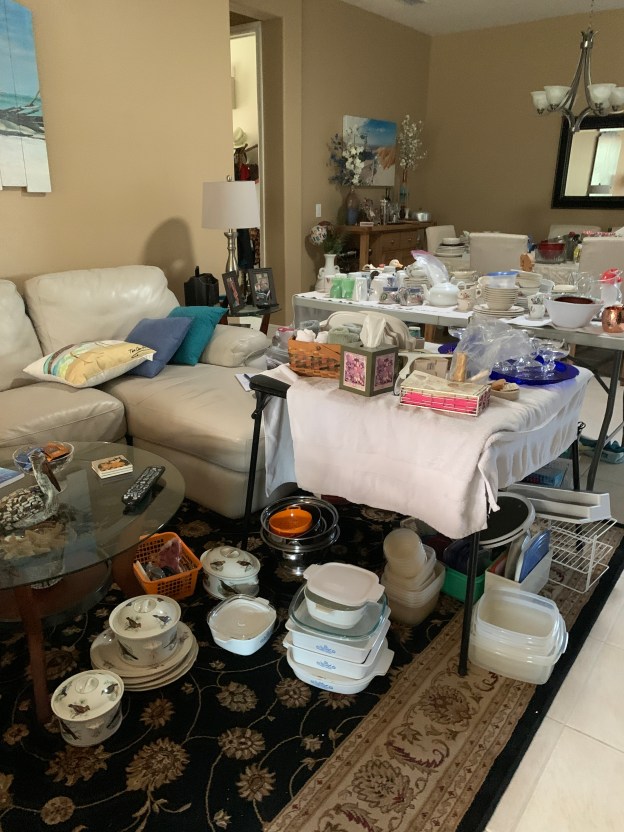
The weekend before my departure, Larry and I emptied out the entire contents of our cabinets into our living/dining room. When I attempted to run one last load of dishes before we had to close up the kitchen for the next few days, the door on the machine fell down with a thud, almost taking out my knee. The door springs had unsprung.
My washing machine must have decided it would have sympathy pains. Less than an hour later, I attempted to run a load of laundry. In the middle of the cycle, the machine stopped, and all sorts of lights began flashing. A Google search informed us that it was either a lid latch ($) or motherboard ($$$) malfunction. We threw the soaked clothes into our fairly new dryer [the old one had died in November]. First thing Monday morning, as the crew descended on our kitchen to begin work, I made a phone call to an appliance repair company to repair the dishwasher door and washing machine latch.
Unfortunately, the appliance people couldn’t help me with my crown on my back molar, that had fallen off that morning while I was flossing my teeth. And the dentist would have to wait, as I didn’t have time to get to his office before my trip. I stuck it back on and hoped for the best.
After driving me to the airport Wednesday, Larry returned to a torn-up kitchen sealed off in plastic and a house filled with the overwhelming smell of paint. Meanwhile, my attempt at self-dentistry only lasted until I bit into an ice cream cone I had grabbed at the airport while waiting for the shuttle to take me to my daughter’s house. An emergency trip to Ten Mile High Dentistry was for naught. After a valiant, 45-minute attempt to glue the sucker back on, the dentist gave up and recommended I think about pulling the remains of the tooth out when I returned home.
Meanwhile, back in Florida, the appliance repairman was one for two: the dishwasher was an easy fix, but the washing machine’s motherboard was gone. Larry and I spent an hour on the phone choosing a new machine from a local hardware store’s website. While I was hiking with my family on a beautiful Saturday in the Rockies, Larry was waiting for the new machine to arrive. No worries. He had plenty to do in the meantime as the kitchen work was completed. Larry put most of the kitchenware back into the new cabinets, leaving the spice drawers and some other cabinets for me to organize to my liking. (Yes, I married a gem!)
I returned Tuesday night, and by Wednesday afternoon, the kitchen was completely back in business—or maybe not. Our nine-year-old refrigerator was not only freezing the ice cream but also the eggs, milk, lettuce and grapes. We made another call to the appliance man, who said that repairs could run up to $500. Maybe we should consider just biting the bullet and getting a new one?Another run to the appliance store, another swish of the credit card, and we only had to live with frozen foods for six more days.
On Thursday day, I got a call saying the truck delivering our new side-by-side would be there in thirty minutes. This gave me just enough time to move the contents of the old refrigerator into laundry baskets and boxes commandeered for the project. When the deliverymen arrived, they pulled out their tape measures, stretched it across our front door, and shook their heads.“Sorry. Doesn’t look like your new frig will fit through the door.” Some quick problem-solving resulted in a “through-the-lanai-if-we-dislodge-the-screen-door” option. An hour later, the old frig was in the truck and the new one was sitting in the middle of a kitchen filled with warming and—worst yet—melting food.
“The new hose for the ice maker doesn’t work. Wrong clamp.” Roy explained from the back of the machine. “I’ll attach the old one.”
“As long as it works, I’’m fine with that,” I said.
Ten minutes later, the refrigerator was ready for the final push into place.
“It’s too wide,” said Roy. “I can’t get it into the space.”
“Just remove the molding,” I suggested.
“We don’t do that,” Roy informed me
“You are not leaving here until that refrigerator installed,” I said between gritted-minus-one-uncapped-molar teeth. “If I have to, I will remove the damn molding!”
Roy shrugged and tried more push. Miraculously, it squeaked in with centimeters to spare.Whew! After two hours of work, these guys deserved a tip, which I gave willingly.
Now let me offer a tip. Before the appliance people leave you with your new refrigerator, check to see if the ice maker and water dispenser work. As I write this, I am still waiting for the callback from the store to arrange for someone to come back and properly attach the line.
All the fails joined the Mr. Coffee, microwave, Ninja blender, electric tea kettle, toaster oven, and aforementioned clothes dryer that had all died in a six-month period. How many appliances did I have left to replace? To add to the mix, I blew out two electrical outlets when I saturated a power strip while washing down our the lanai floor with a hose.
The following week, Larry and I welcomed Chris and Bernie, old friends whom we hadn’t seen since the beginning of the pandemic, The four of us celebrated our reunion by enjoying a delicious dinner at a local Asian restaurant.
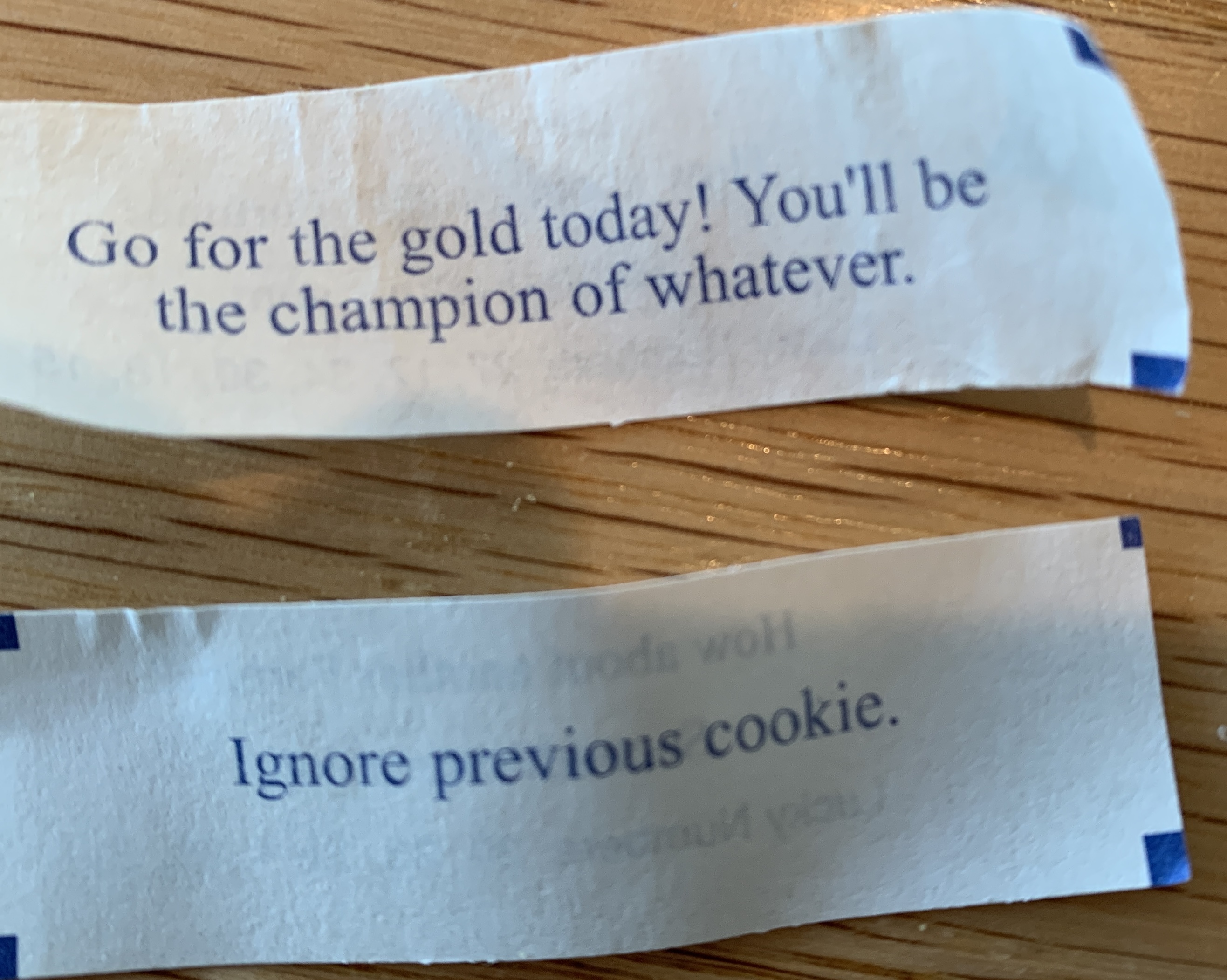
As we were waiting for our waiter to return with our receipts, Chris noted that we hadn’t gotten any fortune cookies. “No problem!” I said. I walked up to the basket of cookies next to the cash register, grabbed four at random, and dropped them on our table. Mine read “GO FOR THE GOLD TODAY! YOU’LL BE THE CHAMPION OF WHATEVER!”
After all that had happened to us over the previous couple of weeks, I was pretty happy to get this fortune. As I shared it with everyone, I proclaimed, “A sign! My luck is changing!”
As I was saying this, our waiter came by with the receipt and four more fortune cookies. When he saw we already had them, he said maybe these would be even better! I opened up mine, only to read this: IGNORE PREVIOUS COOKIE
In the scheme of things, these are all First World Problems. I only need to hear about another friend’s illness or read the latest headlines or see another heart-wrenching picture from the Ukraine, to remind myself that our challenges, as Rick tells Ilsa in the last moments of Casablanca, “don’t amount to a hill of beans in this crazy world.” A wise woman once told me, “If it can be [legally] fixed with money, consider yourself lucky.” We are grateful that we only have had to deal for a short time with unwashed clothes, dangerous doors, frozen eggs, and unfortunate fortune cookies!
You cannot make this stuff up!!! My fortune cookies May 7, 2022.
A version of this article originally appeared in theJewish World News, a bi-weekly subscription-based newspaper in upstate New York.