Author Archives: Marilyn Shapiro

Unknown's avatar

About Marilyn Shapiro

After thirty five years in education, I have retired and am free to pursue my lifelong dream of becoming a freelance writer. Inspired by my mother, who was the family historian, I am writing down my family stories as well as publishing stories my mother wrote down throughout her life. Please feel free to comment and share.

Hometown Tours

A number of years ago, Larry’s sister Carole had her annual Fourth of July party in her backyard in Saratoga Springs. What made this party special is that our niece and her significant other had made the trip up from Virginia, the first time he had ever been to Saratoga County.

Katie wanted to show Swamy around the city, and Larry offered to give the tour. We piled into the Prius, Larry behind the wheel with Swamy next to him for the best view. Katie and I took seats in the back, and we began our excursion.

Larry’s first stop was not the race track or the Hall of Springs or Congress Park. Nope. He immediately drove to Avery Street and parked outside a white two-story colonial. “This is our first house in Saratoga,” Larry explained. “I spent hours playing stoop ball right there on those front steps. My friend Tommy lived down the street, and Al lived around the corner.”

When Katie and I suggested that Larry show Swamy more of Saratoga Springs tourist spots, he assured us he was getting there. But the next stop was in front of another house down the street. “That is where my piano teacher lived,” he offered. “His wife was my fourth grade teacher.”

My niece and I began to giggle. We knew where this was going. Our next stop was in front of one of the gates at the race track, where Larry sold newspapers and, when he turned eighteen, beer to the patrons. This “site” was accompanied by a story as to how Larry was once accused of not having the exact amount of money at the end of the day, and how he had proven his honesty to the manager. We saw the field where Larry played baseball into the summer nights, his old high school, and the outer limits of his newspaper route.

Swamy did get to see a little of the true tourist places but only as we drove by on Larry’s sentimental tour of the “real” Saratoga Springs. By the end of the hour, Katie and I were laughing out loud. Swamy, who is a sweet gentle soul, smiled throughout and offered an occasional “Very nice!”

Recently, I shared this story with my friend Marcie. Rather than thinking it was funny, she told me that she totally got it. Completely. Marcie had grown up in Boston, and after her daughter graduated Northeastern, she insisted that the two of them take a tour of the “real” Boston. Marcie drove her daughter to her old synagogue Agudath Israel, the house where her father had lived in the once thriving Jewish neighborhood of Dorchester, and her old school, Girls Latin. “My daughter thought that she knew Boston because she had been to Fenway Park and walked the Freedom Trail,” said Marcie. “But she knew nothing unless I introduced her to the Boston that was my home.”

It then hit me that one’s home town, no matter how heralded or how small, was not about the tourist spots. It was about memories. Keeseville is just a dot on the map. When Larry first visited me there in 1973, I didn’t bring him to Ausable Chasm, our one claim to fame. He and I took a walk over the swinging bridge and the steep steps up to Pleasant Street. We circled around past my old high school. I pointed out the church right across the street. “When I was a child, all my Catholic friends crossed themselves when they walked past it,” I told him. “I did it for a while until my parents explained to me that Jews ‘didn’t do that.’” Then we walked home over the keystone bridge.

For over thirty-six years we did similar tours for our out-of-area Clifton Park guests. No visit would be complete without a drive past the little red school house where my children went to nursery school, a walk through the Vischer Ferry Wildlife Preserve, and a stop for apple cider donuts at Riverview Orchards in the fall or ice cream at the Country Drive-in in the summer. None of these places would be in Lonely Planet or even local “What To See” guides in the Capital Region. To us, however, they represented what best in our hometown. Not to say that we wouldn’t bring guests to the State Museum or the Saratoga Battlefield or even Cooperstown. However, when it comes to important, we know.

Our home in Florida is less than forty minutes from Disney; Legoland and Sea World are even closer. When guests come, I am sure that these world-famous attractions may be on top of their ‘must see’ list. But after only few months, we already had selected off the grid locations, starting with the view of Pacer Pond from our lanai. On the first day of Rosh Hashanah, Larry and I woke up to the sight of four birds, two lizards, and an alligator that Larry named Brutus, whose size rivals anything one can see in Gatorland. We found a great custard stand down the road, and the Disney Wilderness Preserve is only four miles away.

So, my dear Larry, now I ‘get it’ too. You showed Swamy the best that Saratoga Springs had to offer you, and I know you will do the same for our future Florida visitors. Just warn them about Brutus before they step out into our back yard.

Photo courtesy of Commons.wikimedia.org 

The Candle Debacle

IMG_3695


Growing up as the only Jewish family in our small upstate town of Keeseville had its challenges. Most people were very accepting, but at times we Cohens felt as outsiders. Unfortunately for me, one of the worst experiences I had was because of the problems arose when I was included.

As many of the Catholic children attended a parochial school through sixth grade, most of my friends were Methodists. We were a close group, sharing not only the classroom but also dinners at each other’s homes and frequent sleep-overs. Knowing that I was Jewish was never an issue, and they were happy to share my holidays and to share theirs.

While my classmates in Keeseville were Christian, I also had a group of Jewish classmates at the synagogue in Plattsburgh to which my family belonged. I rarely saw them outside of synagogue as the shul was fifteen miles north of us. As they and their families lived near each other and socialized with them, I considered them acquaintances but certainly not close friends. As a matter of fact, I felt like the Country Mouse to their City Mouse existence in the big metropolis of Plattsburgh. Therefore, I felt as if I lived two different lives: my Jewish life consisting of Sunday school and Friday night services in Plattsburgh, and my secular life consisting of secular school and close friendships in Keeseville.

When we were all in around sixth grade, the Methodist church had a special event planned for their youth. Two sisters, elderly and either widowed or never married,  offered their home to have a weekly get-together in which each of the participants were to make Christmas candles. The mothers of the girls called my mother and asked if I could join them. My mother gave her permission. Glad to be included, I joined the group despite some discomfort that I, the Jewish girl, was participating in a Christmas activity.

Over a period of four weeks, around eight of us climbed the stairs to the ladies’ apartment above one of the stores on Front Street. We melted wax and crayons and then dipped strings into the hot liquid. The two ladies then hung up the candles, let them dry, and had them ready for us the following week. While the other girls created layers of red and green and decorated their creations with holly, I chose blue and white for my candles in honor of Chanukah.

On the last day of our candle making adventure,  we all gathered at the usual time and began putting on the final touches of our masterpieces. One of the ladies announced that she had a very special surprise. The church had contacted the Plattsburgh Press Republican and asked them to do a holiday story about our candle making project. “So, young ladies, she announced, “the reporter will be coming this afternoon to take pictures and interview you all for the article,” she said. “Isn’t that exciting?”

It may have been exciting for my friends, but I immediately panicked. What if my Jewish friends saw my picture with a group of Methodists making Christmas candles? Would they look at me unfavorably, as a further outsider to their life in Plattsburgh? I knew that I could not be in that picture, a public statement that I joined Christians in their religious school events.

“Thank you very much,” I said to the two ladies. “But I don’t want to be in the picture.”

“What do you mean?” one of the ladies asked.

“I don’t want to be in the picture,” I replied. “I enjoyed making the candles, but I don’t want my picture in the newspaper. If my friends in Plattsburgh see it, they will think I’m not acting like a Jew.”

I grabbed my candle and left. Little did I know what havoc I had wrought.

By that evening, my mother had received several phone calls from my friends’ mothers. They said what I did was rude and shameful. My actions indicated that I ashamed of associating with Christians. As a result,  I had not only embarrassed not only myself but also my parents and sibling, the only Jewish family in our town.

My mother was upset and told me that she agreed with the other mothers. My father, however, understood. “You learned a lesson from this, Marilyn,” he told me. “Never put yourself in any situation in which you feel uncomfortable and would feel ashamed.” Fortunately for all of us Cohens, the tempest I created calmed down fairly soon. My friends certainly forgot about it, and the adults moved on to other, more current kerfuffles in our small town. Peace and goodwill returned.

Fifty-five years later, I still look back on this incident with remorse, especially for bringing the wrath of the Keeseville Methodists on my mother. I also have a much more mature perspective: I appreciate how difficult it was for me as a child of to reconcile the need to be accepted by my Christian friends while not betraying my Jewish heritage.

I haven’t had anymore “candle debacles” since that incident in Keeseville.  This doesn’t mean that I still don’t struggle with the holiday season. I, along with many other Jew, still walk a fine line between sharing the joy of the holidays while maintaining my Jewish identity. It’s a dilemma I first faced as a child and continue to face today.

It’s Not About the Cake; It’s about the Commitment!

By MARILYN SHAPIRO

In a Dennis the Menace cartoon published in 1973, just before Larry and I got engaged, the eponymous five-year-old and his friend Joey are looking into a bakery window at a multi-tiered, highly decorated wedding cake. Joey looks mesmerized, but Dennis is not impressed. “After the cake was gone,” he says, “you’d still be married.”

In my lifetime, I have seen many wedding cakes at many weddings. I have realized that the most important part of getting married is not the size of the cake or the grandeur of the festivities but the quality of the relationship and the depth of the love in the months and the years that follow.

My parents’ wedding in 1940 was certainly not elegant. It was held in New York City on a Tuesday night in a hall whose costs were offset by the twenty-five cents given to the hatcheck girl. My father and mother made a handsome couple under the chuppah, Bill in his rented tuxedo ($7) and Fran in her rented wedding gown and floor length veil ($18). After the ceremony, guests were served tea sandwiches, fruit, and wedding cake. Unfortunately, by the time the photographer finished taking pictures of the happy couple, many of the guests had left. Nevertheless, their marriage lasted 68 years. (Priceless!)

Larry and I were married in Agudat Achim in Schenectady on a lovely September afternoon in 1974. The ceremony was a little long. Larry admitted to me many years later that if the rabbi had talked any more, he, the impatient and hungry groom, would have left the bima early and headed for the hors d’oeuvres. The meal contained peas, even though we had specifically asked them to NOT include them on the menu (Larry hates peas!). The band completely botched the words to our first dance, Barbra Streisand’s He Touched Me. The wine my parents had purchased up north in Plattsburgh was not kosher and almost wasn’t served until my mother told the caterer, “I don’t care! Just cover the darn bottles with foil and serve it!” During the course of the afternoon, my father, a little tipsy on the almost rejected wine, took to the microphone to thank Keeseville National Bank for financing the event. To top it all off, Larry spent most of our honeymoon in a Quebec City hospital dealing with a kidney stone. Despite our less-than-perfect nuptials, our marriage has flourished for over four decades.

The majority of the weddings Larry and I have attended have followed a similar pattern: white bridal gowns, rented tuxedos, synagogue or church settings, large receptions with multiple course meals, a band or a DJ, and lots of wine and dancing. Each one has been unique, but not a one any more special than the smaller, less conventional ceremonies.

My niece Laura and her husband Paul had their small wedding on a beautiful summer’s day in the gardens behind the Arlington, Massachusetts, library. Less than twenty-five people were in attendance, with Laura’s Uncle Max officiating. After Paul crushed the wine glass, the newlyweds turned on a battery operated CD player and danced to Alison Krause’s When You Say Nothing At All. Then everyone convened to a seafood restaurant. Laura and Paul now have two beautiful children and an adorable Australian Labradoodle puppy named Cooper. Laura recently posted on Facebook that Paul had suggested that they create more “just us” time by going out onto their yard and picking up the dog’s poop together. Laura wrote, “Thirteen years of marriage and he is still a romantic!”

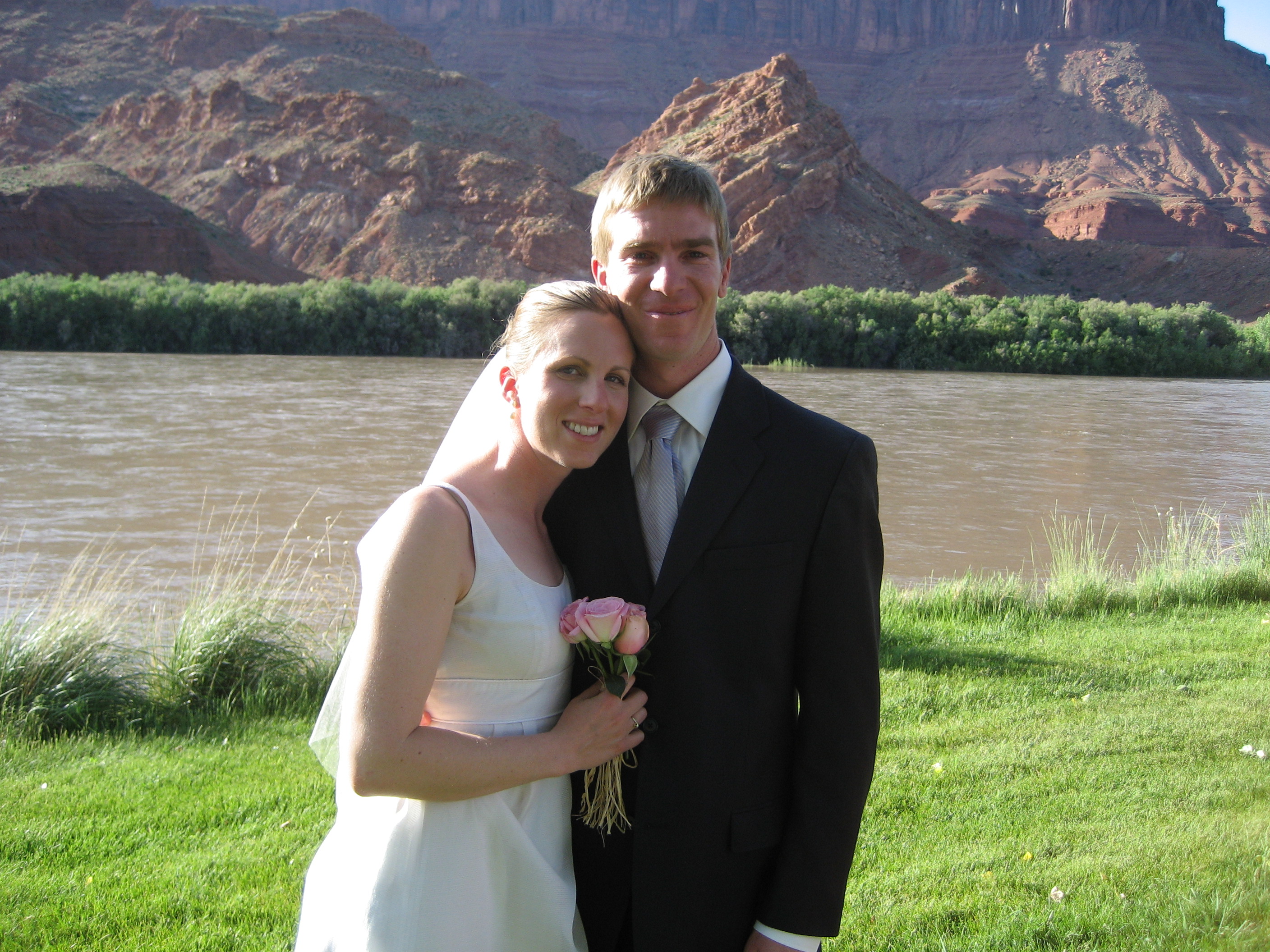
When my daughter Julie got engaged to Sam in 2006, Larry and I were thrilled and more than happy to start their married life with a traditional wedding in a large hall with many relatives and friends in attendance. After several months of researching numerous options, however, Julie and Sam opted for a small destination wedding at a resort near Moab, Utah. Just the immediate family was invited: Larry and I, our son Adam and a girlfriend, Sam’s parents, and Sam’s two sisters. The day before the wedding, all ten of us went to Arches National Park and hiked up to Delicate Arch, where we posed for a group photo. Julie and Sam were married on a brilliant May afternoon on the banks of the Colorado River with the rock formation from Arches as the backdrop. After dinner in the resort’s restaurant, we shared a flourless chocolate cake topped with the two figures from our own wedding cake thirty-three years earlier. The next morning, several of us took a white water rafting trip down the Colorado River. All of us treasure the memories of that long weekend in Utah where we not only celebrated the love between two special people but also the beauty and wonder of an iconic national park and the twisting, historic river that runs near it.

A marriage doesn’t have to last decades to be successful. We have a number of friends whose first marriage, for whatever reason, didn’t work, but their second marriage is going strong. Most of their second weddings were small affairs. And we also have friends and relatives who have never legally tied the knot but are involved in successful long-term relationships. In all these cases, the wedding didn’t make the marriage. Their commitment to each other did.

Barbara de Angelis, author and relationship consultant, wrote, “The real act of marriage takes place in the heart, not in the ballroom or church or synagogue…not just on your wedding day, but over and over again.” Exactly, Barbara! No matter how big or how small the wedding, it is what endures through the years that follow that is important.

IMG_0246

Julie and Sam, May 14, 2007, with the Colorado River in the background.

The “Real” in Real Estate

IMG_2304

Packing up our house and moving to a completely furnished one in Florida brought the “reality” of real estate home for Larry and me.

Although our last move was over thirty-six years ago, I I felt we were up to the task. I proudly went through my newly created “To Do” list: I contacted moving companies three months in advance. I began weekly and then almost daily trips to Captain and the library to give away unwanted household goods and the over two hundred books we had collected on our bookshelves. Larry and I reached out to family and friends to find new homes for our Early American furniture. At the same time we were clearing out what we didn’t need, we started packing up what I thought we would need.

And this is when reality hit. Even after selling, giving away, and donating carloads of our life, we still had much more than we had ever imagined. Bath and Body Works Cherry Blossom shower gel; shoe horns from Larry’s parents’ store; nutcrackers and picks; scissors; supermarket totes, Special Olympics tee shirts—you name it, and we had duplicates and triplicates and more. We upped the amount we were NOT taking. Like the all-consuming plant Audrey in Little Shop of Horrors, however, the amount of stuff continued to grow. We purchased more moving boxes from Home Depot and more bubble wrap, tape, “Fragile labels,” and wrapping paper from Staples, and we kept packing and packing and packing. And we hadn’t yet touched the “essentials” from our kitchen, bath, and bedroom.

Miraculously, by a week before our move, almost all of the packing was completed. I doubled checked the boxes to make sure they were securely sealed, numbered them with a thick marker, and inventoried them in a notebook. When I got to my one hundred and thirtieth box, I began to “real”-ly panic. We even opened up boxes to find items to leave behind. By that point, however, we knew most of it was going to be loaded on the moving van.

When Allied arrived for their pick-up that lovely June morning, even they were a little overwhelmed with the number of boxes. It took three men three hours to load it all on the truck, along with my piano, two dressers, a chair, and a garbage can filled with garden tools, mops, and brooms. By noon, Larry and I said one last good-bye to our home. I sobbed loudly on the shoulders of my neighbors who had gathered to send us off, and we started the two and a half day drive down to Florida

We arrived in the evening of June 3 and were able to quickly unpack what we brought down in our cars: our suitcases, pillows, sheets for the king-sized bed, a couple of towels, two of each of plates, silverware, wine glasses, regular glasses, two knives, two pots, a corkscrew, and a bottle of wine. After a quick trip to Publix for fruit, vegetables, milk, bread, salmon, and veggies, we were good to go. It was like being newlyweds. By that time, we figured out we should have left almost everything home as we already had more than enough to survive. Four days later, the van and our 130 boxes arrived.

Within hours, we were both buried in bubble wrap. While I unloaded the kitchen boxes, Larry took care of the clothes and the rest of our household good. I cursed myself out loud: “How did I manage to bring so much when I thought I gave so much away?” Larry saved his comments for under-his breath rants. “We aren’t going to need long underwear in Florida!” or “I thought we weren’t bringing the pancake griddle!” or “When did we acquire two hundred Broadway musical CD’s?” When our realtors came over the second day of unpacking with a bottle of wine, they suggested that we (1) drink the wine. The entire bottle. Immediately; (2) empty all the boxes as soon as possible to “motivate” us to get settled more quickly; and (3) pile all the empty boxes in the garage so they could give them to another client who was moving. Larry took this advice way too seriously. As I methodically continued to empty the kitchen boxes, Larry emptied every remaining box and piled all the contents on every bit of available space in the great room, office, and second bath. If that wasn’t upsetting enough, he had unloaded all the linens, sheets, pillows, and blankets on the bed in the guest room. When I walked into the room, I felt I was reliving The Princess and the Pea. The pile reached to the ceiling fan. I was so angry I almost slept in that bed that night, but I couldn’t climb on top of the mess.

In the end, our move was successful. We actually had most of our boxes unpacked and organized by the end of the first week. Soon after, a Salvation Army truck picked up around fifteen boxes of items we didn’t need. We knew we would eventually have to deal with the pictures that we brought and had stacked in the second bedroom, but at least we were settled in all the other rooms. And the only things we misplaced in the move were my Weight Watchers charms and two boxes of toothpicks, both which we found six months later. Not bad, considering.

Still, in hindsight,  our “reality” experience is a cautionary tale for all my friends and relatives who are considering a move. Follow the same advice savvy travelers give: Pack only half of what you think you need and leave the rest behind. Meanwhile, if anyone needs a slightly dusty but usable pancake griddle, six pairs of long underwear or a Fiddler on the Roof CD, contact me. I will be sitting on our lanai in my tank top, my favorite pair of shorts, and my Tevas, sipping wine from a huge travel goblet, the only things I needed to pack in the first place.

The Cohens Move to Keeseville

1959_05_03 Bill in Keeseville

My father, Bill Cohen, in front of 5 Vine Street, 1961.

As Larry and I packed up our home in Clifton Park, I remembered my mother’s story of our our 1952 move from Potsdam to 5 Vine Street, Keeseville, New York, where they lived for thirty years.

Once we had sold the house in Potsdam, Bill moved to Keeseville to start his new job managing Pearl’s Department Store and to find a house for us while I stayed home with the three children. Unfortunately, there were not many houses for sale that summer. Bill finally called at the end of June to tell us the good news: He had found a large four bedroom colonial just a block from the store. He told us to start packing as we would be moving at the beginning of August, a few weeks before school started. “The house just needs a few repairs that I will take care of before the move,” he said.  He paused, and before hanging up added,  “Oh, by the way, make sure to bring the cat!”

Although we had hoped to be settled in our new home well before Labor Day, the closing on 5 Vine Street was not completed until five days before school started and a day before Marilyn’s second birthday. As a result, Bill had not been able to arrange for the “minor” repairs he said the house needed.

That Saturday morning, movers filled up a Pearl’s Department Store truck with all of our furniture and possessions and arranged to meet us in Keeseville.  After traveling three and a half hours in our red station wagon, Bill, Laura, Jay, Marilyn, the cat, and I finally arrived. As we pulled into the driveway, I got my first glimpse of our new home.

The outside of the house was beautiful. The house, a  white Victorian colonial with green shutters, was situated on a pretty lot with lots of bushes and flowers. A screened-in porch was on one side of the front of the house, and another porch ran along the side. We walked across the lawn and climbed up six wooden stairs onto a small porch that lead to the front door. We entered the house through a small enclosed foyer that lead into a very large living room and dining room with lots of windows that spanned the entire front of the house. A beautiful oak archway separated the two rooms.

But when I entered the kitchen, I faced a disaster.  In the center of the room was a big old fashioned non-working black stove.  Above the stove was one lone light bulb hanging from a wire from the ceiling. That and an outlet for the stove and refrigerator were the only working electricity in the entire kitchen. The unfinished wood floor was covered with torn linoleum.  When I turned  on the single faucet in the old metal sink, there was no pressure, just drips of rusty water because the house was connected to an almost empty well. In place of kitchen cabinets was a filthy, dark pantry.  I knew then why Bill told me to bring the cat:  lots of mice had moved in before we did.

As my eyes filled with tears. Bill tried to comfort me.  “Please be patient.  Nothing can happen over the Labor Day weekend, but by Tuesday, carpenters will be tearing down the pantry and fixing up the kitchen. I promise you will be happy with it”

The children and I went to explore the rest of the house. There was only one bathroom, a small dark room next to the kitchen. Behind the kitchen was an unheated shed. Upstairs, the four bedrooms had lots of windows, which only served to shed light on how shabby the rooms actually were. Like the kitchen, the floors were unfinished, and all the rooms needed to be painted.  The basement was dark and damp, with several small rooms, including one with a large coal furnace and another with a wringer washer. The furniture from the tiny house in Potsdam barely filled the rooms. To add to our problems, Laura’s beloved second-hand piano that we brought from Potsdam had fallen off the moving truck. It had survived, but barely, and it was even more off key than it was in Potsdam.

By Sunday night, everyone was tired, exhausted, and upset. Laura and Jay had not wanted to move in the first place as it meant a new school and new friends. After living her first two years in a tiny box, Marilyn was terrified of the big, dark house and clung to me for dear life. The only one who was happy was the cat, who had already polished off several of the mice in the pantry.

The next day was Labor Day, and all the stores were closed. To cheer Laura and Jay up, we took them to the empty store and selected new outfits for them to start school.  Marilyn, the birthday girl, got a new dress.To celebrate her birthday, we had an indoor picnic in our new dining room with the food and paper plates and cups we had picked up Saturday at the local A&P.

The next morning, Bill left for the store. I put Marilyn in the stroller and walked Laura and Jay across the keystone bridge that spanned the Ausable River and then up the hill to the school to register them for classes that Wednesday. When we arrived back at the house, a crew of men from the town was digging up the sidewalk in front of the house to connect us to town water. Inside,the carpenters were tearing down the pantry. Brightening, I realized that, without the pantry, I was going to have a nice big kitchen. I was very encouraged until the electrician came to connect our new electric stove. He told me the stove was fine, but the wiring in the rest of the kitchen was so faulty that if we did not take care of it immediately it could cause a fire and burn down the whole house.

As the months went by, the kitchen and the rest of the house underwent the needed repairs and we began to love 5 Vine Street not only for its rooms but also for all the stories those rooms held. All our children grew up there, and we lived there until our retirement over thirty years later.

Camping It Up

Growing up in Keeseville, I knew of no one who went away to “camp” for the summer. As a matter of fact, when my parents wrote relatives that they had purchased a camp by the lake, my Aunt Pearl wrote back, “Don’t you have enough on your plate managing two stores without running a camp for the summer?” From then on, my parents referred to it as their summer cottage.

We had enough to keep us busy in our small upstate town. From the first week of July through mid-August, the town offered arts and crafts at a building across from the high school. In the morning, buses shipped us off to swim lessons at Port Douglas, where we froze in Lake Champlain’s chilly waters. Every afternoon, another bus would drive us again to Port Douglas beach for recreational swimming. On the days that I didn’t feel like going to the beach, I was totally happy sitting on our side porch on an old chaise lounge and reading Bobbsey Twins, Nancy Drew, or Beverly Cleary. My cousin in Long Island went to a Jewish sleep-away camp for at least four weeks, but that was so “downstate.”

The only opportunities for my friends and me to go to a sleep-away camp were at church-run facilities or at Boy and Girl Scout locations. In 1961, four of us eleven-year-old girls from Keeseville spent one week at Camp Tapawingo at Point Au Roche on Lake Champlain, which was in operation as a Girl Scout camp in the 1960s. Julie, Margaret, Betsy and I were set up with several other campers in bunk beds housed in a lean-to. The structure had three walls and a roof, but the front area was wide open to the elements. “I remember the smell,” recalled Betsy. “Woodsy and damp.”

Meals were served in a large dining room. Each morning at breakfast, we were given a glass of orange or grapefruit juice, which we had to finish before we would get the milk to wash down the bitterness. Peanut butter and jelly on white bread was a staple for lunch. We swam, sang Girl Scout songs, told ghost stories, and ate s’mores around an open fire. We took a day hike. Everyone got sun-burned and lined up for a coating of Noxzema that night. We did crafts, making long lanyards from plastic rope. We attempted archery and canoeing. We got bitten by mosquitos.

And we got homesick. Julie had to go to “Nursey” to have a cry, and I shed my own tears when I didn’t get a letter from home. Why I expected mail when I was away for a week baffles me now, but at the time I felt deserted. But we had fun, despite the rain and the sunburns and the occasional tears.

Soon after our camping experience, Julie and her family moved twenty miles away and Betsy and her family moved to Texas. Margaret and I stopped going to Girl Scouts, and we got involved in band and baseball and junior high angst.

Although I have lost touch with Margaret, I have kept in touch with Julie and Betsy all these years. Julie moved back to Keeseville in time to graduate with our class. Her in-laws had a cottage in Willsboro just down the road from my parents’.place, and we would visit when she and her husband came down from Maine during the summer.

During my second pregnancy, I read M. M. Kaye’s Far Pavilions and loved the main character Juli. I thought of my sweet friend from childhood After some discussion, Larry and I chose the name Julie Rose, after my Grandpa Joe and Larry’s Bubbie Rose. Julie and her husband moved to Austin, and we “see” each other on Facebook.

Betsy and I kept in touch with letters, holiday missives, and, more recently, Facebook. In 2014, I received an unexpected email from Betsy. She and her second husband were coming to New York to see their son, who was a chef in New York City. They decided to take a side trip to Glens Falls to see her grandmother’s house. Would we like to meet them for dinner? Yes! I emailed back.

A few weeks later, Betsy came in my front door. We hugged each other, and almost fifty years apart melted away. “My best friend!” she whispered in my ear. We talked and talked, went out to eat together, and had a wonderful evening. We still keep in touch, and I promised her and Julie that I would stop by to see them in Texas on one of our future summer cross-country trips from Florida to Colorado.

When I was packing up the house for our move to Florida, I found on the bottom of an old trunk my green Girl Scout sash with the cloth merit badges along with group picture taken at Camp Tapiwingo. Betsy is front row center; I am next to her, smiling a toothy grin; Julie is at the end. For a moment, I was eleven years old again, homesick, sunburned, and happy.

Marilyn Shapiro's avatarThere Goes My Heart

Camp Tapawingo 1961. Julie is sitting on far left, I am third on the left, and Betsy is next to me on left. Camp Tapawingo 1961. Julie is sitting on far left, I am third on the left, and Betsy is next to me on left.

Camp? What is a camp?

Growing up in Keesevile, I knew of no one who went away to “camp” for the summer. As a matter of fact, when my parents wrote relatives that they had purchased a camp by the lake, my Aunt Pearl wrote back, “Don’t you have enough on your plate with two stores without running a camp for the summer?” From then on, my parents referred to it as their summer cottage.

We had enough to keep us busy in our small upstate town. From July first through mid-August,  the town offered arts and crafts at a building across from the high school. In the morning, buses shipped us off to swim lessons at Port Douglas, where we froze in Lake Champlain’s chilly waters…

View original post 744 more words

Freezin’ for a Reason

IMG_0697

Camp Tapawingo 1961. Julie is sitting on far left, I am third on the left, and Betsy is next to me on left.

I had always been intrigued by stories and pictures of polar plunges, where hundreds of smiling people clad in only bathing suits head into a body of water in the middle of the winter. Participants say they are having fun. I never understood their enthusiasm until I found myself diving into Lake George, water temperature around 50 degrees, on a brisk November day. Crazy? Yes! Glad I did it? Double yes. Because I was ‘freezin’ for a reason. I was raising money for Special Olympics Capital District.

Special Olympics is the world’s largest sports organization for children and adults with intellectual disabilities. The Special Olympics Capital District Region provides year-round training and competitions to more than sixteen hundred athletes from twelve counties in fourteen different sports. For a number of years, Larry and I were involved as Saratoga County Special Olympics track and field and bowling coaches.

We also participated in Special Olympic fundraisers. One of the most popular and well known in the Capital District is the Polar Plunge, where hundreds of people plunge into Lake George on the third Saturday of November.

In a moment of insanity, I had signed up and participated in the plunge in 2011. Larry had a list of reasons why it was not going to be a joint effort: He needed to be on the shore to hold my bathrobe and towel. He needed to take pictures. He needed to drive me home as I would be too cold to handle the wheel. He didn’t want to take the spotlight away from “my” event. Maybe he had more common sense than the rest of us, or maybe he just didn’t know how to have fun. Within minutes of coming out of the water that first time, however, I swore to anyone with ear shot that I would never do it again. Our schedule in 2012 prevented repeat plunge, and I was thinking of finding another excuse for 2013 until……

In a second moment of insanity, I committed to participate in the 2013 event. I rejoined Freezin’ Friends, a team of plungers headed by Joni, whose son Nick participated in several Special Olympic events, including our track and field program. It was time for me to again raise money to support athletes like Nick

In the middle of September, I began a fundraising blitz, mostly through emails and Facebook. The response was overwhelming. I had pledges from family and friends across the country and even from England. Most pledged on line, but many others handed me checks or cash, commenting “Better you than me!” and “Boy, you are brave!” By the day of the plunge, our team had raised close to $5000, and the region total was approaching $77,000.

By this time, you would think that I would be mentally and physically ready to dive back into Lake George. I hadn’t died the first time; my heart had held out; I didn’t even catch a cold. But in the days leading up to the plunge, I had nightmares about going into a freezing lake. In addition, this year I was going to top what I had started in 2011. In my first year, most of my supporters congratulated me and praised my bravery for plunging up to my neck. However, a few people kiddingly questioned as if I had ever gone in the lake, as my hair was still dry and the water droplets on my body didn’t show well on the photos. This time, I was going to make sure that pictures showed a soaked bathing suit and a wet head so that no one would doubt my commitment.

We were fortunate with the weather. The morning of the plunge was a beautiful, sunny, calm day, with air temperatures in the fifties. Larry and I stopped at the registration desk and then headed down to Shepard’s Park Beach. Over my bathing suit, I had flannel pants, a thermal shirt, my Polar Plunge sweatshirt, and a warm terry bathrobe. Under my water shoes were heavy woolen socks. I found Joni in her traditional Dr. Seuss hat she had worn for each of the seven plunges in which she previously participated. I recognized most of my teammates from 2011, a mix of Neil’s family, friends, and Special Olympics coaches. In addition, a large group of students from Schuylerville High School had signed up for the fundraiser to support Nick their classmate. Joni provided all thirty members of the team with a choice of colors in Santa hats.

Several other teams of plungers were also on the beach, including Max’s Buddies, Freeze Duchenne, Brian’s Bashers, and the Siena men’s baseball team. We spent the next couple of hours munching on bagels, sipping hot coffee, taking pictures, and connecting with members of our team and the other plungers. Several were in costume: capes, polar bear hats, boas, and, in the case of one man, a skimpy beige bikini bathing suit. “My Miley Cyrus look,” he explained.

At ten minutes before noon, all the plungers stripped down to their bathing suits. Shivering despite the warm sun, we lined up to wait for the signal to hit the water. At exactly twelve noon, led by three athletes holding the Special Olympics torch, over five hundred and fifty crazies—including me— streamed into Lake George.

As my ankles hit the water, I faced my first obstacle. As our team was near the end of the line, we were going into the lake when the members of the Siena men’s baseball team were coming out. Fast. Blindly, with no concern for who was in their way. I darted through hurling bodies until I found a clear spot in the water, took a deep breath, and dove in, orange Santa hat and all.

OH MY GOD! Why didn’t I remember it was this cold! I immediately thought of those poor people on the Titanic. I had visions of Leonardo DiCaprio’s Jack clinging onto the edge of the makeshift raft that held Kate Winslet’s Rose. I could not get out of the water fast enough. I ran onto the sand, hair and body dripping, searching desperately for Larry and, more importantly, my bathrobe and towel. As soon as I found him, I asked, “Did you get a picture?” Larry said yes, but I must have had ice in my ears. I didn’t hear him and headed back into the water for a second totally unnecessary photo opportunity.

I have to say that the second plunge that day wasn’t as bad as the first time. Maybe the sun had warmed my body. Or I was so numb I couldn’t tell the difference. Larry took a couple of more pictures, and I was finally able to head for the women’s warming tent, where I quickly changed into dry clothes. We drove back to Clifton Park with the car’s heater going full blast.

Later that afternoon, Larry and I talked about the plunge over large bowls of steaming chicken and rice noodle soup at a local Chinese restaurant. “Next year, I need to wear a different bathing suit and a pair of shorts as those pictures I posted on Facebook are just too embarrassing,” I said. “And maybe if I start fundraising earlier, I can raise more money.”

Larry nodded, “Let’s just see what happens with our schedule next year.”

I was not able to plunge in 2014, and by 2015, we had moved to Florida. Joni emailed me in October to ask kiddingly if I would like to come up north to participate, but I declined. Not surprisingly, there are no polar plunges in Central Florida. Maybe an alligator wrestling fundraising event? We’ll have to wait and see.

Mother’s Day

11208944_10204122299914120_118706756_n

Julie and me with family.

When our daughter Julie was expecting our first grandchild, she called me to tell me about the children of her friends, both around eighteen months old. She commented that the little boy is a little fussy and needy, with frequent meltdowns. Her other friend’s child is  easy, calm and sweet; her name “Grace” says it all. Julie said that she hopes her child like Grace. My comment? “So you want a Grace, not a Julie, huh?” Not surprisingly, she wasn’t appreciative of my observation.

Larry and I were ecstatic the prospect of becoming grandparents. Julie and Sam had been married eight years prior to her pregnancy, and I wasn’t sure if they wanted to have children. Over Thanksgiving, 2014, however, we learned they were expecting a baby on a walk along the Mohawk bike path. Sam pointedly asked me how we were enjoying our hot tub. I told him how much we loved going in on cold  November days, “A day like today!” I offered them towels, robes, a bottle of wine, and privacy.

“I can’t go into the hot tub, Mom,” piped up Julie. “And I can’t have a glass of wine.”

“Why not?” I asked.

“Because [—pregnant pause—] I am carrying your grandchild.”

Once I stopped jumping up and down, and once we promised we would not share the news with ANYONE until at least mid-January, I began reflecting on words of advice I could give to the new parents. On Mother’s Day 2015, in honor of her impending motherhood, I gave Julie the following advice:

Nothing will prepare you for the moment you hold your baby for the first time. Throughout my first pregnancy, Larry and I were thrilled about becoming parents. However, Larry and I had several discussions as to how our life would not change that drastically once s/he was born. We would bring our child everywhere, and we would continue to travel and work and socialize as we had done before. Once we each had held Adam in our arms for less than a minute, however, we knew that our lives were never going to be the same. The reality of taking care of a tiny, dependent being who needed every ounce of our physical and emotional attention to survive put any ideas of “business as usual” out the window. In fact, we didn’t mind turning our lives upside down. We would move mountains to make sure our son was well fed, dry, content, and especially safe. Three years later, I harbored similar thoughts regarding status quo while awaiting the birth of our second child. During my pregnancy, I thought to myself, “Okay baby, I will love you, but just know that we already have a child, and he will  come first.” Again, I was proven wrong. The bonding was immediate and powerful, and our arms and hearts were more than big enough to accommodate another child.

Children don’t grow like lettuce. Whenever I encountered a bump in the road while raising our children, whether it was braces or a bad track meet or a broken heart, my mother would offer her favorite expression. Unlike lettuce, she would remind me, which you just put in the ground as a bunch of seeds and harvests thirty days later, children are work intensive. Things don’t always go smoothly, and you don’t sail through the eighteen years until they head off for college. It took me a while to realize raising children was more like growing prized orchids. And I have no green thumb.

Give your child roots to grow and wings to fly  While raising these “delicate orchids,” Larry and I tried provide Adam and Julie with a supportive nurturing environment throughout their formative years. We tried to give them moral values, a strong sense of community and personal responsibility. It was not until Julie packed up her life in my used Toyota and moved to Colorado and Adam headed to the West Coast for law school and life in San Francisco that the Dalai Lama’s words wholeheartedly hit me. Oh, how I envy my friends who have children ten minutes away! I would even settle for three hundred miles. But this was not to be. They have forged a life a long plane ride—or two!—away. They both have put down their own roots far from where we live but are happy, settled, content, and doing what they need to do.  We hope the root system we gave them will guide them in their journeys.

You ultimately know what is best for your child. 

When Adam was six weeks old, I drove him to a local mall, put him in a red umbrella stroller, and pushed him through the stores, my first time shopping since he was born. A woman stopped me and said, “Oh my goodness! Your baby is all crunched up in that stroller, pale as a ghost! He looks dead!” I immediately pulled Adam out from carriage. He began howling with rage because I had jarred him awake. As she walked away, the “baby expert” commented, “Oh! I guess he was okay!” I learned quickly that I knew what I was doing, not some stranger. Remember those roots your parents gave you? Trust that they will help you grow as a parent.

Ironically, during Julie’s pregnancy, friends gave us advice about grand-parenting. We were told repeatedly that the moment we held our granddaughter in our arms for the first time, our life would never be the same. “It’s different with a grandchild,” a friend said. “It is as if you are holding your future.” We even got advice about when, where, and how to give advice to Julie and Sam. Until then, I hoped that the “mommilies” I gave Julie that Mother’s Day would be taken in the spirit in which they are given —with much joy and love

Exercising My Options

IMG_2159

Here I am hiking the Stone Bench Trail, Williamstown MA. Note I am NOT wearing my Fitbit cuz I lost it at the movies the night before this picture was taken.. It has been recovered and will be on my wrist again soon!Growing up in Upstate New York in the 1950s, I never thought much about exercise. I walked to and from school every day, swam in Lake Champlain in the summer, and biked leisurely through the apple orchards outside of town. A couple of my close friends played on a girl’s intramural softball team. With  my hand-eye coordination, I wisely sat on the bench and watched. And gym class? All I remember were those ugly red bloomers we were forced to wear while hurling ourselves over the saddle horses or jumping on a trampoline while our classmates “protected us” by standing along the sides. (I bet that exercise is not part of any gym class in this century!)


Growing up in upstate New York in the 1950s, I never thought much about exercise. I walked to and from school every day, swam in Lake Champlain in the summer, and biked leisurely through the apple orchards outside of town. A couple of my close friends played on a girl’s intramural softball team. With my hand-eye coordination, I wisely sat on the bench and watched. And gym class? All I remember were those ugly red bloomers we were forced to wear while hurling ourselves over the saddle horses or jumping on a trampoline while our classmates “protected us” by standing along the sides. (I bet that exercise is not part of any gym class in this century!)

It was not until I married Larry that I actually began to incorporate regular exercise into my daily routine. Larry was a high school runner. Once he began working for New York State, he met with a group everyday at lunch to do a loop around the State Campus. Although I had no interest in pounding the pavement, his interest in keeping fit encouraged me to do something every day: a bike ride, a walk; video work-outs with Jane Fonda, Charlene Prickett, and Step Reebok.

Over the years, we expanded our exercise options. Around 1990, we purchased our first of several road bikes on which we racked thousands of miles riding throughout Saratoga and Albany country. While living in Clifton Park, we faithfully rode the stationary bike that was in our family room, albeit with two different mindsets.  Larry was intense and focused, pushing the limits of the resistance and rotation settings. I, on the other hand, viewed it as a great way to get to watch movies or reruns of The Big Bang Theory while getting in my mileage. To be honest, I tried to bike when he wasn’t home to avoid his encouraging me to “go faster.” If he did walk into the room, I sped up and started gasping for air. That usually placated him enough to convince him I was working out. Once he left the room, I slowed down and got back to my show.

We also took advantage of the Pacific Fitness trainer that we had set up in our basement in 1996. Larry used it three times a week barring injury or travel. Even though I knew weight training is important for post-menopausal women, I used it in fits and stops, making excuses. After all, I reasoned, I am not interested in winning a Mrs. Universe contest! When I joined the YMCA a few years before we moved. I decided at that point that Zumba and kickboxing classes were enough for toning. For the most part, however, we certainly got our money’s worth out of most of our fitness purchases.

Not to say we haven’t had a couple of misses. The most obvious failure was my purchase of two hula hoop. One was the classic 1950s plastic design. The other, at the suggestion of my Weight Watcher’s instructor, was a super deluxe weighted model. No matter how hard I tried, I never got beyond one rotation on either hoop. Larry, however, was a natural, and he showed off his incredible hip action several times before I gave both hoops to our six-year-old great-niece. She, like Larry, was a natural.

Larry and I had different approaches to keeping track of our exercise. Larry has always used pre-measured running routes and the cyclometer on his bike. For ten years I used a clunky pedometer that attached to my waist band to track my daily steps, especially on long trips where we do a great deal of hiking. I once had to retrieve it when I left it on the plane after a six-hour cross-country flight. The flight attendant’s wry comment? “Bet you didn’t rack up many steps flying over the Great Plains.”

A few years ago, I was given a Fitbit Zip, a compact step/mile tracking device that clipped to my bra. When synched with my iPhone, it gave me progress updates on my 10,000 step-a-day goal. One day, I was in my kitchen when my phone dinged. “Congratulations! You have reached your goal of 10,000 steps!” read the banner. My initial thrill of accomplishment was quickly squelched when I realized I wasn’t even wearing my Fitbit. I had “reached my goal” because I had left the device on the clothes dryer. The vibrations from the machine gave me a quick, easy, no-sweat 8000 steps—No, I didn’t count it. Soon after this incident, I forgot to unclip the Fitbit from my sports bra, and I washed it along with the rest of my laundry. Goodbye, Fitbit! I replaced it a more expensive model that was worn on the wrist, thus avoiding another wash day wipe-out.

While wearing the Fitbit on a trip to Jamaica, I averaged around 12,000 steps a day by morning walks around the hilly grounds and by participation in pool volleyball games. I’d love to tell you that I came back thinner, but I guess all that walking didn’t negate the five course dinners, the wine, and the chocolate martinis for dessert. It took me a few weeks to lose the seven pounds I gained.

One of the features that attracted us to our home in Florida were the miles of bike and walking trails, two large fully equipped fitness centers, and numerous swimming pools where I can do laps. We left all our equipment behind except our outdoor bikes. And my Fitbit. Like Pavlov’s dog, I have become addicted the ding of my iPhone that lets me know I reached my goal. Speaking of which, I am currently five hundred steps short and it’s eleven o’clock at night. Time to quit writing and start jogging in place.9501, 9502 9503……

Next year in…..Florida!

This year marks the fortieth year Larry and I have celebrated Passover as a married couple. Unlike the Israelites, we have not exactly spent it wandering in a desert wilderness. It has been a fruitful, productive life spent in the Capital District. For us, next year will not be in Jerusalem, but the extreme southern part of New York State known as Florida.

Moving Devon Court

Our home of thirty-six years!

A real upstate girl, I was born in St. Lawrence County and raised in in Essex County (Since when is Westchester County upstate?),relocating to Albany for college in 1968. Larry also had spent all but his college years in Saratoga County. We met in Albany, married, moved to Clifton Park, raised two children, made wonderful friends, and spent holidays with our families.

When did the desire to live someplace else begin? The germ was planted twenty years ago when our parents spent six to eight months a year in Florida. Our circle began to expand geographically: our children moved to California and Colorado; my sister moved to Arizona; an aunt moved to South Carolina; a niece moved to Virginia; and a number of friends and family started living two to four months in warmer climates. Other friends were spending time with their own children, who were scattered over the country and the world. We began a nomadic life, visiting friends and family and traveling on our own to Germany, Peru, England, Greece. Although we enjoyed our numerous trips, we felt finding “our spot,” a place that fit all our criteria, would keep us more grounded.

Every place we visited raised the question, “Could we live here?” We did some California dreaming, but the high prices of real estate and the high possibilities of earthquakes ruled it out. Julie and Sam live at 9000 feet in Colorado, truly a Rocky Mountain high. Summit County is beautiful in the summer, but the winters last nine months, and you think Boston gets snow? Try twelve feet a year, every year. Other places in Colorado offered warmer temperatures, but the homes we viewed were close together, and we would still need our snow shovels.We also Arizona would be out of the mix: The desert can be lovely, but no manna—and little rain—fell from the heavens, and we were always happy to get back to “green” and water on the East Coast. Ever the English major, I  even fell in love with the small villages in England, but we knew that would never be where we settled.

Once we retired four years ago, our interest in relocating intensified. The long winters and grey skies hadn’t bothered us when we were working, but once we were home all day, the weather became a factor. Our friends and family changed from asking, “Have you any trips planned?” to “Where are you going next?” And after forty years, Larry and I were ready for our next adventure.

This fall, everything fell into place. Julie told us over Thanksgiving that, after eight years of marriage, she and Sam were expecting our first grandchild in July 2015. After I stopped jumping up and down with joy, Larry and I made the decision that we would like to spend our summers in Colorado and the rest of the year someplace warm. We found that warm spot on a rainy December day in Florida, when we checked out an active adult  community where we were staying near Orlando. From the moment we drove in, Larry and I were impressed with the tranquil setting and the amount of green space and lakes. We fell in love with an immaculate home for sale on a lovely piece of land overlooking a pond and bordering a wildlife preserve. The community itself offered all we were looking for: indoor and outdoor pools, Hadassah chapter, book clubs, a writing club, bike paths, pickle ball courts, movies and shows, and exercise classes.It was close to world class entertainment and an international airport with direct flights to all major cities in the country.

We came back to Albany, to grey skies, piles of snow, and sub-zero temperatures. Even with the miserable weather, we still needed time. After much research, thought, discussion, and several sleepless nights, we decided to purchase the home in Florida and spend two to three months in Colorado. So, after forty years of New York Passovers, next year we will be celebrating with the Shalom Club in our new neighborhood.

If physically packing up the house is a challenge, emotionally leaving behind family, friends, and years and years of memories will be even more difficult. For the last twenty years, I have had the following framed quote hanging in our home, “Come my love and we shall wander, just to see what we can find. If we only find each other, still the journey is worth the time.” Like our Israeli ancestors, Larry and I will be wandering far from the home we have known to begin our next adventure.