Author Archives: Marilyn Shapiro

Unknown's avatar

About Marilyn Shapiro

After thirty five years in education, I have retired and am free to pursue my lifelong dream of becoming a freelance writer. Inspired by my mother, who was the family historian, I am writing down my family stories as well as publishing stories my mother wrote down throughout her life. Please feel free to comment and share.

Camping It Up

Growing up in Keeseville, I knew of no one who went away to “camp” for the summer. As a matter of fact, when my parents wrote relatives that they had purchased a camp by the lake, my Aunt Pearl wrote back, “Don’t you have enough on your plate managing two stores without running a camp for the summer?” From then on, my parents referred to it as their summer cottage.

We had enough to keep us busy in our small upstate town. From the first week of July through mid-August, the town offered arts and crafts at a building across from the high school. In the morning, buses shipped us off to swim lessons at Port Douglas, where we froze in Lake Champlain’s chilly waters. Every afternoon, another bus would drive us again to Port Douglas beach for recreational swimming. On the days that I didn’t feel like going to the beach, I was totally happy sitting on our side porch on an old chaise lounge and reading Bobbsey Twins, Nancy Drew, or Beverly Cleary. My cousin in Long Island went to a Jewish sleep-away camp for at least four weeks, but that was so “downstate.”

The only opportunities for my friends and me to go to a sleep-away camp were at church-run facilities or at Boy and Girl Scout locations. In 1961, four of us eleven-year-old girls from Keeseville spent one week at Camp Tapawingo at Point Au Roche on Lake Champlain, which was in operation as a Girl Scout camp in the 1960s. Julie, Margaret, Betsy and I were set up with several other campers in bunk beds housed in a lean-to. The structure had three walls and a roof, but the front area was wide open to the elements. “I remember the smell,” recalled Betsy. “Woodsy and damp.”

Meals were served in a large dining room. Each morning at breakfast, we were given a glass of orange or grapefruit juice, which we had to finish before we would get the milk to wash down the bitterness. Peanut butter and jelly on white bread was a staple for lunch. We swam, sang Girl Scout songs, told ghost stories, and ate s’mores around an open fire. We took a day hike. Everyone got sun-burned and lined up for a coating of Noxzema that night. We did crafts, making long lanyards from plastic rope. We attempted archery and canoeing. We got bitten by mosquitos.

And we got homesick. Julie had to go to “Nursey” to have a cry, and I shed my own tears when I didn’t get a letter from home. Why I expected mail when I was away for a week baffles me now, but at the time I felt deserted. But we had fun, despite the rain and the sunburns and the occasional tears.

Soon after our camping experience, Julie and her family moved twenty miles away and Betsy and her family moved to Texas. Margaret and I stopped going to Girl Scouts, and we got involved in band and baseball and junior high angst.

Although I have lost touch with Margaret, I have kept in touch with Julie and Betsy all these years. Julie moved back to Keeseville in time to graduate with our class. Her in-laws had a cottage in Willsboro just down the road from my parents’.place, and we would visit when she and her husband came down from Maine during the summer.

During my second pregnancy, I read M. M. Kaye’s Far Pavilions and loved the main character Juli. I thought of my sweet friend from childhood After some discussion, Larry and I chose the name Julie Rose, after my Grandpa Joe and Larry’s Bubbie Rose. Julie and her husband moved to Austin, and we “see” each other on Facebook.

Betsy and I kept in touch with letters, holiday missives, and, more recently, Facebook. In 2014, I received an unexpected email from Betsy. She and her second husband were coming to New York to see their son, who was a chef in New York City. They decided to take a side trip to Glens Falls to see her grandmother’s house. Would we like to meet them for dinner? Yes! I emailed back.

A few weeks later, Betsy came in my front door. We hugged each other, and almost fifty years apart melted away. “My best friend!” she whispered in my ear. We talked and talked, went out to eat together, and had a wonderful evening. We still keep in touch, and I promised her and Julie that I would stop by to see them in Texas on one of our future summer cross-country trips from Florida to Colorado.

When I was packing up the house for our move to Florida, I found on the bottom of an old trunk my green Girl Scout sash with the cloth merit badges along with group picture taken at Camp Tapiwingo. Betsy is front row center; I am next to her, smiling a toothy grin; Julie is at the end. For a moment, I was eleven years old again, homesick, sunburned, and happy.

Marilyn Shapiro's avatarThere Goes My Heart

Camp Tapawingo 1961. Julie is sitting on far left, I am third on the left, and Betsy is next to me on left. Camp Tapawingo 1961. Julie is sitting on far left, I am third on the left, and Betsy is next to me on left.

Camp? What is a camp?

Growing up in Keesevile, I knew of no one who went away to “camp” for the summer. As a matter of fact, when my parents wrote relatives that they had purchased a camp by the lake, my Aunt Pearl wrote back, “Don’t you have enough on your plate with two stores without running a camp for the summer?” From then on, my parents referred to it as their summer cottage.

We had enough to keep us busy in our small upstate town. From July first through mid-August,  the town offered arts and crafts at a building across from the high school. In the morning, buses shipped us off to swim lessons at Port Douglas, where we froze in Lake Champlain’s chilly waters…

View original post 744 more words

Freezin’ for a Reason

IMG_0697

Camp Tapawingo 1961. Julie is sitting on far left, I am third on the left, and Betsy is next to me on left.

I had always been intrigued by stories and pictures of polar plunges, where hundreds of smiling people clad in only bathing suits head into a body of water in the middle of the winter. Participants say they are having fun. I never understood their enthusiasm until I found myself diving into Lake George, water temperature around 50 degrees, on a brisk November day. Crazy? Yes! Glad I did it? Double yes. Because I was ‘freezin’ for a reason. I was raising money for Special Olympics Capital District.

Special Olympics is the world’s largest sports organization for children and adults with intellectual disabilities. The Special Olympics Capital District Region provides year-round training and competitions to more than sixteen hundred athletes from twelve counties in fourteen different sports. For a number of years, Larry and I were involved as Saratoga County Special Olympics track and field and bowling coaches.

We also participated in Special Olympic fundraisers. One of the most popular and well known in the Capital District is the Polar Plunge, where hundreds of people plunge into Lake George on the third Saturday of November.

In a moment of insanity, I had signed up and participated in the plunge in 2011. Larry had a list of reasons why it was not going to be a joint effort: He needed to be on the shore to hold my bathrobe and towel. He needed to take pictures. He needed to drive me home as I would be too cold to handle the wheel. He didn’t want to take the spotlight away from “my” event. Maybe he had more common sense than the rest of us, or maybe he just didn’t know how to have fun. Within minutes of coming out of the water that first time, however, I swore to anyone with ear shot that I would never do it again. Our schedule in 2012 prevented repeat plunge, and I was thinking of finding another excuse for 2013 until……

In a second moment of insanity, I committed to participate in the 2013 event. I rejoined Freezin’ Friends, a team of plungers headed by Joni, whose son Nick participated in several Special Olympic events, including our track and field program. It was time for me to again raise money to support athletes like Nick

In the middle of September, I began a fundraising blitz, mostly through emails and Facebook. The response was overwhelming. I had pledges from family and friends across the country and even from England. Most pledged on line, but many others handed me checks or cash, commenting “Better you than me!” and “Boy, you are brave!” By the day of the plunge, our team had raised close to $5000, and the region total was approaching $77,000.

By this time, you would think that I would be mentally and physically ready to dive back into Lake George. I hadn’t died the first time; my heart had held out; I didn’t even catch a cold. But in the days leading up to the plunge, I had nightmares about going into a freezing lake. In addition, this year I was going to top what I had started in 2011. In my first year, most of my supporters congratulated me and praised my bravery for plunging up to my neck. However, a few people kiddingly questioned as if I had ever gone in the lake, as my hair was still dry and the water droplets on my body didn’t show well on the photos. This time, I was going to make sure that pictures showed a soaked bathing suit and a wet head so that no one would doubt my commitment.

We were fortunate with the weather. The morning of the plunge was a beautiful, sunny, calm day, with air temperatures in the fifties. Larry and I stopped at the registration desk and then headed down to Shepard’s Park Beach. Over my bathing suit, I had flannel pants, a thermal shirt, my Polar Plunge sweatshirt, and a warm terry bathrobe. Under my water shoes were heavy woolen socks. I found Joni in her traditional Dr. Seuss hat she had worn for each of the seven plunges in which she previously participated. I recognized most of my teammates from 2011, a mix of Neil’s family, friends, and Special Olympics coaches. In addition, a large group of students from Schuylerville High School had signed up for the fundraiser to support Nick their classmate. Joni provided all thirty members of the team with a choice of colors in Santa hats.

Several other teams of plungers were also on the beach, including Max’s Buddies, Freeze Duchenne, Brian’s Bashers, and the Siena men’s baseball team. We spent the next couple of hours munching on bagels, sipping hot coffee, taking pictures, and connecting with members of our team and the other plungers. Several were in costume: capes, polar bear hats, boas, and, in the case of one man, a skimpy beige bikini bathing suit. “My Miley Cyrus look,” he explained.

At ten minutes before noon, all the plungers stripped down to their bathing suits. Shivering despite the warm sun, we lined up to wait for the signal to hit the water. At exactly twelve noon, led by three athletes holding the Special Olympics torch, over five hundred and fifty crazies—including me— streamed into Lake George.

As my ankles hit the water, I faced my first obstacle. As our team was near the end of the line, we were going into the lake when the members of the Siena men’s baseball team were coming out. Fast. Blindly, with no concern for who was in their way. I darted through hurling bodies until I found a clear spot in the water, took a deep breath, and dove in, orange Santa hat and all.

OH MY GOD! Why didn’t I remember it was this cold! I immediately thought of those poor people on the Titanic. I had visions of Leonardo DiCaprio’s Jack clinging onto the edge of the makeshift raft that held Kate Winslet’s Rose. I could not get out of the water fast enough. I ran onto the sand, hair and body dripping, searching desperately for Larry and, more importantly, my bathrobe and towel. As soon as I found him, I asked, “Did you get a picture?” Larry said yes, but I must have had ice in my ears. I didn’t hear him and headed back into the water for a second totally unnecessary photo opportunity.

I have to say that the second plunge that day wasn’t as bad as the first time. Maybe the sun had warmed my body. Or I was so numb I couldn’t tell the difference. Larry took a couple of more pictures, and I was finally able to head for the women’s warming tent, where I quickly changed into dry clothes. We drove back to Clifton Park with the car’s heater going full blast.

Later that afternoon, Larry and I talked about the plunge over large bowls of steaming chicken and rice noodle soup at a local Chinese restaurant. “Next year, I need to wear a different bathing suit and a pair of shorts as those pictures I posted on Facebook are just too embarrassing,” I said. “And maybe if I start fundraising earlier, I can raise more money.”

Larry nodded, “Let’s just see what happens with our schedule next year.”

I was not able to plunge in 2014, and by 2015, we had moved to Florida. Joni emailed me in October to ask kiddingly if I would like to come up north to participate, but I declined. Not surprisingly, there are no polar plunges in Central Florida. Maybe an alligator wrestling fundraising event? We’ll have to wait and see.

Mother’s Day

11208944_10204122299914120_118706756_n

Julie and me with family.

When our daughter Julie was expecting our first grandchild, she called me to tell me about the children of her friends, both around eighteen months old. She commented that the little boy is a little fussy and needy, with frequent meltdowns. Her other friend’s child is  easy, calm and sweet; her name “Grace” says it all. Julie said that she hopes her child like Grace. My comment? “So you want a Grace, not a Julie, huh?” Not surprisingly, she wasn’t appreciative of my observation.

Larry and I were ecstatic the prospect of becoming grandparents. Julie and Sam had been married eight years prior to her pregnancy, and I wasn’t sure if they wanted to have children. Over Thanksgiving, 2014, however, we learned they were expecting a baby on a walk along the Mohawk bike path. Sam pointedly asked me how we were enjoying our hot tub. I told him how much we loved going in on cold  November days, “A day like today!” I offered them towels, robes, a bottle of wine, and privacy.

“I can’t go into the hot tub, Mom,” piped up Julie. “And I can’t have a glass of wine.”

“Why not?” I asked.

“Because [—pregnant pause—] I am carrying your grandchild.”

Once I stopped jumping up and down, and once we promised we would not share the news with ANYONE until at least mid-January, I began reflecting on words of advice I could give to the new parents. On Mother’s Day 2015, in honor of her impending motherhood, I gave Julie the following advice:

Nothing will prepare you for the moment you hold your baby for the first time. Throughout my first pregnancy, Larry and I were thrilled about becoming parents. However, Larry and I had several discussions as to how our life would not change that drastically once s/he was born. We would bring our child everywhere, and we would continue to travel and work and socialize as we had done before. Once we each had held Adam in our arms for less than a minute, however, we knew that our lives were never going to be the same. The reality of taking care of a tiny, dependent being who needed every ounce of our physical and emotional attention to survive put any ideas of “business as usual” out the window. In fact, we didn’t mind turning our lives upside down. We would move mountains to make sure our son was well fed, dry, content, and especially safe. Three years later, I harbored similar thoughts regarding status quo while awaiting the birth of our second child. During my pregnancy, I thought to myself, “Okay baby, I will love you, but just know that we already have a child, and he will  come first.” Again, I was proven wrong. The bonding was immediate and powerful, and our arms and hearts were more than big enough to accommodate another child.

Children don’t grow like lettuce. Whenever I encountered a bump in the road while raising our children, whether it was braces or a bad track meet or a broken heart, my mother would offer her favorite expression. Unlike lettuce, she would remind me, which you just put in the ground as a bunch of seeds and harvests thirty days later, children are work intensive. Things don’t always go smoothly, and you don’t sail through the eighteen years until they head off for college. It took me a while to realize raising children was more like growing prized orchids. And I have no green thumb.

Give your child roots to grow and wings to fly  While raising these “delicate orchids,” Larry and I tried provide Adam and Julie with a supportive nurturing environment throughout their formative years. We tried to give them moral values, a strong sense of community and personal responsibility. It was not until Julie packed up her life in my used Toyota and moved to Colorado and Adam headed to the West Coast for law school and life in San Francisco that the Dalai Lama’s words wholeheartedly hit me. Oh, how I envy my friends who have children ten minutes away! I would even settle for three hundred miles. But this was not to be. They have forged a life a long plane ride—or two!—away. They both have put down their own roots far from where we live but are happy, settled, content, and doing what they need to do.  We hope the root system we gave them will guide them in their journeys.

You ultimately know what is best for your child. 

When Adam was six weeks old, I drove him to a local mall, put him in a red umbrella stroller, and pushed him through the stores, my first time shopping since he was born. A woman stopped me and said, “Oh my goodness! Your baby is all crunched up in that stroller, pale as a ghost! He looks dead!” I immediately pulled Adam out from carriage. He began howling with rage because I had jarred him awake. As she walked away, the “baby expert” commented, “Oh! I guess he was okay!” I learned quickly that I knew what I was doing, not some stranger. Remember those roots your parents gave you? Trust that they will help you grow as a parent.

Ironically, during Julie’s pregnancy, friends gave us advice about grand-parenting. We were told repeatedly that the moment we held our granddaughter in our arms for the first time, our life would never be the same. “It’s different with a grandchild,” a friend said. “It is as if you are holding your future.” We even got advice about when, where, and how to give advice to Julie and Sam. Until then, I hoped that the “mommilies” I gave Julie that Mother’s Day would be taken in the spirit in which they are given —with much joy and love

Exercising My Options

IMG_2159

Here I am hiking the Stone Bench Trail, Williamstown MA. Note I am NOT wearing my Fitbit cuz I lost it at the movies the night before this picture was taken.. It has been recovered and will be on my wrist again soon!Growing up in Upstate New York in the 1950s, I never thought much about exercise. I walked to and from school every day, swam in Lake Champlain in the summer, and biked leisurely through the apple orchards outside of town. A couple of my close friends played on a girl’s intramural softball team. With  my hand-eye coordination, I wisely sat on the bench and watched. And gym class? All I remember were those ugly red bloomers we were forced to wear while hurling ourselves over the saddle horses or jumping on a trampoline while our classmates “protected us” by standing along the sides. (I bet that exercise is not part of any gym class in this century!)


Growing up in upstate New York in the 1950s, I never thought much about exercise. I walked to and from school every day, swam in Lake Champlain in the summer, and biked leisurely through the apple orchards outside of town. A couple of my close friends played on a girl’s intramural softball team. With my hand-eye coordination, I wisely sat on the bench and watched. And gym class? All I remember were those ugly red bloomers we were forced to wear while hurling ourselves over the saddle horses or jumping on a trampoline while our classmates “protected us” by standing along the sides. (I bet that exercise is not part of any gym class in this century!)

It was not until I married Larry that I actually began to incorporate regular exercise into my daily routine. Larry was a high school runner. Once he began working for New York State, he met with a group everyday at lunch to do a loop around the State Campus. Although I had no interest in pounding the pavement, his interest in keeping fit encouraged me to do something every day: a bike ride, a walk; video work-outs with Jane Fonda, Charlene Prickett, and Step Reebok.

Over the years, we expanded our exercise options. Around 1990, we purchased our first of several road bikes on which we racked thousands of miles riding throughout Saratoga and Albany country. While living in Clifton Park, we faithfully rode the stationary bike that was in our family room, albeit with two different mindsets.  Larry was intense and focused, pushing the limits of the resistance and rotation settings. I, on the other hand, viewed it as a great way to get to watch movies or reruns of The Big Bang Theory while getting in my mileage. To be honest, I tried to bike when he wasn’t home to avoid his encouraging me to “go faster.” If he did walk into the room, I sped up and started gasping for air. That usually placated him enough to convince him I was working out. Once he left the room, I slowed down and got back to my show.

We also took advantage of the Pacific Fitness trainer that we had set up in our basement in 1996. Larry used it three times a week barring injury or travel. Even though I knew weight training is important for post-menopausal women, I used it in fits and stops, making excuses. After all, I reasoned, I am not interested in winning a Mrs. Universe contest! When I joined the YMCA a few years before we moved. I decided at that point that Zumba and kickboxing classes were enough for toning. For the most part, however, we certainly got our money’s worth out of most of our fitness purchases.

Not to say we haven’t had a couple of misses. The most obvious failure was my purchase of two hula hoop. One was the classic 1950s plastic design. The other, at the suggestion of my Weight Watcher’s instructor, was a super deluxe weighted model. No matter how hard I tried, I never got beyond one rotation on either hoop. Larry, however, was a natural, and he showed off his incredible hip action several times before I gave both hoops to our six-year-old great-niece. She, like Larry, was a natural.

Larry and I had different approaches to keeping track of our exercise. Larry has always used pre-measured running routes and the cyclometer on his bike. For ten years I used a clunky pedometer that attached to my waist band to track my daily steps, especially on long trips where we do a great deal of hiking. I once had to retrieve it when I left it on the plane after a six-hour cross-country flight. The flight attendant’s wry comment? “Bet you didn’t rack up many steps flying over the Great Plains.”

A few years ago, I was given a Fitbit Zip, a compact step/mile tracking device that clipped to my bra. When synched with my iPhone, it gave me progress updates on my 10,000 step-a-day goal. One day, I was in my kitchen when my phone dinged. “Congratulations! You have reached your goal of 10,000 steps!” read the banner. My initial thrill of accomplishment was quickly squelched when I realized I wasn’t even wearing my Fitbit. I had “reached my goal” because I had left the device on the clothes dryer. The vibrations from the machine gave me a quick, easy, no-sweat 8000 steps—No, I didn’t count it. Soon after this incident, I forgot to unclip the Fitbit from my sports bra, and I washed it along with the rest of my laundry. Goodbye, Fitbit! I replaced it a more expensive model that was worn on the wrist, thus avoiding another wash day wipe-out.

While wearing the Fitbit on a trip to Jamaica, I averaged around 12,000 steps a day by morning walks around the hilly grounds and by participation in pool volleyball games. I’d love to tell you that I came back thinner, but I guess all that walking didn’t negate the five course dinners, the wine, and the chocolate martinis for dessert. It took me a few weeks to lose the seven pounds I gained.

One of the features that attracted us to our home in Florida were the miles of bike and walking trails, two large fully equipped fitness centers, and numerous swimming pools where I can do laps. We left all our equipment behind except our outdoor bikes. And my Fitbit. Like Pavlov’s dog, I have become addicted the ding of my iPhone that lets me know I reached my goal. Speaking of which, I am currently five hundred steps short and it’s eleven o’clock at night. Time to quit writing and start jogging in place.9501, 9502 9503……

Next year in…..Florida!

This year marks the fortieth year Larry and I have celebrated Passover as a married couple. Unlike the Israelites, we have not exactly spent it wandering in a desert wilderness. It has been a fruitful, productive life spent in the Capital District. For us, next year will not be in Jerusalem, but the extreme southern part of New York State known as Florida.

Moving Devon Court

Our home of thirty-six years!

A real upstate girl, I was born in St. Lawrence County and raised in in Essex County (Since when is Westchester County upstate?),relocating to Albany for college in 1968. Larry also had spent all but his college years in Saratoga County. We met in Albany, married, moved to Clifton Park, raised two children, made wonderful friends, and spent holidays with our families.

When did the desire to live someplace else begin? The germ was planted twenty years ago when our parents spent six to eight months a year in Florida. Our circle began to expand geographically: our children moved to California and Colorado; my sister moved to Arizona; an aunt moved to South Carolina; a niece moved to Virginia; and a number of friends and family started living two to four months in warmer climates. Other friends were spending time with their own children, who were scattered over the country and the world. We began a nomadic life, visiting friends and family and traveling on our own to Germany, Peru, England, Greece. Although we enjoyed our numerous trips, we felt finding “our spot,” a place that fit all our criteria, would keep us more grounded.

Every place we visited raised the question, “Could we live here?” We did some California dreaming, but the high prices of real estate and the high possibilities of earthquakes ruled it out. Julie and Sam live at 9000 feet in Colorado, truly a Rocky Mountain high. Summit County is beautiful in the summer, but the winters last nine months, and you think Boston gets snow? Try twelve feet a year, every year. Other places in Colorado offered warmer temperatures, but the homes we viewed were close together, and we would still need our snow shovels.We also Arizona would be out of the mix: The desert can be lovely, but no manna—and little rain—fell from the heavens, and we were always happy to get back to “green” and water on the East Coast. Ever the English major, I  even fell in love with the small villages in England, but we knew that would never be where we settled.

Once we retired four years ago, our interest in relocating intensified. The long winters and grey skies hadn’t bothered us when we were working, but once we were home all day, the weather became a factor. Our friends and family changed from asking, “Have you any trips planned?” to “Where are you going next?” And after forty years, Larry and I were ready for our next adventure.

This fall, everything fell into place. Julie told us over Thanksgiving that, after eight years of marriage, she and Sam were expecting our first grandchild in July 2015. After I stopped jumping up and down with joy, Larry and I made the decision that we would like to spend our summers in Colorado and the rest of the year someplace warm. We found that warm spot on a rainy December day in Florida, when we checked out an active adult  community where we were staying near Orlando. From the moment we drove in, Larry and I were impressed with the tranquil setting and the amount of green space and lakes. We fell in love with an immaculate home for sale on a lovely piece of land overlooking a pond and bordering a wildlife preserve. The community itself offered all we were looking for: indoor and outdoor pools, Hadassah chapter, book clubs, a writing club, bike paths, pickle ball courts, movies and shows, and exercise classes.It was close to world class entertainment and an international airport with direct flights to all major cities in the country.

We came back to Albany, to grey skies, piles of snow, and sub-zero temperatures. Even with the miserable weather, we still needed time. After much research, thought, discussion, and several sleepless nights, we decided to purchase the home in Florida and spend two to three months in Colorado. So, after forty years of New York Passovers, next year we will be celebrating with the Shalom Club in our new neighborhood.

If physically packing up the house is a challenge, emotionally leaving behind family, friends, and years and years of memories will be even more difficult. For the last twenty years, I have had the following framed quote hanging in our home, “Come my love and we shall wander, just to see what we can find. If we only find each other, still the journey is worth the time.” Like our Israeli ancestors, Larry and I will be wandering far from the home we have known to begin our next adventure.

Wrong Way Shapiro

Larry and I met at a Purim party forty-two years ago. He was King Ahasuerus to my Queen Esther. All in all, it has been a successful match and a successful marriage. However, Larry has told me that if he realized how directionally impaired I was when he first met me, he is not sure if he would have pursued the relationship. In other words, if his Queen Esther had had to find her way to the palace, King Ahasuerus still would have been married to Vashti.

Larry is one of those people who is endowed with the ability not only to follow directions perfectly but also to intuitively know what direction he should go when lost. I don’t know if he is part bloodhound, but he knows when to turn right, left, or whatever and get us where we are supposed to go.

I, on the other hand, can get lost going through a revolving door. It doesn’t matter where I am going, I need specific, detailed instructions, including street names, recognizable landmarks—the Walgreens on the corner; the elementary school on the right; a Target store on the left—and exact mileage between all of them. And I would still screw up.

You would think things would improve with the invention of the GPS. Initially even that failed me, as demonstrated by my first attempt to use to navigate my way to a business breakfast south of Albany. The machine kept rejected the address I typed in, so I simplified the address to just the name of the road. The directions down the expressways were excellent. When I turned on to River Road, however, an annoying female voice—whom I already named Mappie— chirped, “You have arrived at your destination.” I yelled at her, “No, Mappie! I am not there yet! You need to get me to the building” I was now lost and encountering another problem. If there was a speed limit posted on River Road, I couldn’t find it. I didn’t know if it was 30 or 55 miles per hour. I erred on the side of safety and kept my speed to around 30. A couple of cars got on my tail and passed me, and I just kept looking for the building.

Suddenly, I saw a policeman’s flashing lights behind me. I pulled over, rolled down my window, and asked the policeman if I was speeding. He said, ”No ma’am, you were going too slow. You are a road hazard.”

“I am so sorry, sir, but it’s not my fault,” I explained. “It’s the stupid GPS! Mappie told me that I that I arrived at my destination, but she was wrong!” Thankfully, he took pity on me. “Look, lady, your building is a mile down the road on the left,” he said. “I’m not going to give you a ticket this time, but next time, print out the directions from MapQuest before you get into your car.”

Fortunately, Larry the Scout has been the designated driver for most of our married life. He was perfectly happy to drive while I would sit in the passenger seat, either reading a book or sleeping. After we retired, Larry and I started taking longer car trip, and Larry decided to give me more responsibility. On the way to Arches National Park, Larry insisted that I take out the map and keep track of the routes. Wrong Way Shapiro, who actually got lost going to my own apartment, found map reading a joy. Not only would I follow the map, but I also would plug in the GPS and accompany the two with one or two guidebooks. I kept Larry up-to-date on our location as well as geographic trivia. “We’re heading into Fruita, Colorado,” I reported. “Population is 12,724; elevation 4511 feet. Town is famous for Mike the Headless Chicken.”

I have unfortunately been known to rely too heavily on the route suggested by Google Maps without considering alternative routes. On a trip to Florida, Larry and I were driving up the West Coast from Sarasota to Dunedin. Google map took us on I 75 and west on Route 60, which put us right in the heart of Tampa and its gridlock. Larry insisted that he had told me that we were take 75 ABOVE Tampa and head west on 580. I either never heard him or his memory was wrong. The argument in our car could be heard all the way back to Sarasota.

Larry decided the only way to avoid future arguments based on the best route was to call up the directions on Mapquest before we headed out. I would then trace them on an AAA map. We used this combination on one of our last visits in Florida from the East Coast to Naples. We successfully navigated our way from Vera Beach, over the top of Lake Okeechobee (even finding a quicker route on the map not suggested by Mapquest), and down I75 to Naples. We made our left hand turn off 75, pulled confidently into the targeted community, and pulled triumphantly into the driveway. Unfortunately the wrong driveway. I had gotten the street name correct, but had written down the wrong house number.

Oh well. At least I didn’t have to act as the navigator for our plane back to Albany.

Cash Cow Cookies

I am not a foodie, and I certainly am not Julia Childs. However, I really enjoy my time in the kitchen. I have a few favorite standbys that I whip up frequently: spinach lasagna roll-ups, chicken in wine sauce, a hearty minestrone soup. The one dessert I am known for are what my friends have tagged “Marilyn’s World Famous Chocolate Chip Cookies.” I cannot figure out what makes them so special, as I just use the recipe on the back of Nestle’s Tollhouse chocolate chips package. But somehow, I am always asked to bring them whenever I am sharing a meal with family and friends. In 2015, they had to be especially good, because my World Famous Cookies were also going to be the World’s Most Expensive.

Chocolate chip cookie batter works best when prepared with a full-stand mix master so that the butter and sugar are properly creamed and the batter is sufficiently mixed. For over twenty-five years, I used my mother’s Sunbeam that she purchased in the 1950s and that I inherited when they moved out of our big house in Keeseville in 1981. As was typical of appliances of that era, that machine got me through numerous batches of cookies and sponge cakes and mandelbrodt. In 2001, however, the motor stopped working, and the technicians at our favorite small appliance repair shop said it was no longer worth fixing.

On the advice of my friend Lynn, a master baker, I replaced the machine with a KitchenAid. For the next thirteen years, the appliance, like its predecessor, faithfully churned out my limited repertoire of culinary delights. One day, however, when I was using the mixer to make a marble bundt cake, I realized the machine had only one speed: Spin-So-Fast-That-the-Batter-Flies- Out-of-the-Bowl-Onto-the-Walls speed.

I loaded the mixer into my car’s trunk and drove to appliance repair shop to drop it off to be repaired. To my surprise, I found the store, a possible victim of our throw-away-and-just-buy-new mentality, closed up tight. My Yellow Pages and internet search for small appliance repair people also came up empty-handed. I did, however, find websites that included YouTube videos for do-it-yourselfers. “Hey,” I thought to myself. “We’re retired! We have time, and we certainly can fix this machine ourselves.”

I ordered the two parts in question from the Internet. The first, the mixer sensor, was only six dollars and was considered by our YouTube expert as a minor fix. The second part, a fairly expensive speed control board, was recommended in case the simple fix didn’t work. I reasoned that always could return it if we fixed the mixer with the less expensive part.

Although we purchased the parts soon after it broke, I found over the next few months multiple excuses for not making the repair. I was on another diet and not baking as much. I found a simple one-bowl brownie recipe that required just a spoon. When I had company for dinner, I asked my guests to bring the dessert. However, that November friends extended an invitation to their annual latke dinner, and they were insistent that I bring my World Famous Chocolate Chip Cookies. We had procrastinated long enough.

A few days later, Larry and I pulled up the mixmaster from the basement, the parts from the hall closet, and the laptop from the office. We turned on the YouTube video and began disassembling the mixer to get to the area in which we believed the speed belt was housed. After twenty minutes of unscrewing every screw on the top of the machine, we found a different video that expanded the disassembly. Twenty minute and several tries later, we were still no closer to finding where to put the &*!@ belt. We searched the Internet again, found another video, and started taking apart another component of the machine. By that time, there was grease on the tablecloth, on our hands, and on our clothes, and the table was covered with over a hundred parts, nuts, and bolts. Eureka moment: the parts I had purchased were for a newer model than the one we were going to fix. And even if the replacement parts fit into the machine, we, like all the king’s horses and all the king’s men, didn’t know how to put all the pieces back together again.

“I know you hate to get appliances for Chanukah,” said Larry. “ But if you allow me to dump this whole mess into the garbage bin, you can just purchase a new one” “Agreed,” I said.

We threw the mess that used to be a stand mixer into the trash, After some time researching replacements, I ordered a beautiful deluxe Kitchenaid in espresso, one of the fifteen color options available. We were back in the cookie baking business before our Chanukah dinner.

Between the parts (that were only exchangeable within thirty days) and the new mixer, we invested over $400 to make the first batch of five dozen cookies. I brought cookies and cakes to several more Clifton Park events until I brought the Kitchenmaid down to Florida. My cookies are favorites down here as well. “These are the best chocolate chip cookies I’ve tasted since my mother made them in Buffalo fifty years ago,” one friend commented. Hopefully, my new mixer will be churning them out for many years to come.

Love Sealed in (Kidney) Stone

Larry and I were married on September 8, 1974, at Agudat Achim, with our reception immediately following at the synagogue. Our memories of the wedding are a blur, most contained in the beautiful wedding album that sits on our bookshelf. However, our honeymoon is one of the most memorable…and unusual…on record.

Our first night as man and wife, we stayed in a hotel in Glens Falls. The next morning, we headed up to Quebec City for what we planned to be a romantic week in one of the oldest cities in North America.

Larry had made the arrangements to stay in a brand new hotel that had opened just weeks before. Our room was large and lovely, with a huge king-sized bed and a lovely view of the city. Once we finished checking it out, we went out to dinner a restaurant in the Old City, a lovely old place with stone walls and a fireplace. We both enjoyed French onion soup and steak and returned to our hotel.

At two o’clock in the morning, Larry woke up in agony with severe pains and cramps in his lower back. He thought he had food poisoning, maybe the French onion soup? He tried walking around the room, but in the end he just curled up in a ball on our king sized bed and moaned. After an hour of no relief, we realized we needed medical help.

The hotel was so new that the phone in our room didn’t work. So I threw on some clothes and went down to the front desk to ask for a doctor. He showed up at four o’clock and quickly diagnosed Larry’s pain as a kidney stone. The doctor gave Larry a shot of morphine. He gave me the name and address of the closest hospital with instructions to take him there first thing the next morning. Larry fell into a drugged sleep, and I watched him from the couch. Kidney stones? I knew nothing about kidney stones. I figured that he would be on dialysis the rest of his life. I stayed up the rest of the night trying to envision life taking care of an invalid.

Early the next morning, I packed up our bags, checked out of our beautiful hotel, and drove Larry to the local hospital’s emergency room. His X-ray confirmed that he, indeed, had a kidney stone, a hard, crystalline mineral material formed within the kidney or urinary tract. While kidney stones are painful—described by sufferers even worse than the pain of childbirth or broken bones— we were assured that they are not life threatening. No, he would not be on dialysis for the rest of his life. However, since he was in a great deal of pain and far away from home, the doctor recommended that Larry stay until he either (1) passed the stone; or (2) had surgery to remove it. So Larry checked into his $400 a night hospital room. Once I knew he was settled, I checked into a $9 a night boarding house across the street that was recommended by the hospital staff.

Outside of our doctor, everyone else in the hospital and boarding house spoke French. I had taken the language for five years in high school and a semester in college. Surprising even myself, I was soon able to carry on limited conversations with the nurses, the patients, and their families. By the end of the week, we were engaging in long chats in French, punctuated by broken French —moi!—and broken English —the native Québécois.

My poor husband, however, didn’t remember any of his two years of high school French. I walked over from the boarding house each morning, and we spent the day together—when I wasn’t chatting with “mes nouveaux amis”—holding hands and watching French television. To add insult to injury, his roommate’s doctor’s prescription to pass the stone was for him to drink beer—lots of it. So every night, a group of his family and friends came over with several six packs of Molson’s, and they had a grand old time. Unfortunately, the beer didn’t flush out the stone. Larry’s roommate had surgery on Wednesday to remove it.

The same fate was to befall Larry on Thursday. The surgery was considered ‘minor,’ but it required ‘retrieving’ the stone. Ouch! Not a great way to start off married life.

On Friday, Larry, now stone-free, was released from his “honeymoon suite.” We began our drive back home. Of course, Larry couldn’t drive, so I took the wheel. As I was going down the highway keeping pace with the numerous trucks heading for the border, Larry yelled out, “You’re going ninety miles an hour!” Whoops. Larry had me pull over, and he drove the rest of the way.

As originally planned, Larry and I stopped over at my parents’ cottage on Lake Champlain on the way to Albany, two days earlier than expected. My mother took one look at our sad faces and immediately assumed the marriage had already tanked. We quickly explained where we had spent the last five days. Our marriage was still intact, although our honeymoon was definitely a disaster.

Larry and I tried to make up for our lost honeymoon several times before getting it right. The next summer we headed to Nantucket, only to be delayed a couple of days by a hurricane. The next trip was to Washington, DC, where gale winds closed down the National Zoo and knocked out all the electricity in our expensive hotel. We certainly got past all those vacation missteps, as we are celebrating over forty years of marriage. Yes, our marriage is written in stone, partly in kidney but mostly in love.

Skorts, skirts, and kitty cat shirts: What are you wearing to school this year?

Pic2

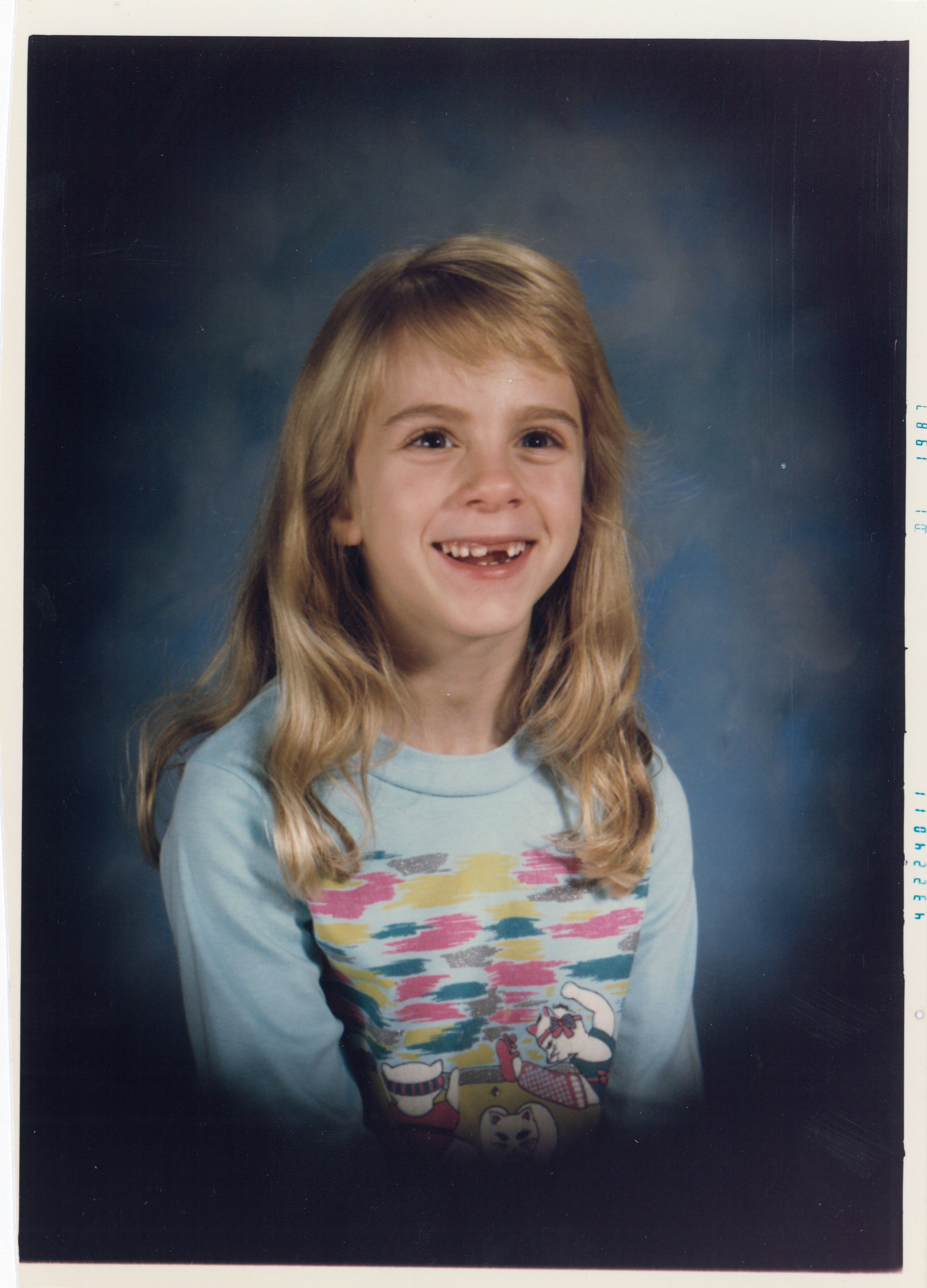
Julie’s famous kitty cat shirt, 1986.

Every August, newspapers are loaded with advertisements for back-to-school clothes. Viewing the options is an experience for me: lacy tight tops, skinny jeans, and leggings for the girls; t-shirts and jeans for the boys. The choices are a far cry from what I wore to school in the fifties and sixties.

I can still remember the smell and feel of new clothes that I put on for elementary school. I always got a couple of new dresses, sweet cotton prints with Peter Pan collars worn with white anklets and sturdy Mary Janes. Since my September birthday always fell close to school opening, new school clothes were included in my presents. I felt a little cheated, as my siblings and friends were getting new clothes, and it wasn’t even their birthday.

By the time I entered junior high, I became more interested in fashion and studied Seventeen magazine all summer, admiring the “mod” look popularized by Twiggy and Jean Shrimpton. Upstate New York was not exactly the fashion capital of the world, but I tried. My stand-by outfit in the mid-sixties was a solid a-line skirt with a ribbed or “poor boy” sweater; a jumper with a turtle neck, or a blouse and a pair of ‘skorts,’ a skirt/pant combination. However, my favorite outfit was a short sleeve wool ‘Mod’ dress, orange with a white hem and white stripes running horizontally down each side. When I wore it, I felt as if I were one of those beautiful, skinny models.

Skorts were the closest I got to pants, as girls were not allowed to wear slacks to our school. My sister Laura and a group of her friends were sent home in their senior year, 1960, when they all came dressed in pants. This all changed in 1966 when one of Larry’s classmates at Saratoga Springs High School was sent home for “improper attire” when she wore slacks to school on a cold winter’s day. The school’s Board of Education decision was overturned by New York State Commissioner of Education, James Allen, who ruled in the student’s favor, freeing female students across the state to forgo dresses and skirts for the comfort of pants. Of course, what we wore, the tailored solid or tweed woolen styles of the 1960s, is a far cry from the leggings and torn jeans that are so popular now.

Once I had children, my job was to shop for them. Dressing Adam for kindergarten was easy. I got a number of Healthtex polo shirts and pant sets from Larry’s parents’ store in Schuylerville, and Adam was perfectly happy. As he got older, Adam switched to jeans and superhero or Star Wars tee shirts.

Then came Julie. Getting her dressed for school became a major battle each morning, especially in first grade. Over the summer, I had taken her clothing shopping, and we had selected several new outfits. When school started, however, she complained that nothing felt comfortable. Her preferred but limited wardrobe came down to one turquoise tee shirt with an imprint of three dancing cats on the front; two pairs of leggings, white with silver metallic stars in the fabric; two pairs of frayed and graying white socks with holes in the toes; and one pair of worn pink sneakers with ratty shoelaces. We had major fights for several weeks. I finally gave in as it wasn’t worth the time and energy. Every night, once she went to bed, I would wash and dry her “kitty cat” outfit, and every morning she put it back on. She wore that shabby outfit almost every day for an entire year.

When Larry and I went in for a teacher’s conference in the spring, I felt I had to apologize. “Honestly, Julie has other clothes, but she chooses not to wear them,” I explained. “Julie wears the same outfit every day because she is comfortable in it. I wash them every night, so she is always clean.”Julie’s teacher smiled and said that was common with first and second graders. Julie also hated to be warm, and she wore an unzipped light winter coat, usually with no hat and gloves, down to the bus, even if it was bitter cold outside. I finally gave up on that battle as well, deciding that she was smart enough to figure out if she needed to add extra layers.

Because of my experience with Julie, I’ve learned to appreciate outfits worn by other young children. When I see, for example, a little girl wearing a flowered top, plaid pants, a pink tutu overskirt, polka dot rain boots, and a tiara for good measure, I ask her if she picked out her own clothes and then compliment her on her good taste. My favorite picture of my great nephew captured his three-year-old self sitting in his car seat on the way to swim practice with his swim suit, his Spiderman pajama top, and cowboy boots. Guess who picked out his outfit for that day?

To this day, Julie hates the heat. She lives in Colorado at 9000 feet, which only has three months of summer. Yes, she is happy as a big horn sheep living in the mountains. To her credit, however, she has become a sharp dresser. Now when I visit her, she takes me clothes shopping, and I am happy with her suggestions. And, thankfully, not one of her choices has included dancing kitties or white leggings with silver metallic stars.

Manna From Heaven: Vanilla Ice Cream

My maiden name is Cohen. In all honesty, however, it should have been Cone. As in ice cream cone. As in my favorite summertime/anytime treat. As a matter of fact, if I were one of the Israelis wandering the desert with Moses, my manna from heaven would have tasted like Breyer’s Natural Vanilla.

My love for ice cream is in my genetic makeup. While I was growing up, a day wasn’t complete in the Cohen household without our dishes of ice cream. In the 1950s in Keeseville, our small town in Upstate New York,, choices were limited. Our freezer usually held one or two half gallons of Sealtest Neapolitan. Having all three flavors for six people worked out well. My father chose vanilla topped with a huge helping of strawberry preserves. My mother went for the strawberry. The four children took whatever we could scoop up with our vintage gray aluminum Scoop Rite ice cream scoop.

Our favorite food also played into all of our family’s special occasions. We dished out ice cream at birthday celebrations, Yom Kippur break-the-fasts, the first post-Passover meal, and Thanksgiving—what was apple pie without the a la mode! As an added treat, my parents would take us for ice cream at the Frosty Dairy Bar, a restaurant on Route 9 in Plattsburgh. Going there allowed us to go beyond Neapolitan, giving me my first tastes of “exotic” flavors like pistachio, chocolate chip, and cherry vanilla.

Fortunately, I met and married a man who, although not as fanatical as me, enjoys ice cream. He loves me enough to tolerate my addiction. Otherwise, I doubt if the marriage would have lasted. Our first date was a movie and a trip to Friendly’s. Larry had a chocolate Fribble, and I had a hot fudge sundae with—you guessed it—vanilla ice cream. It became our go-to place after every movie or play for many years.

Once we had children, we usually kept at least one half gallon of ice cream in the freezer, vanilla for me and Stewart’s Swiss chocolate almond for Larry—he still hasn’t forgiven Stewart’s for phasing out his favorite flavor. Once they could hold a kiddie cone, we would bring Adam and Julie during summer months to the Country Drive-In, a popular hamburger/soft-serve ice cream stand off Exit 8 of the Northway. Julie took Larry there every Father’s Day for a hamburger, fries, and an ice cream cone from elementary school until she graduated college.

My now-adult children don’t place ice cream as high on their favorite food list, but they take care of their mother. Julie and Sam makes sure they have Haagen-Dazs ice cream or gelato waiting for us in their freezer when we visit them Colorado. Adam humors us by taking us to Bi-Rite Creamery for a waffle cone whenever we visit him in San Francisco.

As empty nesters, we usually have a half gallon of vanilla ice cream in the freezer. I will have a small scoop once a week. Larry will indulge a little more often using his own “in-house ice cream routine.” First he softens the ice cream by putting the whole carton into the microwave for a few seconds. He then uses the Scoop Rite ice cream scoop we inherited from my parents to transfer one or two scoops into a cereal bowl. He squirts on Hershey’s Special Dark chocolate syrup, throws on a few Ghirardelli dark chocolate chips, and tosses on a healthy handful of chopped walnuts and sliced almonds. When Larry was laid up with a leg surgery, I tried to cheer him up by ‘recreating’ his masterpiece. I failed miserably as I messed up the proportions of ice cream, chocolate syrup, and nuts. To be honest, I think Larry treats ice cream as another way to eat nuts.

For me, however, a simple unadorned dish or cone of vanilla ice cream is my favorite food, a link to my childhood as well as one of life’s great pleasures. Ice cream even has played an important role during one of the most poignant times of my life. When my mother fell gravely ill four days before she passed away, she lost her desire for food. I asked her if she wanted anything special to eat. She whispered, “Strawberry ice cream.” The cafe at Coburg Village, the independent living place where she was living, had none. The wonderful young woman working behind the counter, upon hearing the story, went up to the main restaurant and brought me back a huge dish of strawberry ice cream to honor my mother’s request. When I got back to Mom’s bedside, she ate three or four spoonfuls before she pushed my hand away. “That was delicious! Thank you!” That was the last food she ever ate, a true Cohen to the end. I can only hope that I, like my mother, will a long, happy, healthy life that concludes with the sweet taste of vanilla ice cream on my tongue.

Until we relocated to Florida, one of my favorite stops was the three-mile trip to the Country Drive-In for a vanilla soft serve. As a matter of fact, I needed to make a trip there to take a picture of my eating my cone for the Jewish World, It was a cold, rainy, day, making it quite tough to buy that cone and eat it. Someone had to do the job, however, and who better than Marilyn Cone Shapiro?