Author Archives: Marilyn Shapiro

Unknown's avatar

About Marilyn Shapiro

After thirty five years in education, I have retired and am free to pursue my lifelong dream of becoming a freelance writer. Inspired by my mother, who was the family historian, I am writing down my family stories as well as publishing stories my mother wrote down throughout her life. Please feel free to comment and share.

A Special Special Olympics Coach

In 2014, my husband Larry spent eight days in New Jersey as the New York State triathlon coach at the Special Olympics USA National Games. He described his experience as “incredible” and “life affirming.” As soon as he arrived home, he tried to catch up on his sleep as he got less than five hours a night for the entire trip. How he got to this nirvana of sleep deprivation is part of Shapiro family lore.

Almost twenty years ago, Larry announced at the dinner table that he had signed the family up to volunteer at the New York State Special Olympics Summer Games that were being held at University of Albany in early June. My children had been involved in sports for a long time, and Larry recognized that many volunteers had made their swimming, cross country, and track and field meets possible. He felt the four of us should pay it forward by contributing our time to the intellectually challenged athletes at the state-wide event in the track and field competition.

We enjoyed our experience enough to sign up to volunteer again the following year. While at the games, Larry was asked to help out with the Saratoga County track and field program that met April through mid-June at the Saratoga Springs high school track. Larry’s co-worker also volunteered, and the two of them drove up every Monday and Thursday from downtown Albany. After a couple of years the two of them extended their time commitment to include helping at local Special Olympic meets.

As the years progressed, Larry took on more and more responsibilities. He became head coach and held additional practices for athletes who exhibited high levels of skill in an event. He started a cross country running program, volunteered to coach for the Clifton Park bowling program, conducted coaching certification classes, and served on various Special Olympic committees. Larry knew that his involvement in Special Olympics would give him focus and purpose after he retired. It was shortly before his last day of work that he found out he was chosen as one of the track and field coaches for the National Games in Lincoln, Nebraska, in July 2010. One of our athletes came home with silver medals in the 1500 and 3000 meter runs.

Along the way, Larry had convinced me and a number of friends to become track and field coaches, and we all gained much from our participation. The best part for all of us was being with the athletes at practices. Twice a week every spring, over forty athletes ranging in age from sixteen to eighty years old, several coaches, and numerous parents and group home staff would gather at six o’clock at the track.  The athletes ranged in age from eight to seventy-five, with their intellectual and physical challenges ranging as widely as their ages. Larry started everyone off with a team cheer P-A-C-E-R-S! Then the activities began. On the field, some athletes threw a softball and had their distances recorded by the coaches. A group of stronger athletes worked with a coach on the turbo-javelin and the shot-put. Others were practicing the standing long jump. On the track, athletes, depending on their levels and abilities, participated in runs, walks, wheel chair events. The visually challenged ran twenty-five to fifty meters holding a baton strung through a 50 meter rope that was held in a straight line by cheering team mates. Practice ended with Larry gathering up the athletes for one more cheer before they went home. Two or three times a season, coaches and members of the team participated in local competitions on a Saturday morning. Whether we were at practices or at our meets, our athletes’ times and distances were secondary to just having fun. The cheers were as loud for the athlete who threw the softball two meters as it was for the athlete who came in first in the 1500 meter run.

Larry took pride in the accomplishments of every athlete and was always recruiting new team members. While helping with Special Olympics bowling during fall 2013, Larry watched an athlete decimate the pins with his powerful swing. Larry persuaded Rich to join track and field and use that strength to throw shot-put and the turbo javelin. By the end of his first season, the athlete impressed officials at the state games in Buffalo enough for Rich to be chosen to compete in Nationals in New Jersey. While there, he not only won a gold medal in his division in the shot-put but also came home with gold in the turbo jab with the longest throw of anyone in the country in the turbo javelin finals.

Saying goodbye to the Pacers when we moved to Florida was one of our hardest moments.We follow their accomplishments on Facebook and through emails. In honor of our athletes, we have named the small body of water in our backyard “Pacer Pond.”

Tikkun Olam is a Hebrew expression that means “repairing the world,” the moral principal that states every individual should leave this world better than he or she found it. I take pride in knowing that Larry’s involvement in Special Olympics is his way of making the world better for so many athletes.

Bluebird Powder Day

10151728_10201716353926974_429979176_n

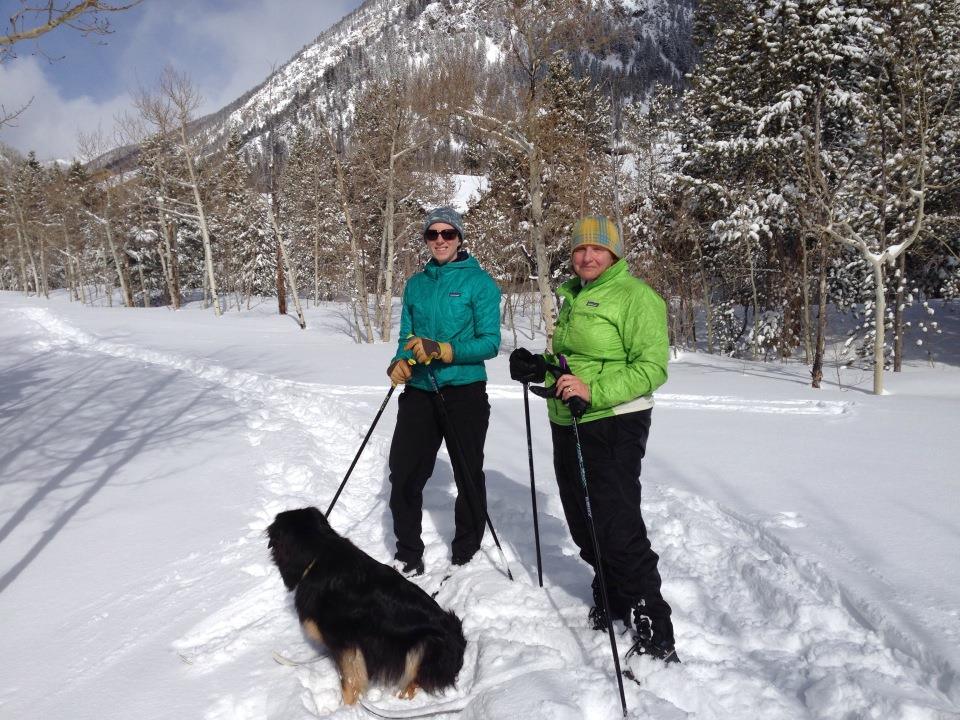
While visiting my daughter and son-in-law in Frisco, Colorado, I went cross country skiing for the first time in several years. It seemed like everything was in place. Clothes? Check. Skis and poles? Check, Beautiful snow cover? Check. Perfect temperature? Check. Ability to cross country ski? Not so good!

Julie had moved to Colorado after college for a “one year” teaching position at a science school near Vail. She fell in love with the mountains, the snow—and Sam. They were married in Moab in May 2007, and after completing master’s degrees and finding permanent jobs, they purchased a home in Frisco.

Larry and I visited Julie and Sam at least once a year, usually around the Fourth of July in time for the parade, town celebration, Julie and Sam’s annual BBQ, and the fireworks over Dillion Lake. Julie and Sam had fully embraced the Colorado winter life style and had encouraged us to visit them during the snow season. For many years, we demurred because of our work schedule. After we retired, Larry and I preferred to spend our winter months getting away from snow and cold, NOT heading in the opposite direction to 9000 feet and more snow and more cold. In 2014, as I missed my daughter, I made the decision that I would go to the mountains in the winter, even if Larry wouldn’t join me.

As soon as I entered the kitchen my first morning there, Julie asked me if I wanted to cross country ski. She and Sam live only a couple of blocks from the Frisco bike trail, and the snow was fresh enough for us to ski right from their house. I agreed to give it a try.

Julie fitted me with an extra set of boots, poles, and skis. I snapped my right foot into the right ski easily, but the left boot/left ski didn’t cooperate. Six to eight tries later, both of my skis were snapped in. By the time we finished, the bottom of Julie’s skis were stuck with snow. She took them off, went back into the house to locate scraper chipped the snow off her skis, and put them back on. Then she showed me how to lift up each ski so at a ninety degree angle and balance on the other leg while she removed the snow and ice from the bottom of my skis. Once we were done, we headed out of the driveway towards the bike path.

The snow was as beautiful as anticipated. I naively thought that cross country skiing would be like riding a bike: Once my skis were on, I would be gliding along the path like a pro. However, I was a little older, a little less flexible, and a little heavier. My progress was pathetic. Fortunately, Julie was a good teacher. She reviewed with me how to kick up my heels, how to glide, how to lean forward to get better momentum. But despite my attempts, I always was at least two hundred yards behind her.

A “Vail 11 Miles” sign soon appeared along the bike path. My mind went back to a show on the Travel Channel, where Samantha Brown did a midnight ski from Vail to Breckenridge. Watching her glide effortlessly in the moonlight, I had thought, “We should do that when we go to Colorado!” But after twenty minutes on the trail, I was bathed in sweat, breathing heavily to compensate for the altitude, and seriously questioning my ability to ski another yard, much less eleven more miles. I didn’t want to disappoint Julie. I soldiered along.

We poked along for a mile or so, and Julie suggested we scrape off the sticking snow from the bottom of my ski as we practiced at home. I kicked out my left ski, tried balancing on my right leg, and crashed to the ground. After several attempts to get up, I finally had to remove my skis and right myself. Now I had to get back into the bindings. Multiple unsuccessful tries later, Julie initial patience was wearing thin. She pointed impatiently to the spot on the binder where the boot snapped in. “Right here?” I asked.

“Yes!” she answered. I put my toe in and snapped the binding down—on my poor daughter’s finger. She spewed out a string of obscenities fit for an angry, drunken sailor.

“I’m so sorry!” I exclaimed. “But where did you learn that language?”

After a couple of more tries, I was into my bindings and on our way again. We had to stop a couple of more times to scrape our skis, but I was enjoying the experience.

Forty-five minutes later, we were home, cozy, warm, and sipping tea.

Sam came down from the home office where he had been working. “You’re back! How did it go?” he asked.

“I’m a little rusty,” I said, “but I’m catching on.”

“How far did you go?” he asked.

“Actual miles were around three,” I said. “For me it felt like we went the twenty-two miles to Vail and back. For Julie it must have felt like to hell and back.”

The next morning, I woke up feeling pain in muscles I didn’t remember I had. But when I went down to breakfast, Julie was ready to try it again. A half an hour later, we were back on the bike path. My skis had clipped in on the first try, and the wax helped me glide smoothly over the fresh tracks Julie broke in front of me. I could not stop smiling. When I fell down, I picked myself up with no trouble.

“You’re doing so much better this morning, Mom,” commented Julie. “Are you enjoying yourself?”

“Every minute!” I responded.

“This is a bluebird powder day,” Julie said.

“What does that mean?” I asked.

“It’s a Colorado expression,” explained Julie. “The sun is shining, the sky is a brilliant blue, the snow is a perfect powder, and the temperature is ideal.”

“You’re right, Jules! It is a bluebird powder day!” And we kept on gliding through the powder.

The old camp is destroyed; long live the new camp.

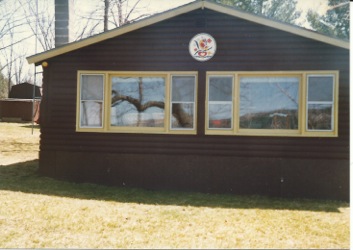
For most people, summer camp means children packing up a trunk and a knapsack and heading off for their own adventure while the parents had a few weeks of freedom.  For my family, “camp” has had a completely different connotation: It was a summer place on a lake. Before my mother Frances Cohen passed away, she recorded many family stories.  This is one of them.  Ironically, today, May 22, Jay and Leslie will be heading up for their summer at their new “camp”  on the same spot as the original purchased by my parents 48 years ago. Jay and Leslie’s new place is absolutely beautiful, but the most beautiful part is the sunset, the same view my parents enjoyed for so many years.  Marilyn Cohen Shapiro

September 17, 2009, was a very bittersweet day for me.  That was the day the Cohen family camp on beautiful Lake Champlain was demolished. Personally it was a difficult day for me to realize that there was a huge pile of logs where our cottage was, where we had spend forty summers.  The cottage is gone, but all the wonderful memories will linger on. The good news is that it is going to be replaced with a beautiful new, modern cottage.

Let’s start from the beginning. Many of our relatives had camps on lakes in Northern New York and Vermont, and we enjoyed visiting them. We hoped that one day we would have one of our own.

In July 1966 we were told that a person we knew had a camp for sale in Willsboro, a very small town on Lake Champlain only 30 minutes from Keeseville.  That evening Bill and I went to see the camp.  The camp was very rustic, just a very large building made of logs that consisted of one big room. Two parts were sectioned off with thin wall boards for the two bedrooms. The wallboards did not reach the ceiling, so there was no privacy.  A large bar with benches for ten people separated the kitchen from the dining and living areas. The small bathroom was the only room that was completely enclosed. Bill asked me what I thought. I looked out on the lake. Just then the sun was setting. The view was magnificent. I said, “Buy it!” Bill was so surprised as I was the one who always said, “I’ll think it over.” By August 1966, we were proud owners of a camp on Lake Champlain.

A few weeks later we received the following letter from relatives downstate in Westchester County made us smile:

Dear Fran and Bill, Good luck on buying a camp.  But we are worried about you Fran. With a large family and working full time, we hope it won’t be too much for you.  Is it a boys’ camp or a girls’ camp?Love, Hilda and Morris

I guess Hilda was right.  I looked up the word “camp” in the dictionary, which defined a “camp” as a temporary place for children out of the city.

Although the camp needed lots of repairs and wasn’t my dream cottage, it was one of the smartest moves that Bill and I ever made.  The property was reasonable and we could afford it.  As our family grew, so did the camp. In 1968, we built on a large family room with huge windows facing the lake. Over the years we entertained lots of company and hosted lots of parties. All our children and our eight grandchildren enjoyed the camp for many, many years.

When Bill and I reached our eighties, we found it was too difficult to keep up the cottage and put it up for sale. We were so happy when our son Jay and his wife Leslie offered to buy it as it would still be in the family.

Ten years have passed. Jay and Leslie are now grandparents. Jay recently retired, and Leslie will join him soon. They plan on spending much more time in Willsboro.  So they are replacing the old camp with a beautiful new one. They are so excited and can’t wait until it is built.  The structure may be new, but the sunset will be the same.  May they enjoy many happy years in their new home on the lake.

My Two Moms

Doris and Fran 1979_Adam BD

My two moms at Adam’s second birthday party. Doris Shapiro is on the left and Frances Cohen is on the right.

Larry has a very special relationship with Mother’s Day: He was born on this Hallmark Card Holiday on May 9, 1948.

I can only imagine the joy Doris and Ernie felt when their second child, a son, was born. He was a beautiful baby. From what I heard from his mother and still hear from his three sisters, Larry was an easy child: quiet, never got into trouble, spent time either in his room or with his friends on the baseball field. He grew up, went to college in Boston, and completed his master’s degree at Syracuse University.

By the time he finished graduate school, Larry’s parents were more than anxious for him to meet a nice Jewish girl and settle down. After meeting me at the Purim party, Larry kept me under wraps until that May, when he invited me to his house. I had a major strike against me; I had completely forgotten his birthday, which fell on Mother’s Day that year. But Doris let that pass once Larry brought me home. Jewish? Check! Nice family? Check! Single and available? Double check! By the end of June she and Larry’s Bubbie Rose, began to put some pressure on him. So what if we had only been dating for three months?

“So what is your relationship with this person?” Doris asked.

“I guess we’re going steady,” Larry replied.

“Steady, smeady,” huffed Bubbie Rose. “She’s a nice Jewish girl.You don’t go steady. You get married.”

Larry and I dated through the summer, and August, we were already talking marriage. Of course, we didn’t share that with our families, but Doris was still working on it. One day, she showed me her engagement ring. “Whoever marries my son will wear this ring,” she told me. Very subtle!

When his first attempt at proposing to me in Saratoga National Battlefield was thwarted by a bee sting, Larry tossed romance out the window and asked me to marry him on our walk home from Rosh Hashanah services on September 28. We shared the news with my parents over the phone, but we saved our big announcement for his parents at the Yom Kippur Break-the-Fast on October 6, which coincided with Ernie’s birthday.

“I have a special birthday present for you, Dad,” Larry announced over coffee and birthday cake.

“Another ugly tie?” snorted one of his sisters.

“No, I’m giving you a daughter-in-law.”

Everyone started hugging us and yelling “Mazel tov!” Doris was true to her summer promise. She ran into the bedroom, grabbed the engagement ring, and put it on my finger. I am sure I am one of the only people in the world who had her future mother-in-law place an engagement ring on her finger. Again, very subtle!

After that day, Mr. and Mrs. Shapiro became “Mom and Dad.” I was really fortunate in that I now had two sets of parents who loved me deeply. Larry’s parents treated me as well as, if not sometimes better, than their own children. Mom, happy with Larry’s choice, often kiddingly said, “If you two ever get divorced, I get custody of you.” I may not have been able to make a brisket or a bed as well as my mother-in-law, but for the most part, I could do no wrong. When we delivered two grandchildren, it was the icing on the cake.

Throughout their lives, Mom and Dad were wonderful in-laws. They took great joy not only in their children’s accomplishments, but also in the accomplishments of their daughter/sons-in-law. They adored their seven grandchildren and showered all of us with their love and their generosity for many years.

My parents and in-laws hit it off from the first time they met, and they spent many happy times together as dear friends as well as mishpocha. When they both retired, my in-laws purchased a condo a minute’s walk from my parents. Ernie and Bill golfed; Doris and Fran shopped and shared confidences over coffee.

When Mom died during heart surgery in April 1994, we were all devastated. And when Dad followed her a mere eight months later, the grief was overwhelming. Since their passing, so many wonderful events have occurred where they were not there physically but were there in our hearts. At so many occasions—bar and bat mitzvahs, graduations, weddings, the birth of their great-grandchildren—at least one of the children or grandchildren have said, “Mom and Dad would have been so proud!”

A few years before Mom passed away, I gave her a framed poem entitled “My Other Mother.” The first lines read, “You are the mother I received/the day I wed your son/And I want to say/Thank you Mom for the loving things you’ve done.” She kept it on the wall in her bedroom. When she passed away, I took the poem and hung it in our bedroom, next to our wedding picture. So on this Mother’s Day, I want to tip my hat to my two moms, the one I received at birth and the one I was given through marriage.

Our Passover Bris

Larry and I at Adam's bris. Adam was asleep in his bassinet, waiting to go home.

Larry and I at Adam’s bris. Adam was asleep in his bassinet, waiting to go home.

This year, as we prepare for Passover,  my thoughts are not only on the upcoming holiday but also the memories of a very special Passover thirty-six years ago.

At this time in 1978, Larry and I were anxiously awaiting for the birth of our first child. My mother and my older sister had delivered their babies early and easily, and I was expecting the same experience for me. It didn’t turn out that way.  After I had gone through several hours of unproductive labor, our baby was delivered on his due date, Saturday, April 15, by Caesarian section. Despite the unexpected surgery,  Larry and I were absolutely thrilled.  We had a perfect healthy little boy, our little tax deduction, our Adam Michael Shapiro.

Now that we had a son, we needed to plan a bris. Unlike today’s births, the average stay for a woman who delivered by c-section in the 1970’s was eight days. We arranged to have the ceremony and celebration in one of the conference rooms in St. Peters on the following Sunday.

Now we faced the difficulty of finding a rabbi and/or moyel. Sunday was the second full day of Passover. As a C-section was not a “natural birth,” the holiday technically superseded the commandment of the bris on the eighth day.  Fortunately, my brother and sister-in-law had a close friend who was the daughter of a local rabbi, and he graciously agreed to officiate on “yontiff.” One of the doctors in my ob/gyn practice, who was Jewish, agreed to perform the circumcision.

By the time we had set everything up, it was Friday, the first night of Passover.  Larry was invited to a friend’s for seder and I had a decidedly un-Passover dinner in my hospital room. One of the nurses came in to check on me, and I commented that I thought I had developed a bed sore from lying around the hospital bed for the past six days.  She took a look, and said, “That’s not a bed sore! You’ve developed a cyst on the bottom of your tailbone.”

“What does that mean?” I asked.

“Well, I’m not a doctor,” she started. “ But you probably will have to have surgery to remove it, and you will have to stay in the hospital for another week while it heals. Of course, as it is an infection, you will have to be in isolation and not be able to take care of Adam until you are healed.”

That did it for me. I was recovering from major surgery, we were planning on a bris on Sunday, and now I was facing more possible hospital time. I did what any other sane, sensible postpartum mother would do: I had a complete, hysterical melt-down. Unfortunately and to add to the drama, Larry was at a seder at a friend who had an unlisted number, so it took some effort to get the phone operator to agree to contact Larry and then have him call me back. Once he was reached,, Larry left his friend’s house mid-seder and drove back to the hospital to comfort me. The next morning, my doctor assured me that a good dose of antibiotics would work in the short run, with surgery only an option down the road if necessary. The bris was still on, and it was time for us to focus on the celebration.

The day of the bris, my mother and mother-in-law  came with Passover wines, cakes and cookies, along with fresh fruit. They covered the tables with white table cloths, and used an extra one to  cover the crucifix that was hanging on the wall. Our family was all there, the rabbi was sweet and kind, and the doctor who performed the circumcision was steady handed.  The adults, including the father and mother, handled the procedure calmly.  The most attentive guest was our five-year-old niece Katie, who took a unusually close-up interest in the procedure. When asked if she wanted to be a doctor when she grew up, she replied.  “Yes, or a fireman!” After the ceremony, we all sipped Passover wine and ate sponge cake and macaroons. Friends and relatives said good-bye, and Larry drove me and our soundly sleeping son home to Clifton Park. We now could begin our life as a family.

I healed nicely, never needed surgery on the cyst, and, outside of having to call the paramedics my second day home after I got my wedding ring stuck on my finger, things settled down to the new normal of having an infant. Over the years,  Adam has had to celebrate many birthdays with Passover sponge cakes and macaroons instead of the traditional birthday cake.. However, he and our family always enjoy the retelling of the Passover bris as much as the required retelling of our “sojourn from Egypt” at our seders.

Best Gift

The baby grand was the center piece of our living room in Keeseville.

The baby grand was the center piece of our living room in Keeseville.

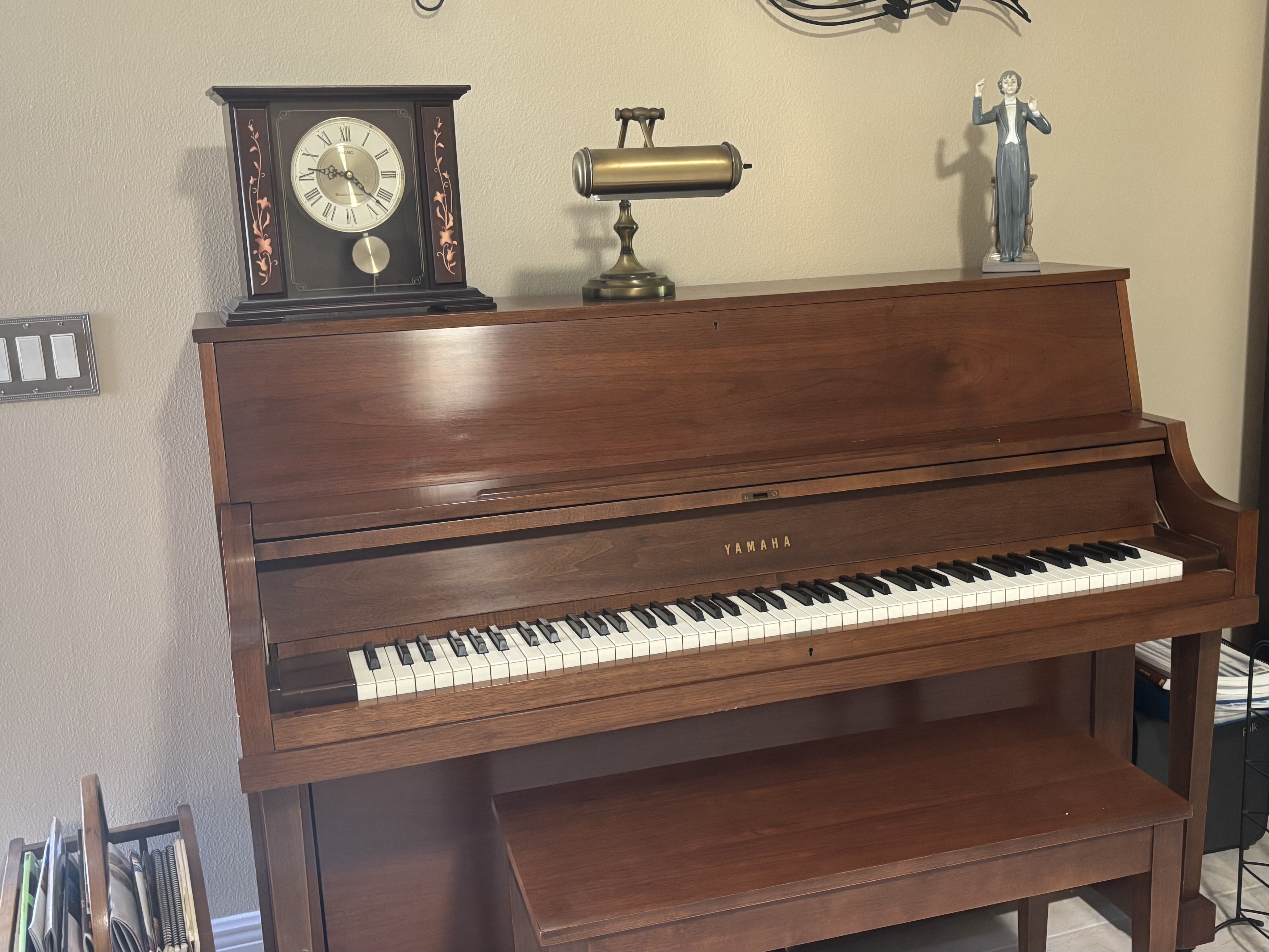
For our family, three of the best gifts we ever received were an ugly orange spinet, a mahogany baby grand, and a walnut Yamaha upright.

After the war, my parents and my two older siblings moved from New London, Connecticut, to Potsdam, New York, so that my father could help my Uncle Eli, my mother’s brother, with his clothing business. Housing was very difficult to find in 1948, and my parents were left no option but to purchase a very small ranch on top of a very windy hill. Cramming the four of them into the two-bedroom house was difficult enough. When I arrived in 1950, things got even more crowded. The kitchen was so small that the person sitting in the kitchen chair nearest to the refrigerator would have to stand up if someone had to grab the milk. Laura and Jay shared a bedroom, and my crib was sandwiched into my parents’ bedroom. The tiny living room had a couch, two chairs, my playpen, toys, books, and, in time, a very ugly piano that was one of my sister’s best gifts.

Potsdam was not only the home of the state college but also the location of the Crane School of Music, which provided many musical opportunities to the community. My sister walked past Crane on her way home from school every day and heard the students practicing their instruments. Intrigued and inspired, she asked my parents for a piano. After proving herself by taking lessons using the neighbor’s rickety spinet, she got her wish. My parents purchased an old upright painted a hideous butterscotch orange that barely fit into the already full living room. The tiny house often reverberated with music, especially when friends gathered around the piano. My Uncle Eli, who could not read music, played any requested song by ear, so he often was on the piano bench.

In 1952, my father took a job in Keeseville, New York, managing a Pearl’s department store one of several in a chain owned by my great-uncle Paul. In order to save money, my parents hired a couple of men from Pearl’s to pack up the household belongings into the company truck and deliver them safely to Keeseville. Unfortunately, the men dropped the piano while unloading it. The piano, never in tune to start, was now hopelessly flat and sported several non-functional keys. That didn’t stop us from playing. My older siblings and I took lessons with varying degrees of mediocrity. We mixed our John Thompson piano lesson books with more popular sheet music, including such Fifties hits as “Stranger on the Shore” and “Mack the Knife.” My sister’s and my favorites were from the American Songbook. We had a healthy collection of Rodgers and Hammerstein, Cole Porter, and George Gershwin.

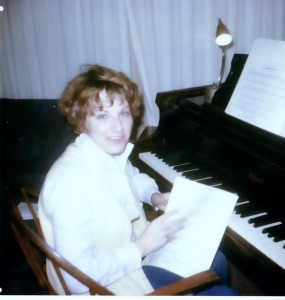
By the age of twelve, I had gone through a couple of piano teachers, one who retired and one who moved away. Despite the lack of lessons, talent, and a decent instrument, I still loved to play. I alternated between the classical music I learned from my former teachers and all the music my sister had left behind when she went to college. I began lobbying for a new piano. I knew, however, that getting even another second-hand one that was in a little better shape than our orange relic was probably out of financial reach for our family.

One evening before Chanukah in 1962, my parents called me into the kitchen. That afternoon, my father found out one of his customers was moving to a smaller home and was selling a used baby grand for only five hundred dollars. Was my father was interested? Yes, I was, in fact, getting my wish. I cried for joy, even more so when the beautiful instrument with its shiny mahogany finish was delivered later that week. Unlike our tiny box of a house in Potsdam, our Victorian house in Keeseville had enough room for the baby grand. With a minimal rearrangement of furniture, the piano became the centerpiece of our living room.

That January, I started lessons with the new young Keeseville Central School music teacher. Initially, I was humiliated to find out that I needed to start from the beginning level books to improve my skills. Over the next three years, I managed to work my way through the third level of the John Thompson series. My teacher, knowing my love for the movie and Broadway show tunes, also supplemented the classics with more contemporary selections such as “Sunrise, Sunset” from Fiddler on the Roof, “You’ll Never Walk Alone” from Carousel, and, my favorite, “Moon River.”

The piano again became a gathering place for family and friends. I often played while my siblings sang along. My brother even joined in with his trombone. I missed lots of the notes, my sisters were not known for their vocal talents, and my brother was no Urbie Green, but we loved the chance to be together. My Grandpa Joe played Yiddish songs after he moved in with us after my grandmother’s passing in 1966. Uncle Eli got to hammer out his share of songs when he visited us from Potsdam.

Once I left for college, I played infrequently, mostly on school breaks. When my parents moved out of their big house in Keeseville in 1982, the piano was sold as none of the children had room for it in their homes. Before my parents downsized, however, I collected all the sheet music from the house and stored it in our home “just in case” we ever got a piano. I had little chance to play—until I received my second best gift ever.

After my daughter Julie was born, I was home with the two small children. The days were getting long. Knowing how much I loved my baby grand in Keeseville, Larry encouraged me to look for one that would fit into our home. The Yamaha upright I selected from Clark Music in Latham was delivered two weeks before my thirty-second birthday. Armed with all the sheet music my family and I had accumulated since my sister started lessons in Potsdam many years before. I spent many hours playing the piano, both for enjoyment and for the peace and serenity playing gave me.

When she was a junior in high school, Julie decided to take piano lessons for the first time. I felt my musical life had come full circle when my daughter’s teacher recommended we purchase new, unmarked John Thompson lesson books. At her first and only piano recital, Julie choose Pachabel’s Canon and my old favorite, Moon River.

When Larry and I decided to move to Florida, I initially thought of selling the piano. It was expensive to ship to Kissimmee; I didn’t play that often; I could always use the piano in the Palms, the community center a mile from our house. It was Larry who insisted that we pay the moving company to bring the piano with the rest of our household. There was no repeat of the Potsdam debacle. The piano arrived safely in our new home. We placed it on an empty wall in the living room. From the moment I first touched the keys, I knew Larry was right. The tile floors and open floor plan improved the sound quality over that produced in our bi-level in Clifton Park.

Soon after we moved in, I had three couples over for a Shabbat dinner. After dessert, my friend Becky, who taught music in high schools for many years, started looking at my sheet music collection. “This is fabulous!” she commented. “Please play for us!” Not used to an audience, I played hesitantly for a few songs,then Becky graciously took over the keyboard. For the next hour, we belted out songs from Les Mis and Wicked as well as my old favorites, “Sunrise, Sunset” and “Moon River.” I had tears running down my cheeks from happiness. Thanks to my piano, our new home was filled with the sound of music.

Freezin’ for a Reason

Image

FREEZIN’ FOR A REASON

I had always been intrigued by stories and pictures of polar plunges, where hundreds of smiling people clad in only their bathing suits head into a body of water in the middle of the winter. They say they are having fun. I never got it until I found myself diving into Lake George, water temperature around 50 degrees, on November 16. Crazy? Yes! Glad I did it? Double yes. Because I was “freezin’ for a reason.” I was raising money for Special Olympics Capital District.

Special Olympics is the world’s largest sports organization for children and adults with intellectual disabilities. The Special Olympics Capital District region provides year-round training and competitions to more than sixteen hundred athletes from twelve counties in fourteen different sports. For a number of years, Larry and I have been involved as Special Olympics track and field and bowling coaches.

We have also participated in Special Olympic fundraisers. One of the most popular and well known in the Capital District is the Polar Plunge, where hundreds of people plunge into Lake George on the third Saturday of November. In a moment of insanity, I had signed up and participated in the plunge in 2011. Within minutes of coming out of the water, I swore to anyone with ear shot that I would never do it again.

I am no scientist, but to me this is definite proof that humans have very short memories. Our schedule in 2012 prevented my doing it, and I was thinking of finding another excuse for 2013 until…..

In a second moment of insanity, I committed to rejoining Freezin’ Friends, a team of plungers headed by Joni Rhodes from Schuylerville. Her son Nick participates in several Special Olympic events, including our track and field program, and I again wanted to raise money to support athletes like Nick. In the middle of September, I began a fundraising blitz, mostly through emails and Facebook. The response was amazing. I had pledges from family and friends across the country and even from England. Most pledged on line, but many others handed me checks or cash, commenting “Better you than me!” and Boy, you are brave!” By the day of the plunge, our team had raised close to $5000, and the region total was approaching $77,000.

By this time, you would think that I would be mentally and physically ready to dive back into Lake George. I hadn’t died the first time; my heart had held out; I didn’t even catch a cold. But in the days before the plunge, I had nightmares about going into a freezing lake. In addition, this year I was going to finish what I had started in 2011. In my first year, most of my supporters congratulated me and praised my bravery for plunging up to my neck. However, a few people kiddingly questioned as if I had ever gone in the lake, as my hair was still dry and the water droplets on my body didn’t show well on the photos. This time, I was going to make sure that pictures showed a soaked bathing suit and a wet head so that no one would doubt my commitment.

We were very fortunate with the weather. The morning of the plunge was a beautiful, sunny, calm day, with air temperatures in the fifties. Larry and I stopped at the registration desk and then headed down to Shepard’s Park Beach. Over my bathing suit, I had flannel pants, a thermal shirt, my Polar Plunge sweatshirt, and a warm terry bathrobe. Under my water shoes were heavy woolen socks. I located our team by finding Joni in her traditional Dr. Seuss hat she has worn for each of the seven plunges in which she has participated. I recognized most of my teammates from 2011, a mix of Nick’s family, friends, and Special Olympics coaches. Om addition, a large group of students from Schuylerville High School had signed up for the fundraiser, bringing our team up to over thirty people. Joni provided all of the members of the team with a choice of colors in Santa hats.

Several other teams of plungers were also on the beach, including Max’s Buddies, Freeze Duchenne, and Brian’s Bashers, and the Siena men’s baseball team. We spent the next couple of hours munching on bagels, sipping hot coffee, taking pictures, and connecting with members of our team and the other plungers. Several were in costume: capes, polar bear hats, boas, and, in the case of one man, a skimpy beige bikini bathing suit. My Miley Cyrus look,” he explained.

At ten minutes before noon, all the plungers stripped down to their bathing suits and, shivering despite the warm sun, lined up to wait for the signal to hit the water. At exactly twelve noon, led by three athletes holding the Special Olympics torch, over five hundred and fifty crazies streamed into Lake George.

As my ankles hit the water, I faced my first obstacle. As our team was near the end of the line, we were going into the lake when the members of the Siena men’s baseball team were coming out. Fast. Blindly, with no concern for who was in their way, I darted through their hurling bodies until I found a clear spot in the water, took a deep breath, and dove in, orange Santa hat and all.

OH MY GOD! Why didn’t I remember it was this cold! I immediately thought of those poor people on the Titanic and had visions of Leonardo DiCaprio’s Jack clinging onto the edge of the makeshift raft that held Kate Winslet’s Rose. I could not get out of the water fast enough. I ran onto the sand, hair and body dripping, searching desperately for Larry and, more importantly, my bathrobe and towel. As soon as I found him, I asked, “Did you get a picture?” Larry said yes, but there must have been ice in my ears, as I didn’t hear him and headed back into the water for a second totally unnecessary photo opportunity.

I have to say that it wasn’t as bad as the first time. Maybe the sun had warmed my body. Or I was so numb I couldn’t tell the difference. Larry took a couple of more pictures, and I was finally able to head for the women’s warming tent, where I quickly changed into dry clothes. We drove back to Clifton Park with the car’s heater going full blast.

Later that afternoon, Larry and I talked about the plunge over large bowls of steaming chicken and rice noodle soup at a local Chinese restaurant. “Next year, I need to wear a different bathing suit and a pair of shorts as those pictures I posted on Facebook are just too embarrassing,” I said. “And maybe if I start earlier, I can raise more money.”

Larry nodded, “Let’s just see what happens with our schedule next year.”

A final note: Larry has yet to sign up to plunge, citing several reasons why it should not be a joint effort: He needs to be on the shore to hold my bathrobe and towel. He needs to take pictures. He needs to drive me home as I will be too cold to drive myself. He doesn’t want to take away from “my” event. Maybe he has more common sense than the rest of us, or maybe he just doesn’t know how to have fun.

First published in Jewish World, 11/21/2013

Love in the Time of Retirement

Larry and I enjoying our retirement in  Mission San Juan Capistrano, California.

Larry and I enjoying our retirement in Mission San Juan Capistrano, California.

Ah! Young love! This is the time in life where two individuals cannot get enough of each other! Each moment away from one another is agony, and even when they are together in the same room, there is a desperate need to touch and hold and talk. Their wish is to share every waking moment together.

Yes, my husband and I were like that once. We met, we courted, we married, and we spent the next thirty-six years of our lives juggling our relationship with children, jobs, and outside commitments.

Then, Larry and I retired, and we got our wish. We were together twenty-four/seven, but we weren’t young anymore. As a matter of fact, living under the same roof resulted in a period of major adjustment.

Please don’t get me wrong. I love my husband dearly, and I am so grateful that we have had the opportunity to retire in good health. It is just that—well — love in the time of retirement may test even the closest relationship.

Our first battle took place soon after Larry retired. We were in the kitchen, cleaning up after dinner. As was our usual routine, Larry was putting away the leftovers while I was putting the dirty plates in the dishwasher. He looked over while he was closing the refrigerator door and offered, “Here, Marilyn, let me show you how to load a dishwasher.”

I stopped mid-dish, and stared at him. “What do you mean by that?”

“You’re not doing it right. I can show you how to do it properly.”

“So you mean to tell me I have been loading this thing WRONG for the last three decades?”

“Yes, my way is much more efficient!” We had a brief, spirited discussion as to whether he wanted to accept my tried and true way of doing it or if he wanted to wash dishes on his own for the rest of our married life. Thankfully, he saw it my way.

The second conflict occurred six months later when I retired. I planned to set up my calendar and some files in our home office. When I tried to find room on our computer desk, not an inch was available. “Larry,” I said, “do you think you can organize all those piles on the desk so that we can share the space?”

“I retired first” was his response. “I already claimed the desk. You will need to find another spot.”

Initially, I managed to carve out a few inches of blank oak, but it wasn’t worth the fights that ensued when I moved any of his piles, which he referred to as his “filing system.” I eked out a two-inch crevice between the computer and the printer that allowed me to prop up a few folders. It took three years to have the sense to get my own lap top so I could have the flexibility to work on any surface in the house.

Over the next few months, we played an uneasy game of adjusting. Larry spent a great deal of time following me around closing cabinet doors and drawers I continually left open, a bad habit I had had my entire life. I learned to accept the fact that he was king of the television clicker. He could watch several television shows simultaneously, including a couple of basketball games, reruns of The Big Bang Theory, and a showing of a favorite movie. I found this tolerable as long as I was multi-tasking on the couch —doing a crossword puzzle, checking emails, reading a book, and cutting coupons—while he ruled the remote. My annoying habit cancelled out his.

I know that I am not the only person who has experienced post-retirement angst. One friend, whose son had been in a playgroup with Adam over thirty years earlier, told me that her husband had acquired this overwhelming need to be with her wherever she went. Grocery shopping, dropping off mail at the post office, running to the drug store for a prescription, was now regarded by Steve as a two-person outing. “If Larry isn’t busy,” Fern suggested, “maybe we can arrange a weekly playdate between our two husbands. Then I can get out of the house by myself for a couple of hours.”

My friend Judy commented that only after they were both retired did she realize how ‘uber-organized’ her husband was. A week before they left for their two-month stay in Florida, Judy was haphazardly stacking clothing on her bed and throwing cosmetics and toiletries into a bin. Charlie strolled into the bedroom and opened up a file marked “Florida.” It included a detailed list of everything he needed to pack, including the number of pairs of socks, shirts, and shoes he was bringing. Another list included restaurants in Naples, with notes on ratings and menus. He even planned their drive down to Florida in minute detail: He had researched hotels and restaurants en route on Trip Advisor, printed out weather forecasts from weather.com, and created a chart of estimated travel times between stops from Google maps. “He researches every single detail and isn’t willing to leave anything to chance,” Judy said. “It’s driving me nuts!”

Quite a few of my friends have commented that their retired husbands, who managed people all their working life, feel the need to manage their wives. “Mark loves to come up with projects,” Melody shared with me over coffee. “He suggests these projects on a weekly basis, pointing out, for example, that the linen closet needs to be reorganized or the bookshelves in the fourth bedroom need to be cleaned out. Of course, Mark is the idea person. I am the person who is expected to implement his projects.”

When I talk to couples about adjusting to retirement, I find that the wives are much more forthcoming about their experiences. The men I spoke to, for the most part, were oblivious.

This is not just part of our generation. Joan, a friend from North Dakota, remembered mediating a fight between her in-laws. After many years of farming acres of wheat and soy, the husband had decided to help his wife with her vegetable garden. While they were cutting up potatoes for planting, he insisted that each potato mound have five eyes. The wife explained that she had always limited the mounds to three eyes. When he tried to drag his daughter-in-law into the discussion, Joan demurred, saying, “I am sure it all depends on the year.” She said, in the end, they decided on four eyes, a nice compromise.

Compromise—the bottom line as two people learn to live their dream, to spend most of their time together. Maybe love is relearning give-and-take and embracing each other’s quirks.

My favorite piece of advice came from a man who held a high position in the federal government for many years before he and his wife retired. “I get to make the big decisions,” he explained. “Who should run for president of the United States. Whether or not we should go to war with Syria. And she makes the less important decisions, such as where we live, what we eat, with whom we spend our time, when and where we are going on vacation. It works out really well for us.”As I hope it works out for all the retired love birds I know and love.

Some enchanted evening….

2014-02-20 Purim 2 300 reolution

I am a true believer in love at first sight. It happened to me at on March 18, 1973.

The Jewish Singles group in Albany was having a Purim party at Herbie’s Restaurant in Albany. A group of my girlfriends was going, and it seemed like a fun way to spend a Sunday evening. The notice recommended costumes, and I dragged along a long flowered dress I had purchased in New York City eight months before.

The event was taking place on the banquet room on the second floor of the restaurant. When I got to the top of the stairs, one of the organizers handed me a pink slip of paper. “It’s for skits we’re doing,” he explained. “You’re assigned to the pink group.” I thanked him and scanned the room for my friends, who had arrived separately.

As I looked for them, I noticed a man standing across the room. I don’t know what it was about him, but I immediately felt an attraction. Like the Rodgers and Hammerstein song from South Pacific, I felt as if that stranger across that crowded room was destined to be in my future. I noticed that he was holding a blue strip of paper.

When I located my friends, I noticed that Debbie had a blue strip. “Debbie, change colors with me.”

“Why?” she said.

“I don’t have time to explain,” I said. “Just trade with me.” She complied, and I changed into my “costume” and waited for instructions.

Steve, the party organizer, soon told us to find our groups by color and to plan a short skit with a Purim theme. The ‘blue slip’ group got together. We made quick introductions, and I formally met Larry Shapiro. The five of us decided to do a dating game, with the three women playing Queen Vashti, a gum snapping trollop, and Queen Esther. Larry was chosen to play King Ahasuerus, and the remaining member of our group played the host. The other groups also quickly arranged their skits, and each one performed. I had been taking pictures of the groups. Just before our group was “on,” I asked Debbie to take a couple of pictures. The skit— as corny and as silly as the rest of the ones performed —went well. The king, played by Larry, chose the lovely Esther, played by me.

Forty years later, I am not sure if what followed was part chance, but I am sure that I had a hand in making sure of the outcome. After the last of the groups performed, Larry said, “Well, since I ‘won’ you in the Dating Game, would you like to share a hamantashen with me?”

That probably was one of the corniest pick-up lines in history, but it worked. Of course, by that point, I was willing to fall for anything he was going to offer. Over an apricot hamantashen and some punch, Larry and I got to know a little about each other. He had never been to a Jewish singles event before. He and a friend were playing chess that afternoon and decided on a whim to head down from Saratoga Springs to Albany for the night. I learned about his background: he had gone to undergraduate college in Boston and had just completed his master’s degree at Syracuse University. While looking for a job, he was working at his parents’ store in Schuylerville and living with them in Saratoga Springs.

What impressed me was how much we had in common. Both of us had grown up in fairly small towns and belonged to small synagogues. Both of our parents operated small, family run department stores in upstate New York. Both of us were one of four children, with the same birth order: a girl, a boy, a girl (coincidentally both named Marilyn), and an unexpected girl a few years later. The more we talked, the more I was smitten with his warm smile, his intelligence, and his pleasant demeanor. My first impression was correct: I knew I wanted to see him again. However, he didn’t seem to be getting any closer to asking for my phone number. My devious mind started working again. I had noticed that there was a sign-up sheet for a Jewish Singles event at the beginning of May. Although I knew that I would be visiting my parents in upstate New York that weekend, I put down my contact information in bold letters. Hopefully, he would take the bait.

As the evening drew to a close, Larry and I said our goodbyes, and I reconnected with my friends. Debbie gave me back my camera, and I was surprised to see that she had taken ten pictures of our Dating Game skit. “Why did you take so many?” I asked. “I don’t know. I just kept snapping away,” she explained.

The next night, I called my mother. “Last night I met the man I am going to marry,” I announced.

I filled her in on the Purim party, and she asked, “Did this man ask you out?”

“Not yet,” I said.

“So he asked for your number?”

“No, not exactly,” I said. “But I put it on a sign-up sheet for another event, and he will call.”

My mother was not as confident as I was. But,sure enough, the next night, Larry called to ask me out to a movie for the following weekend. The sign-up ruse had worked! We saw Man of La Mancha at the Hellman, and then we went to Friendly’s restaurant for a chocolate Fribble for Larry and a hot fudge sundae with vanilla ice cream for me.

The rest, as it is said, was history. We dated over the next few months, Larry proposed to me on our walk home from Rosh Hashanah services on September 28, and we announced it to our families after Yom Kippur was over on October 6. The road to the wedding was not as smooth as the first six months of our relationship, but that is another story.

And those pictures Debbie had snapped? When I developed the Kodak roll a month later, I realized she had captured the hour Larry and I first met. In my favorite, I am sitting in a chair with the other potential wives of Ahasuerus looking up at my future husband with stars in my eyes.

In this day of dating websites, social networking, and speed dating, it is a little embarrassing to relate our own meet-up. Larry’s reaction is always the same. “You’re not telling that story again! It’s too dorky!”

He’s right. But I know that ‘dorky’ meeting, with its blue slips of paper, the long flowered dress (which I kept in my closet for thirty-six years), and apricot hamantashen was B’Shert, meant to be. And as Larry and I work our way through our fifth decade of marriage, that tale of that enchanted evening will always be one of my favorite love stories.