After thirty five years in education, I have retired and am free to pursue my lifelong dream of becoming a freelance writer. Inspired by my mother, who was the family historian, I am writing down my family stories as well as publishing stories my mother wrote down throughout her life. Please feel free to comment and share.
A version of this article originally appeared in the Jewish World News, a bi-weekly subscription-based newspaper in upstate New York.
One of the advantages-or maybe disadvantages-of being Jewish is that we have two opportunities a year to make resolutions: our sacred Rosh Hashanah and our secular New Year’s Day.
My Rosh Hashanah resolution came directly from a comment from my husband. Larry had just had surgery for a ruptured Achilles tendon, and he spent the High Holy Days in a Lazy Boy with ice packs on his huge cast. Services started at 9 am, and I was still getting ready at 10 a.m.
“You’re running late,” he commented, as I dashed back and forth in front of his spot in the family room. “You seem to be doing that a lot lately.”
Initially I wanted to make some snide remark about how taking care of his needs as well as all the household responsibilities that he had not been able to do as a result of his surgery had contributed to my problem.
As I spent time in synagogue reflecting on my morning rush, however, I realized that my lateness was not limited to those last few weeks. Friends had been left waiting at restaurants, movie theaters, and book stores, with a quick telephone call from me saying, “I’m running a little late! Should be there in 10…or 15 minutes.” And this had been going on for a while.
Lateness was not an issue for many years, especially when I was teaching. I used to be the first one at a party or restaurant, and I made sure I was at doctors’ office with time to spare. For my twenty five years of teaching, I was in my classroom on time, and I became impatient with the stragglers. It was when I moved out of the classroom into an administrative position that my ability to be on time became a question.
My new job required that I wear many hats. I was responsible for public relations, institutional research, grant writing, special events, as well as any “duties as assigned.” Although I enjoyed what I did, my job often required that I multi-task; as a matter of fact, my boss felt strongly that the ability to handle numerous balls in the air was a sign of a good administrator. As a result, I got into the habit of not only working on numerous projects at one time, but also switching quickly from one task to another. In order to handle the myriad of responsibilities, I also found myself trying to complete just one more thing. As a result, I was always sweeping into a meeting a couple of minutes late. Of course, since everyone I worked with were also trying to multitask, I was not always the last one in conference room. Larry also noticed it on the home front, as my necessity to finish up something resulted in my coming home one or two hours late.
These bad habits carried into my personal life, and even when I retired, I still found myself trying to squeeze in “one more thing” before heading out the door. Whether it be making that phone call or paying that bill or putting away that load of laundry, I always was running late, just like that proverbial White Rabbit in Wonderland. Which was where I was on that Rosh Hashanah
Since September, I have worked hard to focus on being on time. That means being ready in advance. No last minute showers. No running around trying to find the sweater I planned on wearing. No, the new me is dressed, ready, and packed up ten minutes before any estimated time of departure.
Or not. Despite best intentions, it doesn’t always work out. I can try my best, but life does get in the way. On Tuesday, I was heading out the door to the YMCA when my brother and sister-in-law called, and we chatted for fifteen minutes. Pulling the car out of the garage, I realized it had started snowing, which meant it took twice as long to make the four mile trip. Once I got to the Y, I ran into Tim, who caught me up on his winter running woes, and Lily, who shared with me that she was celebrating the holidays with her children from Chicago.I finally got on the elliptical, and it took me about five minutes to untangle the wires on my earbuds. I had to cut my ride short to make it to class, which, because of the snow, was comprised of the instructor and four brave souls. OK. I tried! And I did get to class on time, unlike the unfortunate soul who showed up at 11:55 (Friday start time) for our 11:30 am Tuesday class.
So, for the secular New Year, my resolution is to continue my quest to be on time. Whoops! look at the clock! Need to cut this short to get to an 11 o’clock spin clas……
A version of this article originally appeared in the Jewish World News, a bi-weekly subscription-based newspaper in upstate New York.
“I’m late / I’m late / For a very important date. / No time to say “Hello, Goodbye”. / I’m late, I’m late, I’m late.” White Rabbit in Alice in Wonderland, by Lewis Carroll
Lewis Carroll’s classic novel has always been one of my favorite children’s books, and I often dreamed of being Alice, falling down a rabbit hole, and meeting the Chesire Cat and the Mad Hatter.. I never realized until recently that I wasn’t Alice. I was the White Rabbit.
My epiphany came on Rosh Hashanah, while I dashed around getting ready to leave for shul. My husband, who was unable to attend services due to recent leg surgery, commented on the fact that I was still trying to leave at 10 am, an hour after services began. “You’re running late,” he commented. “You seem to be doing that a lot lately.”
Initially I was going to make some snide remark about how taking care of his needs as well as all the household responsibilities that he had not been able to do as a result of his surgery had contributed to my problem. I, being the good wife, bit my tongue and headed out to shul.
As I spent time in synagogue reflecting on my morning rush, however, I realized that my lateness was not limited to those last few weeks. Friends had been left waiting at restaurants, movie theaters, and book stores, with a quick telephone call from me saying, “I’m running a little late! I should be there in ten or fifteen minutes.” And this had been going on for a while.
The irony in this situation is that I have always been the Calendar Queen. For years, I lugged around a Franklin Planner, meticulously writing down every appointment and writing elaborate To-Do lists. I was always the person given responsibility for event planning and date tracking. For at least twenty years, I have been secretary of my book club. If anyone needs to know what book we are reading, or which member is hosting, or what date we are meeting, I am the person. Now that I have moved from the Franklin Planner to the electronic version, I drive Larry crazy with all the dings and beeps and twills that signal an upcoming event. It’s just that all these reminders don’t get me out the door when it is necessary. To paraphrase Marilyn Monroe, “I’ve been with a calendar, but I’ve never been on time!”
Lateness was not an issue for many years. For my twenty-five years of teaching, I was in my classroom on time, and I became impatient with the stragglers. It was when I moved out of the classroom into an administrative position that my ability to be on time became a question.
My new job required that I wear many hats: I was responsible for public relations, institutional research, grant writing, special events, as well as any “duties as assigned.” Although I enjoyed what I did, my job often required that I multi-task; as a matter of fact, my boss felt strongly that the ability to handle numerous balls in the air was a sign of a good administrator. As a result, I got into the habit of not only working on numerous projects at one time, but also switching quickly from one task to another. (Do you hear the sounds of balls bouncing?) In order to handle the myriad of responsibilities, I also found myself trying to complete just one more thing. As a result, I was always sweeping into a meeting a couple of minutes late. Of course, since everyone I worked with was also trying to multitask, I was not always the last one in conference room. Larry also noticed it on the home front, as my necessity to finish up something resulted in my coming home one or two hours late.
These bad habits carried into my personal life, and even when I retired, I still found myself trying to squeeze in “one more thing” before heading out the door. Whether it be making that one phone call or checking Facebook or finishing my Cryptoquote, I often was running late, just like that proverbial White Rabbit in Wonderland. Which was where I was on that Rosh Hashanah morning.
So I decided then and there that I would start the new year with the resolution to improve my track record for promptness. I would stop multi-tasking, No last minute phone calls. No checking emails. No last minute laundry folding. No, the new me would be showered, dressed, ready, and packed up ten minutes before any estimated time of departure.
Or not. Despite best intentions, it doesn’t always work out. I can try my best, but life does get in the way. Recently, I was heading out the door to the YMCA when my brother and sister-in-law called, and we chatted until I begged off, saying I had to get out the door. Pulling the car out of the garage, I realized it had started snowing, which meant it took twice as long to make the four-mile trip to the Y. Once I got there, I ran into Tim, who caught me up on his winter running woes, and Lily, who shared with me that she was celebrating the holidays with her children from Chicago.I finally got on to the elliptical, and it took me about five minutes to untangle the wires on my earbuds. I had to cut my ride short to make it to class, which, because of the snow, was comprised of the instructor and four brave souls. OK. I tried! And I did get to class on time, unlike the unfortunate woman who showed up at 11:55 (Friday start time) for our 11:30 am Tuesday class, a feat I had pulled myself on a few occasions.
One of the advantages-or maybe disadvantages-of being Jewish is that we have two opportunities a year to make resolutions: our sacred Rosh Hashanah and our secular New Year’s Day. So, for the secular New Year, my resolution is to continue working on the promise I made to myself this past September to be on time. Whoops! look at the clock! Need to cut this short to get to the Y for an 11 o’clock spinning clas……
A version of this article originally appeared in theJewish World News, a bi-weekly subscription-based newspaper in upstate New York.
A version of this story was first published in The Jewish World in October 2015. I am sharing the article for the first time on my blog.
Up until this past May, Larry and I sat in the same seats at Congregation Beth Shalom in Clifton Park. We always sat in the fourth row, left side of the bima, on the two end seats. The Elmans were on the middle aisle, the Grossmans were next to them, and the Toubs sat behind us.
There was a reason for our seating choice. First of all, Larry and I chose to be with close friends. Second of all, Larry liked the end seats so we could get out easily if we needed to take a break. Finally one of two memorial plaque boards were next to us, and we sat right next to the plaques we had gotten in memory of our parents and an uncle. That was our spot every Shabbat service we attended for innumerable years. Sometimes, especially during Rosh Hoshanah and Yom Kippur, we would arrive late and someone else would have taken “our” seats. I am not sure if our angry glare burned a hole in the back of their heads. It would have served them right!
Having one’s spot is ingrained in our brain from our earliest years in school. We were given seats in elementary school, but it was even more formal in the upper grades when we were always seated alphabetically. In home room, I, Marilyn Cohen, sat behind Stephen Bullis from seventh through twelfth grade, the same place we were assigned in many of our classes. Steve wore shirts with a loop in the middle under the seam, and I remember grabbing it and trying to pull it off. I thought my attempt at flirting was cute, but I am sure his parents didn’t like the fact that he was coming home with holes in the back of those nice button downs.
However, even when we are not assigned seats, humans, by habit, tend to choose the same place out of a psychological need. In his book Maximizing Project Success Through Human Performance, industrial psychologist Bernardo Tirado gives this action a name, seat marking. It is a way in which we humans unconsciously mark our territory. ”Think of how many years you sat in assigned seats in school,” says Dr. Tirado. “That level of conditioning continues into our adulthood, even though our seats are no longer assigned.”
Larry and I certainly haven’t outgrown the habit. We eat in our “assigned seats” at our dinner table; we often request the same table and same chairs at a favorite restaurant; we sleep on the same sides of the bed no matter where we are. And when I go to one of my exercise classes, I choose the same spot on the dance floor to follow the instructor. I like to be in the first row in the middle with a clear view of the mirror.
Of course, all this territoriality does cause problems. While taking a Zumba class at the YMCA just before our move, I choose the one empty spot in the first row. A minute before the class was to start, a woman took her place next to me, literally touching my left arm. “Excuse me,” I said. “I am standing here.” “No, this is my spot,” she informed me, and refused to budge.We almost came to blows until I found an empty space in the back of the room.
In our new home, I have also found another spot that is very important in my new life. When weather permits, I move one of the patio chairs in the middle of the open part of the lanai, between the two ferns the former owners left for us. With my feet on the matching hassock and with a cup of Earl Grey tea in my hand, I can look out at “our” pond. It is the best place to observe the bird life and the location of whatever alligator is inhabiting our pond on that particular day. Larry and I have plans of getting a double glider later this winter so that we both can enjoy the view. Not since I was a teenager on Lake Champlain, when I used to sit on the rocks on Willsboro Point overlooking the lake to Burlington have I had a particular place whereI can find such peace and contentment.
Now that we have moved to Florida, I don’t know who sits in our seats at our Clifton Park shul. Has another couple moved into our seats, or are those two blue chairs sitting empty, waiting patiently for us to return? We are too new at Congregation Shalom Aleichem in Kissimmee to have found the place we want to sit on a regular basis. On the first day of Rosh Hoshanah, we found empty seats a few rows back next to a couple we had met, and Wendy saved those seats for us for each of the Yom Kippur services. We’ll have to see if that place continues to work out for us.
After the morning Rosh Hoshanah services, two other couples joined us for a holiday meal. As we moved from the chopped liver and Manischewitz wine in the breakfast nook to the chicken in mushroom sauce, kasha varnishkis, and honeyed carrots at the dining room table, one of my friends asked, “Where would you like us to sit? Do you and Larry have your own special spots?” Larry and I looked at each other questioningly. This was the first time we had ever even eaten in the dining room and had no idea where our spots were. But Larry gravitated to the head of the table, and I chose the seat closest to the kitchen. We all settled into place, said a haMotzi , the traditional prayer over bread, and began our meal. Larry and I had found our spots, and our new new house felt more like our home.
It’s genetic. It’s a life-time achievement award. It’s inevitable.
Choose all or some or one of the above. Along with cataracts, high cholesterol, worn-out knees, and numerous aches and pains that come with age, we can add hearing loss.
According to a 2021 study by the National Institute for Deafness and Other Communication Disorder, approximately 28.8 million American adults need hearing aids. Unfortunately, only one in six does something about it. My husband decided to be one of them.
Larry’s problems began a few years back. His inability to hear had become a source of irritation to me, for our family, for our friends. He had to crank up the television, and his listening skills had diminished. After almost fifty years of marriage, maybe his “selective hearing” had become more attuned. But he was missing words and phrases. A recent test at an audiologist had come back showing he was on the verge of needing them.
Finally, when we came back from Colorado in August, 2023. he decided it was time. Choosing a hearing center that many in our community recommended, Larry underwent a thorough one-hour examination and got the expected news: he had “moderate” hearing loss.
Two weeks, Larry was fitted with a pair of hearing aids. He adjusted fairly quickly, and his “selective listening” didn’t seem to be as much as a problem.
While his hearing improved, mine tanked. The volume of Larry’s voice, which was always on the quiet side, went down a couple of decibels, meaning I was constantly asking him to speak up. Also, with his new bionic ears, he could turn down the television volume so I could’t hear it. He began to complain that the music on Alexa was blaring. He suggested that maybe I needed hearing aids.
I fought it. First of all, I had been tested eighteen months earlier by the same audiologist at the same time that Larry had, and I was told that my hearing was “borderline. “
Besides, I already could not keep track of my iPhone, my Apple Watch, my Kindle, my keys, my Solivita pass, and my purse. I could not imagine adding another thing to my life that I had to find.
What concerned me most was that I remembered all too well my father’s experiences with hearing aids. When those blobs of plastic were in his ears, they buzzed. At least once, he ruined them when he jumped into a swimming pool. When he took the out, goodness knows where we would find them. On his dresser? Next to his favorite chair? Under the clothes line?
I especially recalled the day that Aunt Pearl, who lived in Long Island, came up to visit Mom and Dad in Clifton Park. Both of them wore hearing aids, and my mother was on her way to getting them. Brian, my cousin who drove Aunt Pearl up to Saratoga County, escaped to another room while the three of them yelled to each other to communicate. Despite the distance, Brian and I heard the distinct buzzing of a hearing aide coming from my father.
“Dad, do you need to turn down your hearing aids?” I asked.
“No,” he replied. “The damn things don’t work. I put them in my pocket.”
Oy! This is what I had to look forward to?
But Larry was due for his six month check-up, and he strongly urged me to make my own appointment.
“I am sure I don’t need hearing aids,” I said. “You just talk too low.” But for Shalom Bayit, for peace in our house, I signed up for a consultation.
I thought I would breezed through the test, but I was shocked to find out that my hearing loss was “moderate to severe.” For the next two weeks, my prescription was being filled, I felt sad and—well—old!
Amazingly, I adjusted very quickly. I immediately noticed the difference: I could hear! Okay, maybe a little too loudly. But the world became hearable. My constant refrain, “Could you repeat that?” was gone. I could go to a movie or show and actually hear what was being said.
My fear of losing them also proved groundless. Between the over-the-ear microphone and the tiny receivers that go fairly deep into my ear canal, I haven’t lost them. They also are a little more waterproof than I anticipated as accidentally wearing them into the shower or even into the pool would not be a disaster
Finally, being a woman has its perks. Larry doesn’t have the hair to cover them, so they are pretty obvious. It takes a much sharper eye to detect the tiny wires in my ears when it is covered with hair.
Rather than being embarrassed or ashamed, I am grateful that my hearing is correctable, that we have the resources to make the purchase, and that hearing aids are so much better than those huge things my parents wore.
“It was a dark and stormy night. Suddenly shots rang out!” Snoopy
Poor Snoopy! For all his “dogged” attempts, Charles Schultz’s beloved beagle has not yet published his novel. Thanks to The Jewish World, however, I have been more successful. I have published a book.
Actually, it was a bright and sunny day in June 2013, when Josie Kivort, Hadassah Capital District’s Chapter Campaign Chair, and I paid a visit to the Jewish publication’s office. For the past several months, we were serving on the committee to plan the organization’s annual Special Gifts event. Jim Clevenson, the publisher of the Schenectady, New York,-based biweekly, Josie, and I met to discuss the timeline future press releases and advertisements.
I had communicated with The Jewish World, mostly through press releases. For years, I had worked on publicity, first as a volunteer for several organizations in Clifton Park and later as part of my responsibilities at the Capital District Educational Opportunity Cente, a division of Hudson Valley Community College, in Troy, New York.. We had been in “virtual contact” as I had been sending the newspaper articles that I felt would be relevant to the Jewish community.
During our discussion, I mentioned to Jim that I had retired three years earlier. Jim asked if I would be interested in doing reporting for the Jewish World.
“I have done enough press releases for a lifetime,” I told Jim. “However, would you be interested in publishing some short non-fiction pieces about my life as a Jewish woman, wife, and mother in Upstate New York?”
Jim agreed to give the idea a try, and he told me that I should send the articles to Laurie Clevenson, his sister and the paper’s editor-in-chief.
My first newspaper article appeared in the August 27, 2013, school opening issue. “There Goes My Heart” recalled how saying goodbye to my children—whether putting them on the bus the first day of kindergarten or dropping off at their dorms their first day of college or waving them off as they got in their own cars and drove cross country to new jobs—always brought me to tears.
I had asked my mother if the farewells ever got easier. “Oh, Marilyn,” she said. “Every time any one of you gets into the car and drives away, I think to myself, ‘There goes my heart!’”
So started my regular contributions to The Jewish World. Every two weeks, I wrote a story and submitted it for the newspaper’s consideration. Growing up as the only Jewish family in a small Upstate New York town; experiencing anti-Semitism on my first teaching job in the Capital Region of New York; participating in a playgroup for our two-year-olds; adjusting to retirement; leaving the home we shared for thirty-six years to move to Florida—these many once-private moments became very public columns.
Initially, I was afraid I would run out of ideas. As the months progressed, however, I found that even the smallest event— biking up a steep mountain in the Rockies, visiting the Portland Holocaust Memorial, changing my granddaughter’s diaper—could morph from an idea to a story. Family and friends shared their experiences, and, with their permission, wove them into my articles.
Not that the stories always flowed easily from my brain to the Mac laptop. “Writing is easy,” wrote sports writer Red Smith. “All you do is stare at a blank sheet of paper until drops of blood form on your forehead.” I often found myself up at midnight before a deadline trying to polish what I had written. But, like some people I knew who devoted hours to quilting or photography or golf, I devoted hours to my writing.
When I moved to Florida in 2015, I joined SOL Writers, a group of women who met twice a month to share their drafts or to participate in a free write. A few of the women were published authors; others, like me, had dreams of expanding their audience. I brought in pieces I had either completed or were working on for The Jewish World. The women were not afraid to criticize but they were also generous in their praise. “You seriously need to think about putting these essays into a book,” one of my writer friends suggested.
In March 2016, I got up enough courage to contact Mia Crews, a professional editor who would be responsible for formatting the manuscript, designing the cover, and uploading the finished product to Amazon.
Nothing prepared me for the amount of work required to go from a collection of stories to a polished book. I started editing. And editing and editing. I thought I was close to finishing before we left for our summer trip out west. However, I worked on it on the plane to San Francisco, at nights in different hotels up the Oregon Coast, and during every spare minute during our six week stay in Colorado. I enlisted Larry’s help, and we sat together on the couch in our rented condo going over the manuscript with a fine tooth comb while two political conventions and the Summer Olympics played on the television.
When we got back to Florida, Mia and I completed the final revisions, On September 3, my sixty-sixth birthday. There Goes My Heart was launched on Amazon. I had done it! I had written a real, live book with, as a friend commented, with a cover and pages and nouns and verbs and everything!
”A writer only starts a book,” wrote Samuel Johnson. “A reader finishes it.” Thanks to Laurie and Jim Clevenson for giving me the opportunity to publish my articles. Thanks to you, my readers, who have helped me reach the finish line of my lifelong dream.
This article was first pubished in The Jewish World, soon after I launched There Goes My Heart in September 2016. is available in paperback and Kindle versions on Amazon.
I have published this blog on September 1, 2024, what would have been Frances Cohen, my mother’s 107 birthday.
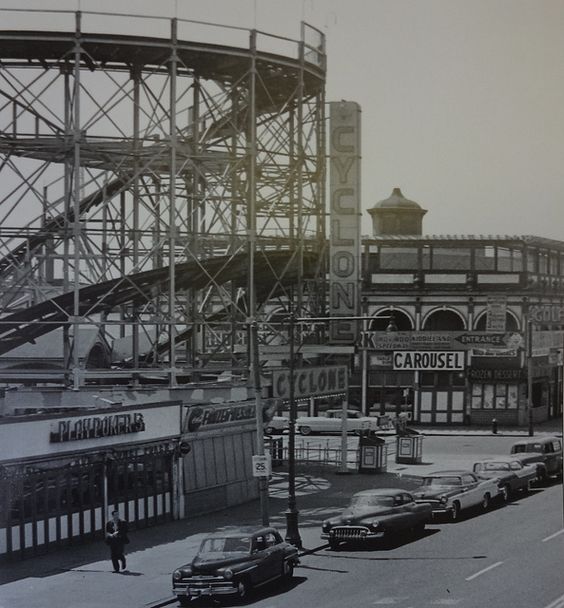
I spent most of my early childhood in Coney Island. I loved living in that special section in the New York City borough of Brooklyn, especially during the summer.
We did not have many of the conveniences that we have today. Rather than a refrigerator, we had an icebox. The iceman delivered ice every other day. We had a pan under the ice box. When we forgot to empty the pan, there would be a huge puddle on the floor. There were no supermarkets, just local grocers. Milk,which was not homogenized, was purchased from the grocer. It was stored in a large metal buckets and ladled out. As the ladle was often left out with the milk uncovered, flies and roaches swarmed around the bucket. Mice licked the ladle until they were chased away by the store’s resident cat. When we brought the milk home, the cream was on the top, and my mother would make whipped cream with a hand beater. I grew up before radios, washing machines, dryers, and dishwashers. Even toilet paper was yet to be invented. We used orange wrappers and pages from the Sears catalog.
I lived two blocks from the beach and the boardwalk. I loved to go swimming in the ocean and walking the boardwalk. We had two big amusement parks within walking distance, Luna Park and Steeplechase. I preferred Luna Park as it had a circus. It was such fun watching the clowns, the animals, and especially the men and women on the trapeze. Nearby was the famous Nathan’s hot dog stand, where we could buy a hot dog with sauerkraut for five cents.
As there were no televisions, we went to the movies every Saturday. For ten cents, we saw a double feature along with newsreels, a serial, and cartoons. We bought a penny’s worth of candy and enjoyed the entertainment. On rainy days, we stayed indoors, drawing pictures with crayons and reading books from the library. We did not have as many toys as our grandchildren and great grandchildren have today, so we improvised. My brother made a train out of drawers from my father’s Singer sewing machine.
As all little girls, I loved to play with dolls. My mother had bought me a small celluloid doll with moving arms and feet that I could even bathe. I wanted a new doll carriage, but we were in the midst of the Great Depression, and my parents could not afford to buy me one from the store. So, we became creative. A shoebox became my doll carriage. My mother made a hole at the end of the shoebox and put a string through it so I could pull the carriage. The top of the box became the hood. She also gave me scraps of material which I made into a pillow, a carriage cover, and clothing for my doll. With a child’s imagination, I thought that my doll and doll carriage were the most beautiful in the world.
It was convenient to live near the beach, but my neighborhood was not the best. It was all pavement—no flowers and no lawns. One summer, my second-grade teacher thought it would be a good summer project to learn how things grow. The last week of school, she had us bring in a small wooden cheese box and a small potato. She helped us put the dirt that she supplied into the bottom of the box. We cut up the potato, placed it in the dirt, and then covered the potato with more dirt. I placed the potato plant on the fire escape and watered it every day. In July, I was happy to see some green leaves. My parents and teacher had never told me that potatoes grow underground. So, when August arrived, I got so angry that no potatoes had grown on the leaves, I just dumped the plant. I was so surprised to find four little potatoes!
Looking back, I had a very happy childhood. Although we did not have much money, I never felt deprived!
Ever since I could remember, my mother, Frances Cohen, was the family story teller. Give her an opening, and she would regal any audience with stories of her grandparents’ and parents’ lives in Russia, of her early years of marriage to “My Bill,” of their life in small towns and smaller apartments in the North Country, and of raising four children, watching them leave for college and for marriage, and their returning with her grandchildren to visit her and my father in their beloved cottage on Lake Champlain.
For many years, these stories were always told orally. Mom shared them when the family got together around the old oak table in the dining room, when she visited friends, and when her children’s friends came to visit. What was fascinating was that no one ever got tired of hearing them. As a matter of fact, she was highly regarded as the family historian. If anyone needed to know who was related to whom and how my father’s side was related to my mother’s side and what really happened between those two cousins—well, you just had to ask Fradyl, and the truth would be known.
As my parents got older, my mother realized that she needed to record these stories. We never were one for video cameras and tapes, so she began writing them down on lined paper, usually from the six by eight notepads. . The writing was messy, with words misspelled and whole sections crossed out, but she began to put them down on paper.
My parents retired in 1981 and spent the next nineteen years living six months in Florida and six months on a cottage on Lake Champlain. As it became too difficult to maintain two homes, they sold their cottage to my brother and sister-in-law, and my parents lived in Florida permanently. When I went to visit, my mother would tell me the stories as I transcribed them onto paper. Unfortunately, these scraps of paper remained in their original state for several years.
In 2007, after a number of health setbacks, we children insisted that my parents sell their condo in Florida and move back up North to be closer to the family. Everyone decided that the best location would be close to Larry and me, and on May 1, 2007, they moved into Coburg Village, an independent living facility only four miles from our home.
Initially uncertain about leaving Florida, their friends, and their independence, my parents soon realized that this was an ideal living arrangement that provided nightly five-course dinners in a lovely dining room, a shuttle service that brought them to grocery stores and doctor’s appointments, live entertainment and numerous clubs.
Soon after moving in, my mother called me to tell me she was joining Coburg’s monthly writing group to polish all those stories she carried in her head and on those scraps of paper. The night after her first meeting, however, she phoned to tell me she wasn’t sure she would fit in. “Most of them have college educations and write beautifully, Marilyn,” she lamented. “They will look down on my family stories as being silly and boring.” However, when she brought her first story to the group, her accounting of why she and my father moved to Coburg, she was surprised to find that the group enjoyed her writing style. “They loved my story, Marilyn! They said I have a real flair for story telling!” After that, my mother’s voice in phone calls after the monthly Wednesday meetings was filled with pride.
Mom rarely had difficulty finding a topic and writing it down with paper in pen. However, the group leader requested that the stories be typed so they could be published in the semi-annual collection and distributed to Coburg resident. My mother asked me, “my daughter the English major,” to type them, and, while I was at it, to do some proofing and minor revisions so that they would read more smoothly.
Thus began our five-year collaboration. Every month, about a week before the group met, my mother would give me her hand-written story, and I would bring over the typed version by Sunday afternoon. If I didn’t have it done by Sunday night, the phone calls would begin. “Marilyn, if you don’t have the time, just bring back my copy and I’ll read it from the original.” I would assure her that it would be delivered in time for her meeting, even resorting to sending the final copy to her via the Coburg fax machine.
The oral stories evolved into written documents, always original, always entertaining. She wrote about the Old Country: how her mother’s mother died in childbirth and how the two children were raised at first by an uncaring stepmother and then by a loving women who raised them and the seven others that followed; how my father’s father escaped from Russia in a cart filled with hay; what it was like living in Regalia and Vilna at the turn of the century with the fear of pogroms always on the Jewish population’s mind. She wrote about her mother’s family coming to America: how her Uncle Sam saved enough money to bring over his sister Ethel; how Aunt Lil turned down a job at the Triangle Shirt Factory a month before the fire because she thought it looked unsafe; how Grandpa Joe left his future bride at the jeweler’s as collateral until he got a second opinion of the diamond ring they were purchasing. And she wrote about our family: how she and Bill met on a blind date; how they raised four children in various small towns in the North Country, and, and how they came to buy their cottage on Lake Champlain. The stories were funny, sad, and painful, but they were always ready the first Wednesday of every month for her meeting.
When my father passed away in November, 2008, my mother’s contribution for December was an open letter to my father. She wrote that she was moving into a smaller apartment down the hall, but “Wherever I go, you also go in spirit.” Grieving quietly, she continued with her life at Coburg, going to the concerts, visiting with friends and family who were always stopping by to see her, and continuing with her writing. All of the children asked her to write about our birth and early childhood, but she always postponed those stories, focusing on the Old Country, her childhood, her Bill.
On December 22, 2010, my mother had a heart attack. The doctors recommended Hospice and living her remaining time to the fullest. She complied, enjoying visits from the children, grandchildren, her cousins, and the many friends she had made in Coburg and Clifton Park. She kept writing, and in February, with my sister Laura and I sitting close by, she shared her story: “The Birth of My First Child,” in which she described her joy in having a beautiful little girl and her fears that she would not be able to be a good mother. The last words, written in pencil on the bottom, were “To be continued……” She died four weeks later, one day before the March meeting.
My parents were not wealthy people, and had little of material value: a wedding ring, two beautiful framed pictures of my father at thirteen and my mother at six, a few nice dishes. As my siblings and I sadly dismantled Mom’s apartment, my daughter was surprised that I wanted so little. “It’s ok, Julie,” I said, “We have her stories.”
And we do….Over one hundred typed pages as well as a file of her handwritten notes that she had kept over the years. What a gift to her family, her friends, and all who knew and loved this amazing woman!
Since the year that we met, my husband Larry and I have attended Rosh Hashanah—the Jewish New Year—services. We hear the shofar, listen to melodies that we only hear on the High Holy Days, and greet our friendswith L’Shana Tova—Have a good year!
Attending High Holy Day services as an adult is different from my experiences as a child growing up in Keeseville, a small upstate town of two thousand people about ninety minutes south of Montreal. My uncle Paul had opened Pearl’s, one of a chain of small department stores he had established in Vermont and Upstate New York. He hired my father to manage it. Although my parents had both grown up in New York City in Jewish neighborhoods, they had lived most of their married life in overwhelmingly Christian communities. In 1952, however, they found themselves in a town where they were the only Jewish family except for a childless couple, a lawyer and his wife. The next Jewish family didn’t move in until the mid-sixties.
To offset the effects of our non-Jewish environment, my parents immediately joined Congregation Beth Shalom, a Reform temple in Plattsburgh. We attended High Holy Day services and, depending on the weather conditions for the fifteen-mile drive, Shabbat services on Friday night. Saturday services were only held for the boys’ bar mitzvahs; all the girls were confirmed at age sixteen.
In addition to attending services, my parents were insistent on their children getting a Jewish education. For a span of twenty years, our father made the trip up Route 9 every Sunday with whatever number of his children between the ages of five to sixteen were taking religious school lessons. We would arrive in Plattsburgh a half hour early. Then Dad would take us to the newsstand across the street from the temple on Oak Street. He purchased the New York Times for himself and comic books for us, our perk for going to Sunday School. My brother Jay chose Superman; Laura and Bobbie, Archie and Richie Rich; and I, Classics Illustrated. Dad would then wait for us in his idling car —It got cold in that parking lot in the winter—reading the paper and smoking Kents. Over the years, all of us learned Jewish history, customs, and ethics. Jay learned Hebrew for his bar mitzvah. The three of us girls’ Hebrew education was limited to the six-word Shema and blessings over bread, candles and wine. When we got home from school, Mom would have an elaborate dinner waiting for us—brisket, roasted potatoes, candied carrots, pickles, and delicious spiced apples from a jar—another perk for our going to Sunday school.
As residents of Keeseville and members of a temple in Plattsburgh, we were caught between two worlds. As we did not live in Plattsburgh, we often viewed ourselves as outsiders at Temple Beth Israel. My mother, in particular, did not feel comfortable with many of the congregants. A daughter of poor Russian immigrants, she often felt inferior to those who were third or fourth generation German Jews who historically regarded themselves as more educated and refined than those from the shtetls—the small towns with large Jewish populations which existed in Central and Eastern Europe before the Holocaust.
The residents of Keeseville were generally welcoming to our family, and we rarely experienced anti-Semitism. There were moments, however, that are etched in my memory. My parents were usually included, but there were occasional “lost” invitations to events, and we knew some viewed us as different. On rare occasions, the insults were more direct. When I was around six years old, I was playing on my front lawn with my doll. A teenaged boy who lived up the street came by and, giving the Nazi goose salute, yelled “Heil Hitler!” I ran inside crying. Jay, four years older than I, ran out of the house to chase him down and punch him in the nose. When Jay was in high school, the local priest advised his young female parishioners that it was best not to date “Hebrews.” Obviously, this did not help Jay’s social life.
The High Holy Days emphasized this “otherness” even more strongly. We did not attend school on Rosh Hashanah and Yom Kippur. My father closed the store, an event worthy of coverage in the Essex County Republican. Jay, who played football for Keeseville Central, missed every game that fell on the two major fall holidays, again newsworthy enough to make the local paper.
Everyone in Keeseville knew that the Cohens celebrated their Jewish High Holy Days, but I was still sensitive to our being the only children missing school. One Rosh Hashanah, I was pushing my doll carriage in front of the house when I was overcome with embarrassment. What if someone saw me and wondered if I were playing hooky? I went inside to avoid the potential scrutiny and a visit from the truancy officer.
My feeling of “otherness” continued as the seasons changed. Beginning in November, I often had to explain that Chanukah was not the “Jewish Christmas,” and no, we didn’t have a Christmas tree or a Chanukah bush. As soon as we returned to school from the Thanksgiving break, the music classes I attended and, later, the choruses I joined in junior senior high, were filled with Christmas music. I could handle “Little Town of Bethlehem” and “Deck the Halls.” When it came to the line in “Silent Night” which stated “Christ the Savior is born,” however, I would just mouth the words. The token inclusion of the song “I Had a Little Dreidel” didn’t make me feel that the school was sensitive to my religion and culture
Other events brought their challenges. Passover often fell around Easter, and I watched my Christian friends devour bunny shaped chocolate eggs and jelly beans while I nibbled on my dry matzoh and butter. Once again, I felt different. In high school, my World History textbook reduced the Holocaust to the iconic 1943 picture from the Warsaw Ghetto of a German soldier pointing his machine gun at a little boy, clad in a coat with the yellow star, holding up his hands in terror. I can still remember looking down and crying silent tears while the teacher quietly and sympathetically moved on to the next topic. I understood clearly that the horror of the persecution of the Jews was diminished by this negligible treatment of the Holocaust in our textbook.
For many years, I saw other Jewish children mostly at Sunday School. As I got older, I joined a Jewish youth group and finally had Jewish friends. For the most part, however, our friends were our Christian classmates from Keeseville. We all dated in high school, but my parents pressed upon us their wish we would leave Keeseville after we graduated and make our lives in settings with more Jewish people.
In part because of my desire to be with other Jews, I enrolled in University of Albany in 1968. While at college, I attended High Holy Day services at Congregation Beth Emeth, but that was the extent of my Jewish participation until I met my future husband in 1973.
Larry and I attended High Holy Day services at Congregation Shaara TFille, the then-Orthodox shul—synagogue—in Saratoga to which his family belonged. What a dramatic difference for me! Men sat in the center pews, and the women, although not behind a mehitzah, (a curtain which separated the men from the women), sat in the back or on the sides. Most of the service was in Hebrew, and everyone prayed at what seemed to be lightning speed. Page numbers that were displayed on a chart on the bima provided my only means of following along with the prayer book. The services were much longer than those at Temple Beth Israel, and even the rabbis, with their black beards, payots (side curls), and yarmulkes (skull caps), were strange to me. In many ways, it was as foreign to me as the churches I had attended on occasion with my Christian friends.
After Larry and I were married, we bought a home in Clifton Park, a suburb of Albany, New York, in part because we knew that a synagogue had recently been built in the community. We joined in 1983, and we found that the Conservative service was a good compromise between Larry’s Orthodox shul and my Reform temple. Ten years later, I celebrated my own bat mitzvah on my father’s eightieth birthday, my way of honoring his commitment to our Jewish education.
Throughout my life, people assume that I, like many Jews, was brought up “downstate,” in New York City or Long Island. When I tell them about growing up in Keeseville, they comment, “That must have been hard!”
It had its challenges, but it also offered wonderful opportunities. I grew up in a loving, close knit family, developed lifelong friendships, and enjoyed the beauty of Lake Champlain and the Adirondacks. I proudly identify myself as an Upstate New Yorker, with roots still entwined in that tiny town an hour south of the Canadian border.
Because of my unique upbringing, rather than losing my Jewish identity, my faith grew stronger. I could never take being a Jew for granted. And having a faith I had to hold on so tightly to maintain makes each High Holy Day, each Jewish milestone, even sweeter.
A version of this story was published in The Jewish World, August 29, 2013. I am finally posting it on my blog eleven years later!
Marilyn and Larry Rosh Hashanah 1973 (Shh! We were engaged but didn’t tell anyone yet!)
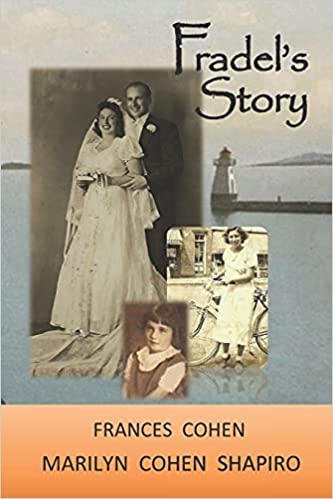
This story was written by my mother, Frances Cohen. A master storyteller, Mom joined a writing group when she was 87 years old. This is one of her many tales about her life captured in Fradel’s Story, available on Amazon in both Kindle and paperback format. Click here for the link. I have posted this on August 20, 2024, which would have been my parents’ 74th anniversary.
They say that all marriages are made in heaven. My parents also had help from my Grandma Vichna.
My mother Ethel was the oldest daughter of nine children, who all eventually immigrated to the United States from a small hamlet called Rogala, which was part of Lithuania.
Joining the wave of Jewish immigrants who came to the United States at that time, Ethel, only fourteen years old, arrived at Ellis Island in 1899. It was the era of horse and buggy. Garfield was president of the United States. It was quite an ordeal for a child to leave her parents, cross an ocean by steerage and then find a way to support herself. But with the help of her older brother Sam, who had come to America a few years earlier, Ethel settled in New York City, got a job, and lived with different relatives.
Two years after Ethel arrived in America, Ethel’s older brother Sam married and moved to Baltimore. My mother was really struggling, as she worked in a factory making umbrellas for only three dollars a week. So her brother and his wife invited her to come and live with them in Baltimore. While Ethel was living in Baltimore, four more of her siblings arrived in the United States.
In 1910, Ethel’s father passed away and the six children who had settled in the United States saved up $75 to pay for steerage for Grandma Vichna and the three youngest children. The four of them settled in the Lower East Side of Manhattan.
It was a very difficult time for Grandma. She was in a new country, not knowing the language or the customs. But Grandma was an amazing woman and kept her family afloat. And with all her problems, she was most worried that her Ethel was 27 years old and not married.
Every Sunday, all the friends from the Old Country would love to congregate at Grandma’s as she was an excellent cook. One day, a young man by the name of Joseph Cohen came to visit. He told Grandma that he had a job in a factory as a tailor making $13 a week, a good wage at that time, but was lonely and sleeping at his sister’s on a cot. Grandma said, “What you need is a wife, and I have just the girl for you….my Ethel!”
The problem was that Ethel was living in Baltimore, but that situation was soon solved when Joseph courted Ethel by writing letter and traveling the long way to visit. Ethel eventually returned to New York City to live with Grandma and be closer to Joseph.
And so the romance continued to blossom. Every Sunday, Joseph came to visit to see Ethel and to feast on Grandma’s cabbage soup and other goodies. Joseph bought Ethel a warm winter coat and other presents. (Later I would tease my mother that she was a kept woman!). After courting Ethel for several months, Joseph took Ethel to the jeweler and they picked out a diamond engagement ring. Wanting to make sure the price offered was fair, Joseph left Ethel for security so he could have the ring appraised, returned soon, and purchased the ring for $100.
Soon, Grandma Vichna was busy arranging a big wedding for her Ethel. In 1912, one could rent out a banquet hall for a big event. The host didn’t pay for the hall, but everyone who attended had to pay a 25-cent “hat check.” All the friends from the Old Country helped cook up a storm, and my parents were married in January 1912.
The week after my parents were married, my mother made a cabbage soup. My father said, “Ethel, please dot no make cabbage soup. I am tired of cabbage soup. I don’t even like cabbage soup!” My mother replied, “You always thanked my mother for her delicious soup.” My father replied, “It was the proper thing to do. I didn’t like the soup! It was my way of saying thank you for giving me a lovely bride!”
Ten months after the wedding, my brother Eli was born. I followed in 1917. My parents shared over fifty-four wonderful years together until my mother passed away in 1966 at the age of 82. Bereft, my father left New York City came North to live with my family until he joined his beloved Ethel in 1968.
A version of this article originally appeared in theJewish World News, a bi-weekly subscription-based newspaper in upstate New York.
Grandpa Joseph Cohen Circa 1912Ethel Ossovitz Cohen Circa 1912Grandma Ethel and Grandpa Joe ~1950. I love the love seen in my grandfather’s eyes.
As we have done since our Mountain Girl was born in 2015, Larry and I are enjoying time in Summit County, Colorado, where we rent each summer to escape the Florida heat and to enjoy family time.
Each summer, we look forward to attending performances of the National Repertory Orchestra. Eighty young professional musicians are selected for the summer symphony orchestra. Along with performances at the Riverwalk Center in Breckinridge, the talented performers participate in free “pop-up” concerts offered throughout the county. We have fortunately been been able attend several NRO events throughout our stay.
On July 8, 2023, Larry and I brought our then eight-year-old granddaughter to her first concert performance, the NRO’s pop concert. Rather than classical music, the pop concert includes lighter fare, including songs from Broadway and the silver screen. In the days before the event, we explained to her about the protocols for the concert: her need to sit quietly, to be attentive, to applaud at appropriate times, and to avoid any actions that would distract from other concert goers. Outside of asking if there would be a ‘half time’ (she and her father are huge Denver Nuggets fans), our Mountain Girl was well prepared. She even stood up and yelled “Bravo!” at the appropriate times.
The same could not be said for the eighty-something man that occupied the seat next to her. He and his younger companion settled in moments before the concert began. During the opening number, the rousing theme from the Raiders of the Lost Ark, the gentleman opened up a plastic shopping bag, rustled some smaller plastic bags, and took out a chunk of turkey. He gnawed on it through Raiders and continued through Jaws. By the third number, my beloved theme from Schindler’s List, the smell of turkey was wafting around us. During Star Wars, he added another noisy addition to his repertoire: a chocolate chip cookie. At least its delicious aroma masked the turkey.
I was not the only audience who was annoyed. The woman in front of me had turned around several times to give the evil eye to the offender. He was oblivious.
At “half time,” I complimented our granddaughter on her behavior and also quietly explained that the turkey- touting twit to her left was NOT a typical concert goer. As she and “Zayde” headed to the concession stand, the elderly gentleman and his companion also left for a break.
Leaning forward, I tapped the shoulder of the woman in front of me. “I noticed that you too were disturbed by that man’s behavior,” I said.
“I am the conductor for a Nevada high school orchestra,” she said. “I’ve never encountered such rudeness!” She headed off to find an usher so there was no repeat performance during the second half of the program.
While she was searching for help, the two gentlemen returned. I overheard the younger man’s commenting on his companion’s ill-timed dinner, especially calling out the fact that the smell of turkey had permeated our entire section.
“No worries!” he exclaimed. “During the second half, I brought these individual apple sauce containers with pop-off tops that won’t smell as much.”
At this point, I lost it. “No!” I yelled. “You are not going to take another bite! We brought our eight year old granddaughter to her first concert with rules as to what was expected of her. Your chomping away at turkey and cookies and rattling plastic bags has set a terrible example! No more food!”
Luckily the man actually listened. He didn’t pull out as much as a breath mint during the second half. We got to enjoy the themes from The Wizard of Oz,The Lion King, and The Godfather in peace. And we were able to fully enjoy selections from Fiddler on the Roof, especially when a clarinet solo by the conductor included he sounds of the shofar— Tikiah! T’Ruah! Shevarim— the section played by the illustrious Issac Stern in the movie version. of the JerryBock/Sheldon Harnock classic.
Later in the season, we took our granddaughter along with her parents to a performance of The Lion King. The Disney animated classic was shown in its entirety on the big screen above the orchestra as 80 musicians, lead by conductor Jason Seber, performed the score in precise timing with every scene.” Once you watch a movie accompanied by the power of a live orchestra, you’ll be spoiled for life,” wrote Shauna Farnell in an NRO article in July 2023. She was right. We loved it!
During intermission, I was talking to an usher and in passing mentioned I was enjoying this concert without the disturbance of any meals outside of what Simba and Nala were eating. The usher was fully aware of the July 8th kerfuffle, as she herself was monitoring the activity in Row H after the high school music teacher had complained.
Although she was unable to attend this year’s Pops concert, our Mountain Girl was she joined us for the NRO’s showing of Star Wars: The New Hope, again replete with the symphony lead by Jason Seber replacing the entire musical score. The Force was with us, as we enjoyed every minute.
Sources
Farnell, Shauna. “The National Repertory Orchestra presents Disney’s ‘The Lion King’ in Concert Live to Film.” www.nro.org website. July 23, 2023.