Category Archives: Jewish Interests

Veterans Day: A WWII Jewish Sacrifice Remembered

A body of an American solider lying peacefully in the snow in a battlefield in Belgium. A Jewish boy in Brooklyn orphaned twice by World War II. And the  world-renowned photographer who connected the two. This is their story.

Samuel Tannenbaum was born on July 10, 1942, in Washington DC to Henry and Bertha Fiedel Tannenbaum. Less than two years later, Henry was drafted into the United States Army,  Bertha and Sam moved to  Williamsburg section of Brooklyn to be closer to their families. After training at Fort Meade, Maryland, Henry was assigned to the 331st Infantry regiment, 883rd division and was shipped to England. His rifle platoon subsequently fought in battles in France and Luxembourg, which garnered Henry several medals.

Between December 16, 1944, and January 25, 1945, on the border of Belgium and Luxembourg, Allied and German troops were engaged in what would later be known as The Battle of the Bulge, one of World War II’s deadliest fights. On January 11, Tannenbaum and his division were ambushed by German soldiers. Only one person—Platoon Sergeant Harry Shoemaker—survived.

When Shoemaker escaped and returned to regimental headquarters, he told the sentry, Corporal Tony Vaccaro, the details of the massacre. Vacarro and Shoemaker returned to the site the next morning . The two stared at the horrible carnage.If the soldiers had survived,  the Germans had murdered the wounded and had stripped the corpses of their watches and other valuables. Then the Germans had rolled their tanks over the dead and dying, crushing them into grotesque, mangled shapes.

Only one figure looked peaceful and untouched by death. The prone body of a lone soldier lay face down, his boots, backpack, helmet and rifle showing through the white snow that blanketed him.  Vacarro pulled out his Argus C vintage camera and captured the scene. Afterwards, Vaccaro and Shoemaker cleared away the snow to discover the dead soldier was their army friend, Private Henry Tannenbaum.

Henry Tannenbaum was buried in Henri-Chapelle Cemetery in Belgium with plans to bring his body home. Bertha Tannenbaum. his widow, falsely believed that the transfer would adversely affect her four-year old-son Sam’s war orphan benefits. She was against reinterment. Henry’s family fought Bertha’s decision and won. Henry’s remains were returned to New York in 1946. The disagreement caused the widow’s estrangement from the Tannenbaums, isolation from her family and her growing mental deterioration. In her mind, Bertha believed that Henry was still alive and working secretly for the FBI. Sam’s childhood was filled with his mother’s shouting at the ghost of her husband, several psychotic episodes, and even an attempt to kill her son and then commit suicide. “The bullet that killed my father also destroyed my mother’s mind and ended my childhood,” said Sam.

With “my father dead and my mother crazy,” Samuel was forced at a young age to raise himself. He took care of household chores, did the shopping, and, through conniving, even paid the bills. When he was thirteen, he arranged for his own bar mitzvah, fortuitously connecting with his father’s family through a Hebrew school classmate. Upon graduating high school, he moved into his own apartment and, supporting himself with a war orphan scholarship and odd jobs, graduated  from Brooklyn College.

While Sam was in college, Bertha was evicted from her apartment and was committed to a state mental institution. The eviction resulted in the destruction of the family’s belonging, including all artifacts of Sam’s family’s history. Outside of his name and the date of his death, Sam knew nothing about his father. Sam married (Bertha didn’t come; she thought it was another FBI plot), had a daughter Lisa, and divorced. Bertha met and fell in love with Sam’s fiancee Rachel, promising her that Henry would return in time for the wedding.

Meanwhile, with the help of the extended family, Sam was putting together pieces of his father’s past. Henry was regarded as intelligent with a great sense of humor. He had graduated from the same grade school, high school, and college as his son. Henry worked for the Office of Price Administration and taught Sunday school at a local synagogue. Henry had an inherited bleeding disorder which probably caused  the private’s  quick and peaceful death in Belgium on that bitter cold January day and that unfortunate disorder was passed on to his son.

In 1986, three years after his mother died, Sam invited his father’s family to his daughter Lisa’s bat mitzvah. His first cousin, Henry’s niece, gave Sam a victory mail correspondence that identified Private Henry Tannenbaum’s regiment. Sam now had the tool he needed to further research his father’s military history.

In 1995, he and his wife Rachel journeyed to Seattle to attend the first meeting of the American World War II Orphan Network, (AWON), an organization composed of the Gold Star children and others classified by the Veterans Administration as War Orphans.

At a second  AWON meeting in Washington DC in 1996,  Sam met several people from Luxembourg who came for the express purpose to meet and thank the children of their liberators. Sam invited several to his home. One of the guests, Renee Sclhoesser, a journalist, published the Tannenbaum story in a series of articles in a Luxembourg newspaper. Another attendee, Jim Schiltz, was also impressed with Sam’s search. When he returned to Luxembourg, Schiltz found a book of photographs of World War Two and specifically, of the 331 Regiment in Luxembourg taken by the sentry Tony Vacarro.

The picture taken on battlefield in Ottre was not the only one Tony Vaccaro had taken.  Michaelantonio Celestino Onofrio Vaccaro had carried his  Argus C with him when he, along with thousands of other Allied soldiers, stormed the beaches at Normandy on D-Day. Tony —at first surreptitiously and then with his superiors’ approval—went on to take thousands of pictures of Allied campaigns in Normandy and Germany.

After the war, Tony stayed in Europe through 1949 to document post-war life in Europe. When he returned to the States, Tony became a photo journalist for Life and Look magazine, photographing famous figures including John F. Kennedy, Frank Lloyd Wright, and Sophie Loren.  Throughout his career,  “White Death: Photo Requiem for a Dead Soldier, Private Henry I. Tannenbaum” had circled the world through multiple exhibits and books and had become the iconic image of the Battle of the Bulge.

Schiltz also found out that Tony was alive and living in New York City. In 1997, the orphan and the photographer met for the first time. Tony gave Sam a professional print of the photograph.Tony’s greatest joy besides meeting Sam and his family was taking a picture of Henry’s grave in Mount Hebron Cemetery, New York City. For Tony, that picture brought him closure after more than fifty years.

In 2002, Sam and Rachel Tannenbaum and Tony Vaccaro flew to Europe as guests of the grateful citizens of Luxembourg and Belgium. The Tannenbaums met with the countries’ war orphans. They visited the Henri-Chapelle American Cemetery where Henry was originally buried.In Ottre, Belgium, Sam and Tony placed a wreath at the AWON monument, dedicated to “PVT Henry Irving Tannenbaum and other members of the 83rd Infantry Division.” For Sam, it was a “trip of a lifetime.”

Fifty-seven years after Tony first shot “White Death,” Sam Tannenbaum and Tony Vaccaro visited a beautiful tree-filled spot in Ottre, Belgium. The former battle field is now a Christmas tree farm called Salm Sapin in French. And in German? Thanks to at the famous German folk song now identified with Christmas, it would be associated by many with “O Tannenbaum.”

Sam’s home in Kissimmee, Florida, is filled with artifacts from his family’s history—pictures, books, his father’s medals, and a replica of the bracelet Henry was wearing before it was stolen by the German soldiers. “I may not have had the opportunity to tell my parents that I love them,” said Sam. “Through telling their story, I believe I am honoring them. And that, is, after all, what the Fifth Commandment tells us to do.”

Samuel Tannenbaum next to his signed picture of “White Death,” photographed and signed by Tony Vacarro. Use of picture courtesy of Tony Vacarro/Tony Vacarro Archives.

Originally published in Capital Region, New York’s Jewish World, November 9, 2017.

Sources:

DeStafano, Anthony M.  newsday.com. June 7, 2017. https://www.newsday.com/news/new-york/at-94-tony-vaccaro-looks-back-at-his-brutal-images-of-wwii-1.13710291?view=print

“Finding Hope in the Depths of War.”  Before It’s News. June 28, 2011. http://beforeitsnews.com/international/2011/06/finding-hope-in-the-depths-of-war-photos-757981.html

Henry Irving Tannenbaum’s Story. http://www.indianamilitary.org/83RD/UnUsedItems/Henry%20I%20Tannenbaum%20story.txt

Mix, Ann Bennett. Lost in the Victory: Reflections of American War Orphans of World War II. University of North Texas Press.

Hadler, Susan Johnson and Ann Bennett Mix. Lost in the Victory: Reflections of American War Orphans of World War II.

http://www.awon.org/awfather.shtml

“Pvt. Henry I. Tannenbaum and 83rd Infantry Division Memorial.” American War Memorials Overseas. http://www.uswarmemorials.org/html/monument_details.php?SiteID=503&MemID=770

Roberts, Sam. “Viewing World War II Through a Soldier’s Camera Lens”. New York Times. March 4, 2013. https://cityroom.blogs.nytimes.com/2013/03/04/viewing-world-war-ii-through-a-soldiers-camera-lens/

Tannenbaum, Samuel. Interview. Sunday, October 29, 2017. Kissimmee, Florida.

Under Fire: The Untold Story of Pfc Tony Vaccaro. HBO http://tonyvaccarofilm.com

awtannen

Lost and Found: A Torah crown and family return to community


IMG_1715

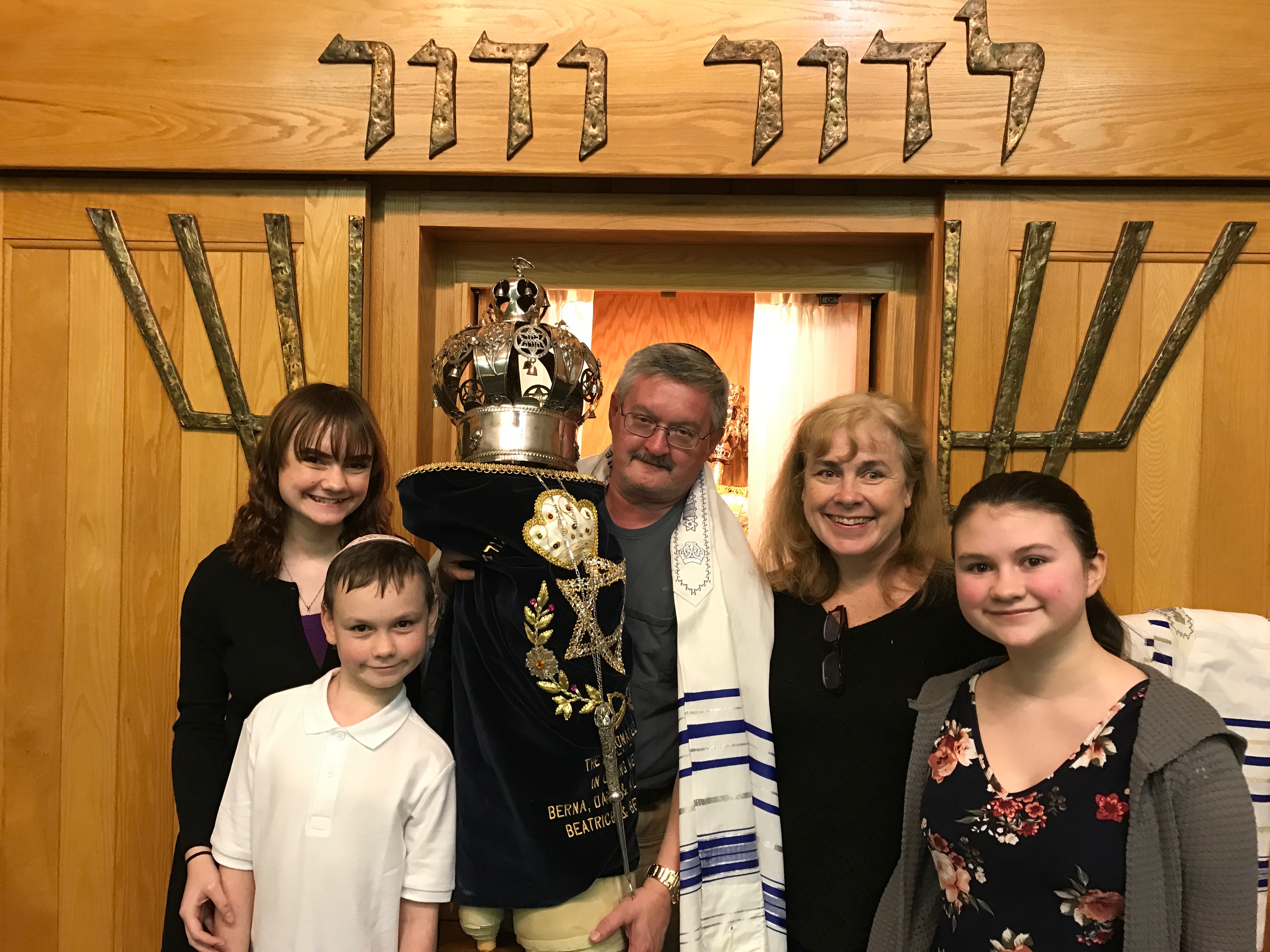
A proper home: The Gutensohn family (L to R) Gabriel, Karen, Peter, Kelly, and Liza.

“That doesn’t belong here.”

Peter Gutensohn stared at the large tarnished sterling silver piece almost hidden in a dusty corner of Lanier’s Historic Downtown Marketplace.

Peter had come in to the antiques mall in Kissimmee, Florida, on an early spring day in 2016 to look for a silver serving platter for his wife Kelly. He was a frequent visitor, often successful in his search for a specific old, beautiful object. And sometimes he bought interesting items “just because.” A few years earlier, Peter had found a Kiddish cup and a prayer book. Kelly had polished up the sterling silver goblet to use at their weekly Shabbat dinners. Their son Gabriel, who was six years old,  had confiscated the prayer book, refusing to let any of his siblings see the treasure he kept next to his bed.

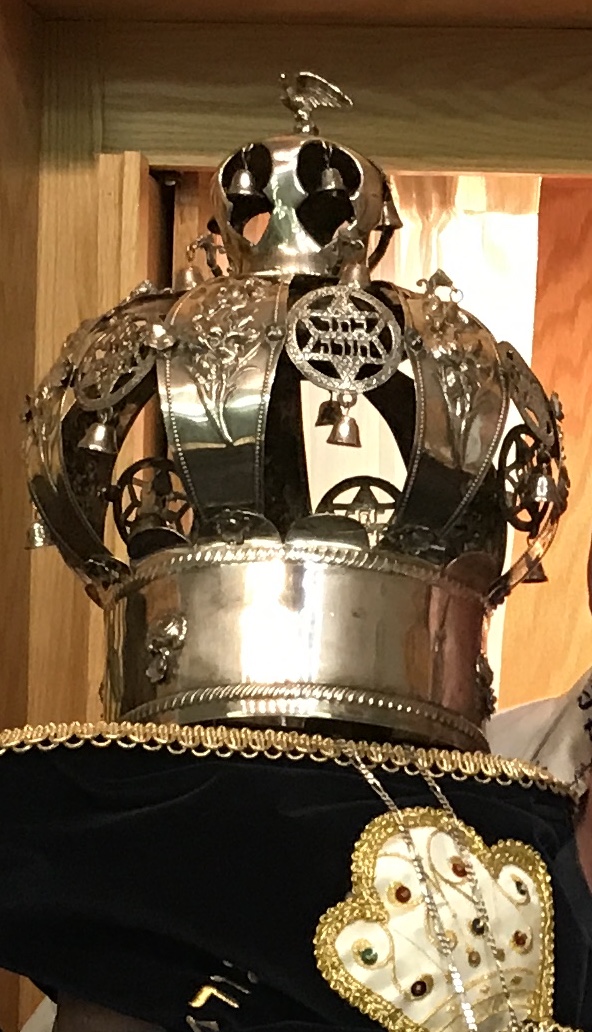
Unlike the previous Judaica he had purchased at Laniers, however, Peter had a differenT intent for that day’s find. Despite its sad appearance, Peter knew that he was looking at a Torah crown, an object made to cover, protect, and honor a Torah scroll, the sacred parchments on which the first five books of the Tanakh are meticulously inscribed.

Peter asked how such an object landed up in an antique store in Kissimee. The owners told Peter that the Torah crown was one of many objects stuffed into an abandoned storage locker. The identity of the original owner was unknown. Forgotten? Left behind? Abandoned as the monthly fees for the space in the storage facility had become unaffordable?

No matter. After the management of the storage facility had made a good faith effort to find the renter without success, the unit was put up for auction and purchased by Laniers. The Torah crown, one of many objects in the unit, had sat in a corner of the store for months, gathering tarnish and dust, until it had caught Peter’s eye.

Peter felt  a sense of loss that such a piece of Judaica sat unclaimed, unused, unappreciated, He purchased the crown—along with a silver tray for Kelly—and brought them to their home in St.Cloud.

A tragedy early in their marriage had led them to reclaiming their Jewish roots that had been lost over the previous three generations. Peter’s Jewish great-grandfather had married a Catholic and assimilated. Kelly’s great grandparents had changed their names to hide their Jewishness. Peter had memories of conversations with his grandfather about Jewish food, and music; Kelly had early memories of lighting Shabbat candles with neighbors who were observant Jews. Otherwise, neither Peter nor his Kelly were raised with any religious affiliations or traditions.

Peter and Kelly had much in common. They both were one of four children with similar birth years. Both of their fathers were career diplomats, jobs that took their families around the world. Kelly and Peter first met when they were fifteen and seventeen respectively outside the library at their high school in Bangkok, Thailand, where both of their “embassy families” were stationed. Subsequently, their fathers were assigned to Seoul, Korea, where Peter and Kelly both attended college.

After their graduations, Peter joined the Marines and Kelly married an Army officer. Five years and two children later, Kelly was divorced. She and Peter reconnected while both their families were living in Washington, D.C..They were married in 1989.

In 1990, while Peter was in Kuwait for the first Gulf War, their first child together was born. Tragically, Joel died when he was three months old of what was first diagnosed as Sudden Infant Death Syndrome. Authorities later determined that Joel and two other local children had succumbed to lead poisoning linked to lead in the pipes of their municipal water supply.

Devastated by their son’s death, Kelly and Peter began a search for answers—and faith. “We were looking for something we could give our children,” said Kelly. “We wanted something bigger than ourselves, something we had not had.” They explored different denominations, questioning chaplains, pastors, priests, and rabbis in hopes of finding a spiritual connection.

Kelly’s best friend, who was Jewish, knew of the Gutensohn’s quest.  She invited Kelly to a

Friday night service at her synagogue. “The first time I went, it felt like coming home,” said Kelly,” like the piece of me that was lost had been found.”

Soon after, Kelly prepared her first Shabbat dinner for Peter and her two children, complete with blessings over the candles, the wine, and the challah and a traditional meal.. As the family grew with the birth of eight more children, Kelly learned more about Judaism, its traditions, its holidays. She taught herself and her children Hebrew. The family observed the Jewish holidays.

The family attended conservative synagogues, but they were not comfortable with the strong focus on tradition and the literal interpretation of scripture. While Peter was stationed in Virginia with the Marines, however, they were involved with a group of fellow Jews who met in each other’s homes for Shabbat and the Jewish holidays. And they celebrated Shabbat every Friday, including the Friday before Peter came home with Torah crown from Laniers.

Moved by the  by crown’s hidden beauty and its mysterious past, Kelly and two of their daughters began the process of polishing and restoring the intricate metalwork to its full shine. Family obligations filled their lives, however, and the still tarnished crown was hidden away in one of their closets for several months. Finally, in January 2017, the Gutensohns began in earnest to find a “proper home” for the Torah crown.

Their original intent was to donate it to the Holocaust Memorial and Education Center in Orlando. On further consideration, the family decided that the crown belonged not in an archive but part of a living, active congregation.

The Gutensohns had  attended services at Congregation Shalom Aleichem on Pleasant Hill Road in Kissimmee. Remembering the shul’s warm, inclusive atmosphere, Peter contacted Rabbi Karen Allen, who assured them that his family’s generous donation would be not only accepted but also valued and cherished.

On a Friday night in May 2017, just before services were to begin, Peter walked into Congregation Shalom Aleichem carrying the huge crown on his shoulders. Two weeks later, Peter brought Kelly and three of their children—Liza, Karen, and Gabriel—to services. Harry Lowenstein, a Holocaust survivor and one of the founding members of the shul, had brought the crown home to shine it to its full glory and had placed it on the synagogue’s Holocaust Torah. The crown now has a home.

On Yom Kippur, with Kelly and three of their children watching, Peter was given the honor of holding the Holocaust Torah during Kol Nidre. They are now active members of the synagogue, attending services, sharing the break-the-fast, helping to build the Sukkah. Their fifteen-year-old daughter Karen will be participating in Birthright Israel this December.

“This beautiful artifact has brought them back more deeply—individually and as a family—to their Jewish roots and identity,” said Rabbi Allen.

“Every Friday night when I light the Shabbat candles, I think about my grandparents and great grandparents,” said Kelly. “They thought that religion was a small thing to sacrifice  Looking back over the past 150 years, I see my family members with no anchor, no roots, and no identity. They gave up more than they could ever know.”

Jewish World, October


fullsizeoutput_2e06

The Torah crown restored to its full beauty.


Profile of a mensch that I know

harry_lowenstein_category

Harry Lowenstein speaking about his Holocaust experiences.

This year, for the first time in sixty years, Harry Lowenstein will be celebrating Rosh Hashanah without his beloved wife Carol. It will be a bittersweet occasion, only a few short weeks after what would have been their sixtieth anniversary. But Harry is a survivor—as well as a mensch—a person with integrity and honor.

Harry Lowenstein was born in Fuerstrau, Germany, in 1931, the younger of two children. When he was seven years old, Harry was expelled from school for being a Jew. In 1940, he and twenty members of his family were deported to the Riga ghetto in Latvia. The train carrying approximately one thousandJews left Bilefeld, Germany, on the first night of Chanukah. Someone had brought candles on the crowded compartment and started singing Ma’oz Tzur, Rock of Ages. Soon the entire train joined in. That last sweet memory sustained Harry for the next six years.

In the ghetto, his entire family was crowded into a two-room apartment. A year and a half later, the family was sent to the concentration camp of Riga-Kaiserwald, where the men and women were separated. “Return home after this is over to find us,” his mother begged before she said goodbye.

One day, Harry found a piece of bread outside a building and brought it to his father to share. “Where did you find this?” his father asked. When Harry told him, his father said, “You just took that bread away from someone who is as hungry as you were. Give it back and apologize.” When Harry returned, his father slapped him on the face. “I still can feel that slap,” said Harry. “What a lesson in ethics he gave me!”

Soon after, Harry’s father fell ill and was sent back to the ghetto, which was liquidated in November 1943. Harry never saw his father again. While in Riga-Kaiserwald, Harry remembers the constant fear of being chosen for the gas chamber and the ongoing, intentionally cruel actions by Nazi guards. When Harry stole a piece of bread from a kitchen, Nazi prison guards stood him outside in the freezing cold and blasted a water hose down his shirt. “I thought to myself, ‘I will somehow survive,” said Harry. “You learned to live minute to minute—not even hour by hour— to make sure the next day comes.”

In the fall of 1944, as the Russian front drew close, the Nazis tried to avoid the Allied forces. Harry, along with thousands of other Jewish prisoners, were shipped by boat to Danzig and then by barge to the Stuthoff concentration camp in Poland. On March 9, 1945, the camp was liberated by the Red Army. He and other survivors were brought to a makeshift hospital. For six weeks, he and fellow survivors were fed a diet of oatmeal to help them regain their strength. The next day—and freedom—had come.

Remembering his mother’s instructions from years earlier, the 14-year-old returned to Fuerstenau to reunite with his family. His trip was in vain. He was the sole survivor.

As the High Holy Days approached that fall, Harry visited a fellow survivor, and a group of them went to services in a makeshift shul. A Polish Jewish officer serving in the British army asked Harry if he had had his bar mitzvah. When Harry said no, the Polish officer said, “Then you will be bar mitzvah today, on the first day of Rosh Hashanah, the beginning of the rest of your life.”

After spending the next four years in children’s homes in Hamburg and Paris, Lowenstein emigrated to the United States in March 1949. He stayed in the Bronx with an aunt and uncle who had emigrated to the United States in 1928. He worked in a butcher shop during the day and attended school at night, trying to build on two years of schooling he had before the war.

In 1952, after serving two years in the army, Harry moved to Florida, where he got a job working in his uncle’s clothing shop. “Selling a pair of pants or some shoes was easier than hauling sixty pounds of frozen ‘trief.’” said Harry. He hung up his butcher’s apron for good.

On February 14, 1957, Harry went on a blind date with Carol Sainker, the daughter of another butcher. After only six weeks of long distance dating (they lived four hours apart), he proposed. They were married on August 18, 1957.

Harry and Carol lived in England during the 1960s, and then moved back to Florida in the 1970s with their three children, Berna, David, and Karen. In 1974, Harry and Carol took over Goolds, clothing store in Kissimmee, that had previously been run by another uncle, Luther Goold. Carol and he ran the business for thirty years, expanding the building from 1600 to 6000 square feet. As the only department store in town, it sold what everyone wore in Central Florida—jeans, cowboy shirts, and boots.

The Lowenstein’s attended Congregation Shalom Aleichem, which had met since its founding in 1981 at the Kissimmee Women’s Club.The Lowensteins began to press for a building of their own. “I saw a synagogue burn,” said Harry, “and I was determined to build another one.” Starting with a $120,000 contributions from Sandor Salmagne, another Holocaust survivor, the  Lowenstein’s—through their own and others’ contributions — raised another $60,000 for building expenses.

Once Congregation Shalom Aleichem opened, the Lowenstein continued to work tirelessly to obtain a Torah, the prayer books for both every day and holy days, the Torah rimonim (filials),  and the Yartzheit (memorial) board, most coming from their own pockets. Carol served as treasurer for over thirty years, and Harry held “every position on the board,” except president. “My language skills were not up to my standards,” explained Harry.

Rabbi Karen Allen, Congregation Shalom Aleichem’s spiritual leader, expressed her admiration for the extraordinary and exemplary hospitality that characterized the Lowensteins at home as well as in their role as congregation leaders  ” It was my privilege to be their guest on many Friday nights after services, and I will always be grateful for the kindness and generosity of their elegant graciousness,” said Rabbi Allen.”It is easy to understand how such caring and sensitive people could have created a successful business that for so many years contributed greatly to the growth of our community.”

Their daughter Karen remembered her parents as “the most loving couple” with an old school work ethic that they instilled in their children:“Be honest, put in 110%, be truthful, and remember that being on time was being late.” Karen has especially fond memories of the High Holy Days. “My mom would spend weeks cooking. On the night of the dinner, the table was set with our best china, silverware, and crystal, with flowers gracing the center.”

Unfortunately, Carol faced major health problems throughout most her life. She experienced her first heart attack at thirty-eight, and that began years of cardiac issues.  “Each time she was hospitalized,” recalled Karen, “we thought it was the end. We were blessed to have her for so long.” Carol died peacefully on February 10, 2017, at the age of eighty-one.

Despite his grief, Harry remains intensely committed to the Congregation Shalom Aleichem, its building and its spiritual aspects. He quietly continues his tzedakah—his charity—to many others.

As he has done for many years, he gives frequent talks about his Holocaust experiences to local synagogues, schools, and other public venues. Video accounts of his first person narrative are on file in both The Holocaust Memorial Resource and Education Center of Florida in Orlando and Stephen Spielberg’s the University of Southern California Survivors of the Shoah Visual History Foundation.

Harry shows no bitterness about his experiences in World War II. “The Nazis couldn’t take away from me who I am in my heart.” said Harry. “They could not change me. I was and still am a Jew.”

And most importantly, Harry is a mensch. I know many people who share this sentiment: May you live for many more High Holy days in which you make your life—and Carol’s memory—a blessing.

Mazel Tov! Six Couples Celebrate Fifty Years of Marriage!

Four of the happy couples: Goldbergs, Grossman’s, Plass, and Secans

What does The Jewish World have in common with the following six couples? All are celebrating their Fiftieth Anniversary!

Susie and Ed Goldberg met each other at a dance at The Laurels, a resort in the Catskills. Susie, who had just turned seventeen, came back to the room that she was sharing with a girlfriend and found several young men sprawled out asleep in the beds and couch of her hotel room. She called security to have them all thrown out. The story of the “Good Girl with Chutzpah” quickly spread through the guest grapevine. Ed was impressed “if I ever go steady again, I want my girlfriend to be just like you,” he said,and then asked for her number.

After casually dating for eighteen months, the two started “going steady” once Ed was drafted into the army. When he got his orders to go to Vietnam, Ed proposed. Despite parental pressure to wait until he returned, Susie and Ed chose to have a small wedding at Temple Israel in New Rochelle, New York, a month before Ed shipped out. Fifty years later, Sue and Ed agree that many factors that constitute a great marriage:  love, communication, empathy, patience, compromise, quality time with family, with friends, and especially with each other.

“Bubbemeises”—tales from a Jewish grandmother— brought Hedy and Harvey Flechner together. They were just sixteen and seventeen when they started dating as freshmen at CUNY City University of New York. The first time she met him, Hedy’s grandmother said he was an incarnation of  her own late husband, Frank. “I’ve dreamed about this day,” she told Hedy. “He’s the man you’re going to marry. Just finish your college degree first.”

On their one month anniversary, Harvey gave Hedy a red rose, a tradition he continues every month to this day. “When he was too poor to buy a rose, he’d steal one from a neighbor’s garden,” said Hedy. Six hundred and fifty roses later, they attribute their long marriage to carefully picking their battles and following Hedy’s beloved grandmother’s advice. “Never go to bed angry,” she told the young couple. “It will take away the fun of being in bed together!” Smart woman, that bubbe!

A grandmother also had a hand in the Plass’s marriage. While spending her summer on Far Rockaway on Long Island, Mickey was introduced by her girlfriend to “the cute boy who works at the penny arcade.”  After their first date, Grandma Spitz told the soon-to-be college freshman  to finish her teaching degree before marrying Richard. “I told her I barely knew him,” Mickey recalled, “but she insisted he was The One.” They were married—the summer after Mickey graduated college The Plass’ advice: Don’t marry anyone with expectations to  change them. “Why would you want to change someone you really love?” Mickey asked rhetorically.

Chris and Bernie Grossman met at a dance at Grinnell College at the beginning of her freshman year. Bernie, a junior,  was about to ask another girl to dance when Chris “got in the way.”  They dated while at college. As they both were from the Chicago area, they continued their relationship during school breaks and even after Bernie graduated. They got engaged during the summer after her junior year. Chris took Jewish conversion classes through her senior year, and  they were married the following summer after her graduation.  Chris and Bernie follow the advice that Chris’ parents’ offered at their fiftieth anniversary: “The secret of a long marriage is to always keep in mind that the little things that annoy you about your spouse are not that important in the grand scheme of things.”

The Secans met on a blind date. Phyllis’s sister-in-law and Joel’s sister, who were friends, gave Joel Phyllis’ number. Five months later, he finally made the call and invited Phyllis to lunch at Nathan’s in Oceanside, Long Island. They had such a good time that lunch was followed by a movie,dinner, and a commitment for a date on Monday night. By Tuesday morning, Phyllis knew that this was “the love of her life.” Ever since that first night, Phyllis and Joel have built on their immediate mutual attraction by anticipating each other’s needs staying “up” when the other was “down,” and, most importantly, finding ways to keep the romance going. “Having a date night is a must,” Phyllis said.

Betty and Steve Schoenberg were fixed up by their fathers, who knew each other through their jobs with the United States Postal Service. “Eighteen year old” Steve (he was really twenty-one) asked sixteen-year-old Betty to join him on a boat ride on the Hudson River. At first regarded as passing summer romance, Betty and Steve continued to date that fall. “It was hard to say we didn’t like each other when our own parents had set us up,” recalled Betty. They got married after Betty’s sophomore year at NYU. “A good marriage takes a great deal of patience, said Betty,” and a good sense of humor—a VERY good sense of humor.

Six couples. Six decades of marriage times five. Eleven children and twenty-one grandchildren later, all have no regrets. Phyllis Secan summed up all the couple’s life-long romances in her outlook on the future: “Our marriage just keeps getting better and better.” Congratulations to happy couples and The Jewish World on their Fiftieth Anniversary. May you all go from strength to strength.

From Pizza Boy to Pizza Rabbi

My husband Larry and I missed the Pizza Boy’s bris.

Diane Silverman, the future Pizza Boy’s mom, and I met in 1977. The two of us, along with several new members, sat together at a event sponsored by Clifton Park Hadassah. Within a year, all the women around the table were expecting. Our son Adam was born in April; the Silverman’s daughter Erica came one month later. By the time the eight children were walking, the Hadassah Baby Boom mothers formed a weekly playgroup, one of us baby sat while the other moms got a break.

“Three years apart” must have been the Hadassah mantra, because six of us delivered our second child in 1981.Diane and Mark’s son arrived on March 11. Eight days later, while Todd Harris Silverman was ongoing his rite of passage into Judaism, I was having a planned caesarian-section. Obviously, Larry and I couldn’t be at their simcha. Therefore, Diane and Mark announced the birth of our daughter Julie Rose—to the large group of mutual friends.

As did our two older children, Julie and Todd grew up together. They were in the same playgroup (Hadassah Baby Boom Two), and the same nursery school class. When I went back to work, Diane watched Julie before school. It was Diane who put Julie, along with Todd, on the bus the first day of school as I was teaching my first class.

Julie and Todd were close—maybe too close! At the end of first grade, their teacher recommended the two friends be in separate classes as “Julie was leading Todd around by the nose.”

Todd was a frequent guest at our house, and he loved his pizza. Larry nicknamed him “Pizza Boy,” a moniker that stuck with him for a long time.

By this time, both of our families had joined Congregation Beth Shalom, and we parents shared responsibilities for the children’s religious school carpools.We even were each other’s helping families at their bar/bat mitzvahs.

Early in his religious education, Todd felt the strength and pull of his Jewish roots. Growing up in kosher home, Todd lived in a family that actively participated in Judaism through holidays, simchayots, and synagogue membership. Additionally, he felt surrounded by fellow Jews. “You might be hard pressed to find another kid in Upstate New York who felt like the majority of his family’s friends were Jewish,” Todd said. He realized at a young age that being “a part and parcel of the Jewish community” was important to him.

After his bar mitzvah, Todd joined Temple Gates of Heaven’s North American Federation of Temple Youth’s (NFTY) chapter. He attended summer camp for three of his four high school years at Kutz Camp, the Reform Movement’s youth leadership academy.In 1997, Todd participated in a five-week NFTY-sponsored trip to Israel. He came back bronze-skinned, twenty-five pounds lighter and his eyes opened to Israel.

His religious faith was tested in college. As a theater major at State University of New York at Oswego, Todd found few opportunities for participation in Judaism. Furthermore, the death of three people close to him—an accident, an illness, a suicide—made him seriously question what direction his life would go.

In his last year of college, help came from his NFTY connections. Todd reconnected with a fellow camper from the Kutz Camp, who invited Todd to be on staff at a summer camp in Malibu, California.

Immediately after completing bachelor’s degree in theater, Todd  headed to the West Coast. After the summer camp experience, he found a job as an elementary school teacher at Brawerman Elementary School in West Los Angeles. His experience at the Jewish day school helped confirm his the lifelong belief  that he needed to serve the Jewish people. As Todd admitted, his vision was a “romanticized version of spiritual leader, pastoral guide, educator, and keeper of the stories and traditions.”

In 2011, Todd enrolled in the Hebrew Union College-Jewish Institute of Religion. As part of his seminary training, he  lived for eleven  months in Israel, learning the language, the customs, and the politics of the Middle East. He returned to Los Angeles, where he spent another five years immersed in history, liturgy, counseling education, pedagogical instruction — everything a series of internships and student pulpits could provide.  

Upon his ordination in 2015,Todd learned of a rabbinical position opening in New Orleans, Louisiana.  His initial reaction: “There are Jews in New Orleans?”  Through the interviewing process, however, Todd learned that the Touro Synagogue, one of the oldest Jewish congregations outside the original thirteen  colonies, had a large and active membership. He felt an instant connection to both the shul and the city.

In July, 2015, he accepted  the position as assistant rabbi and  rabbinic director of lifelong learning. Along with life-cycle events and liturgical duties, Todd oversees the synagogue’s  religious school and Hebrew program and youth group activities.

Todd also continues to teach classes, including courses in .Pirkei Avot and rabbinic literature (Midrash, Mishna and Talmud). One of his favorite duties is teaching each semester a four-part  cooking class called,“In the Kitchen With Rabbi Silverman.”  Session topics have included recipes for challah, Jewish soups, Chanukah latkes and sufganiyot  (donuts); and a Middle Eastern dish of eggs poached in a cumin-infused sauce of tomatoes, chili peppers, and onions. “I love shuksuka almost as I love pizza,” said Todd

“I preach and I teach and I learn and I walk to work when it’s not 100 degrees with 110% humidity,” said Todd. “And I love every second of it.”

March 11 is Rabbi Todd Harris Silverman’s thirty-sixth birthday, That evening, he  will celebrate the holiday of Purim. He will  help lead a service, join.his fellow congregants as they twirl their groggers, and eat the traditional cookie, hamantashen. Our former Pizza Boy has grown up to become the Pizza Rabbi. I, for one, can not be prouder of him!!

The Holiday Card: Connecting with Others and Sharing Our Love

The holidays are over. The greeting cards we find in our mailbox are slowing down to a dribble.Yet,  I totally understand if they arrive even mid-January. I’ve had numerous years where good intentions to get all my cards signed, sealed and delivered before the first night of Chanukah or before Christmas Eve have failed.

We were fortunate to receive many lovely holiday cards from across the country throughout the past month.  Most were simple but attractive ones from Hallmark or American Greetings. The two handmade cards, beautifully crafted pieces of art, will get saved in my memory box to enjoy again and again. Many greetings were in the form of photo cards: a picture of my great niece and nephew with their labradoodle,; a three-generation photo from a childhood friend; a picture of two friends, Santa, and their “children”-two rescue dogs.

BRINGING US CLOSER

I especially appreciated cards that included a holiday newsletter that recapped the senders’ year and shared what their family had been up to in 2016.  Reading about relatives, friends, and their loved ones, especially those that live far away from us, brought us closer together despite the miles between us.

Happily, this year, we did not receive any form of the ‘Dreaded Holiday Letter.’ You know the kind I mean. Happy Holidays! We just bought a little present for ourselves. The red Ferrari is parked in the four-car garage next to the Lexus, the Maserati, and the Tesla.  Of course we have to find the time to drive it  as we will be working around our upcoming trip to the French Riviera and our two month cruise to South America on our yacht. 

EDITS BY FAMILY

Embarrassingly, I may have been guilty of putting a little too much enthusiasm in past holiday letters. The Shapiro Year in Review was contained in a single-spaced letter with a border of dreydels or menorahs. Before I mailed it out, I would ask Larry, my husband,  and our children, Adam and Julie, to review it. Being much more private people than me, they would eliminate many of what I considered news-worthy items. “Too much information!” they would comment. The edited letters were shorter and considerably less, well, Pollyannaish.

Last year, I decided I wanted to go the photo card route. I created my masterpiece in a very short time at the Walgreens kiosk with three pictures representing our  year. One showed  Larry and me posing with Phineas and Ferb at Disney World. Another was a picture of Julie, her husband Sam, and their month-old daughter Sylvie Rose in their backyard. The third was a picture of Uncle Adam holding Sylvie.

I didn’t get them started by Chanukah, which started in early December, so I aimed for December 24. And then New Year’s. And then Martin Luther King’s Birthday. By the end of January, I purchased cute little heart stickers to add to the photo with the intention of mailing them out by Valentine’s Day. By April, I ruled out Easter egg stickers, and the ten plague stickersI found on the internet seemed a little depressing.

Sylvie was now nine months old and looked nothing like the infant in the pictures. The photo cards went into the trash, and the odd-sized envelopes are being used to pay bills that require a check and a stamp.

A NEW IDEA

Friends in England introduced us to the Jacquie Lawson website, and since then we have sent out its beautiful animated greeting cards for all occasions—birthdays, anniversaries, get well wishes, the winter holidays— to family members and friends.

I wasn’t going to repeat the photo card disaster. This year, Larry and I decided to send e-cards for the holidays. The Chanukah card, choreographed to Chanukah Oh  Chanukah, showed a lovely tree transformed into a brightly lit menorah. Our non-Jewish friends received a card set to a medley of Christmas songs that showed a sleigh making its way through a picture-perfect English village and surrounding countryside.

WELL RECEIVED

The first night of Chanukah fell on Christmas Eve, so it gave us more time to get them ready to send out. Of course we procrastinated until December 24th. Larry worked from his computer in the office getting out the Christmas cards while I worked from my laptop in the kitchen sending out Chanukah wishes to all our Jewish friends. By the time we left for the Chanukah party at our synagogue that evening, we had sent over one hundred cards with short personal notes to friends and family across the country and world.

I was a little concerned that the recipients would not bother to open them or, if they did, they would be bored with the ninety seconds of animation. We were therefore happy to receive thank you notes back from most the recipients within hours—sometimes minutes—after we clicked the send button. The e-cards were a success!

Recently, I saw the following quote in a friend’s kitchen: “Though time and miles may separate us, we have built a bridge of lovely memories to span the distance.” No matter how we share our good wishes for the holidays, and no matter when those good wishes arrive,  they all are sent and received with love and happiness.

Shapiro family creates Star Wars tradition

img_2075

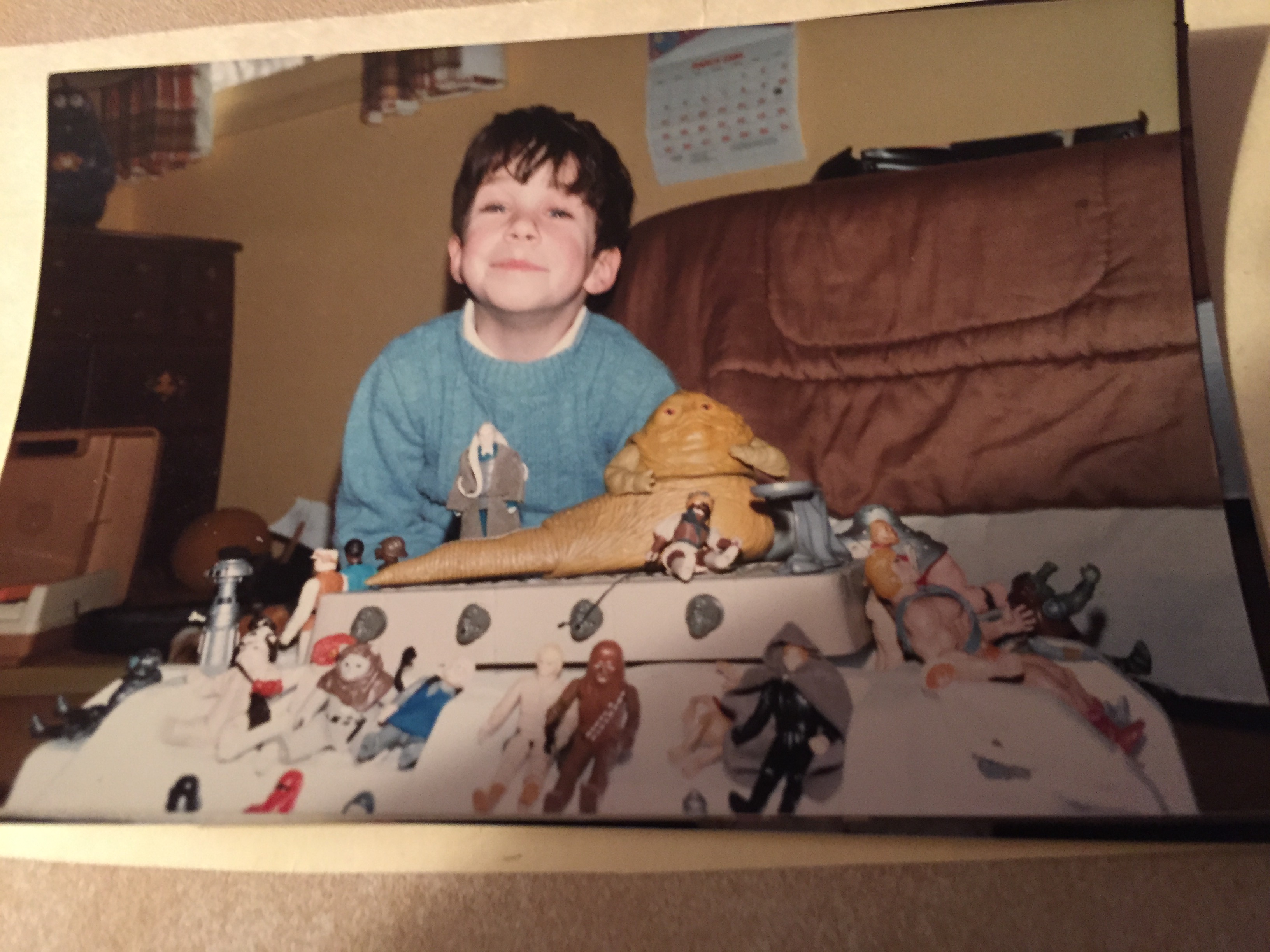
Adam with his Star Wars action figures

img_1215

Timmy Harris as a Stormtrooper

During the eight days of Chanukah, in between candle lighting and latkes, my husband Larry and I will celebrate a Shapiro tradition: We will go to see the newest Star Wars film.We have been fans since Adam caught the Star Wars bug from a future storm trooper.

How It Began

In September 1979, I began substitute teaching two to three days a week at our local high school. We left Adam in the care of a wonderful baby sitter, Sandy Harris, who lived just down the street.

Adam was seventeen months old and just beginning to talk. His vocabulary consisted of a few words—mamma, dadda, apple dus.

Less than a month later, however, Adam shocked us by announcing at the dinner table, “I know Star Wars.”

“You know Star Wars?” Larry asked, astonished.

“Yes,” said Adam. “Luke Skywalker. Han Solo. Princess Leia. Chewbacca…”

And Adam continued to prattle on, clearly stating the names of  numerous characters from the Star Wars movies.

It didn’t take us long to figure out where Adam had picked up his expanded vocabulary. Sandy’s twelve-year-old son Timmy had been enthralled with George Lucas’ blockbuster since the first Star Wars was released in 1977. Kenner Toys had the license to make the related toys, and Timmy had collected them all. He set the little action figures and their spaceships on shelves in his  room, recreating scenes from the first movie and its sequel, The Empire Strikes Back. When he came home from school, Timmy would entertain his mother’s charge by allowing him to play with his collection. Adam was hooked.

Tales, Toys Capture Imagination

That Chanukah, Larry and I purchased several action figures and a Millennium Falcon for Adam.  He got more for his second birthday and the following Chanukah.  Although he had yet to see the movie, his interest and ability to recreate scenes using his collection and other toys as props—blocks, Legos, even a blanket on top of other toys—improved.

In April 1981, Larry and I planned a surprise for Adam for his third birthday. While I stayed home with his one-month-old sister, Larry took Adam to see a re-release of the original Star Wars film. This was Adam’s first movie, and he had no idea why he and his father were sharing a  box of popcorn in a huge room filled with chairs.  The minute the music started  and the opening credits rolled, however, Adam knew exactly what was happening. Our three-year-old was transfixed for the entire length of the film.

“Yours Eyes Can Deceive You. Don’t Trust Them”

Over the next few years, Adam watched and re-watched the first two movies and, in 1983, The Return of the Jedi. As the franchise expanded, Adam’s collection expanded—sometimes with his help.

When he was around four years old, Adam asked us if he could get a new Luke Skywalker as the light saber was missing. We refused, saying he could use a toothpick or a prop from one of the other characters. A few days later, Adam brought us a headless Luke.

“It fell off,” he explained. “Can I get a new one?”

So we replaced Luke, only to have Adam bring us a headless Storm Trooper, one of the white armored minions of the evil Empire, a few days later. When the head of bounty hunter Boba Fett also went missing, we realized that Adam was biting the heads off to get us to purchase a complete toy. His gig was up.

Adam’s passion for Star Wars continued until he was nine years old, when his interest in science fiction expanded to Star Trek and Tolkien’s Lord of the Rings Trilogy. The action figures and a couple of space ships were relegated to a box in the closet. By the time the series was revived in 1999, Adam was in college. On his visits home, he would occasionally open up the box, reminisce, and put them back on the shelf.

Once you start down the dark path….

In January 2015, Larry and I came back from a trip to Florida to sub-zero temperatures, twelve inches of snow on the front yard, and a broken mailbox, the victim of the town snowplow. A day after a call into town hall, a  Clifton Park truck was parked at the end of the driveway. I opened the door, to be greeted by no other than Timmy Harris, whom I had not seen in at least twenty years.

“I’m here to fix your mailbox, Mrs. Shapiro,” Timmy said. “But first I have to ask you a question. My mother has told me for years that because of me, Adam’s first words were the names of Star Wars action figures. Is that true?”

I assured him it was and recounted the story of that night over thirty-five years ago when Adam’s vocabulary increased exponentially.

“Are you still a Star Wars fan?” I asked Timmy.

“Absolutely!” Timmy responded. “ I have a two bedroom house, with one room devoted to forty years of Star Wars collectibles. My favorite pieces are still the Kenner toys from the late 70’s.”

Not only is Timmy still a fan, but also he is part of the 501st Legion, “Vader’s Fist,” an international costuming group that “troops” as the bad guy characters from Star Wars. Along with other members, Timmy dresses up as both as a Storm Trooper, and as Boba Fett.

The 501st’s main function is as a charity organization. In 2015 alone $587,000 was donated on its behalf to various children’s charities including Make-A-Wish Foundation, Ronald McDonald houses, and local pediatric hospitals. The “bad guys doing good” are also found at science fiction and comic book conventions and new Star Wars film openings.

Star Wars costuming is gratifying on a few levels.” Timmy later shared with me “I get to contribute to something worthwhile. And as a 49 year old man who dresses up as a plastic spaceman, I get to be a 9-year-old again. That’s worth all of the time, sweat and armor pinches that we go though.”

When Larry and I moved to Florida in June 2015, Adam requested we send him very little from the house—two Adirondack photographs and a Monet print, his yearbooks, and the Star Wars action figures. And like his parents, he too will be watching Star Wars: Rogue One over his holiday break.

Happy Hanukah, and may the force be with you!

My Friend Marc


marc

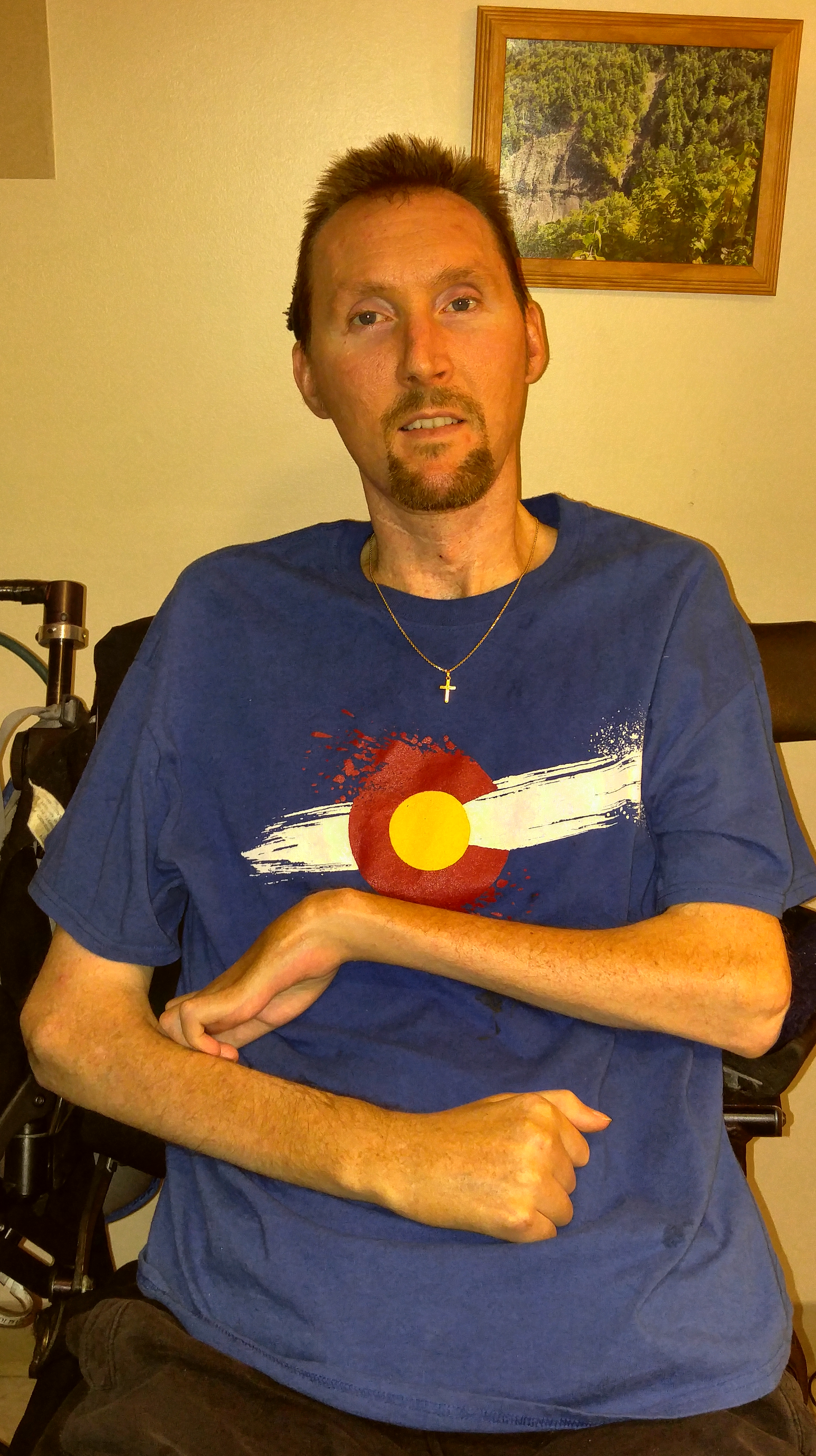
He was easy to spot. In a room full of frail, elderly people, Marc and his motorized wheelchair loomed large. His six foot four-inch thin frame rested on the chair, his head on the headrest, and his face inches away from the straw-like device that, through his breathing, powered him around the Daughters of Sarah, a nursing home in Albany, New York. 

I had come to Daughters that afternoon to visit Rose, a 99-year old friend. But she had decided to attend a lecture, and I was waiting for her in the community room. So I used my free time to strike up a conversation with the young man, a rarity among the ancient. I found out that he had lived at Daughters for eight years, he was  thirty-four years old, and he maneuvered his chair around the building chatting with young staff members for companionship—the only people in the facility close to his age. I asked him if I could visit him every week before my time with Rose, and he said, “Sure!”

Maybe because he was just two months older than my son Adam. Maybe because he is just a genuinely nice person. No matter, we just clicked. Over the next few weeks, I learned more about his situation. He had become a quadriplegic in a freak motorcycle accident when he was 16—yes, he was wearing a helmet! “Since the accident,” Marc told me later, “I really feel I haven’t had much choice in anything in life other than give up or carry on.”

His parents have been there for him since they got the life-changing  phone call that their son had been in a terrible accident. “It was my strong-willed father who especially pushed me to improve my situation,” Marc said. “He posted a sign on my computer that read, ‘What can I do today to make myself more independent?’

For the first ten years, Marc had lived with his parents in their home near Sacadaga Lake. Finding good home health care to meet his needs became more problematic, and he and the family decided that Daughters was a better option for him. 

Marc never exhibited any bitterness about his situation, and he rarely complained even when he was uncomfortable from his kidney stones or he struggled with breathing. He loved his family and Westerns and fishing and stock car racing. I picked up 101 Things You Should Know About NASCAR from the library and studied the book so I could talk intelligently with him about the sport. To my husband Larry’s amusement, I even started following the results in the newspaper and caught some of the races on the television.

Marc also liked McDonalds, so I often stopped on my way to the nursing home in one the franchise’s restaurant a mile from Daughters. The bag of burger and fries left a tantalizing trail of non-kosher, or what Jews know as ‘treif’—aromas down the hallway. It took a few times for us to find a rhythm as I fed him: two bites of the Big Mac, two fries, and two sips of soda. Repeat. He loved chocolate, so I usually brought him brownies or chocolate chip cookies, which he saved for later.

Marc owned a fully equipped handicap accessible van, which was kept in the nursing home parking lot. It took me a while to get the courage to take him for outings. One beautiful fall day, however, I asked Marc if he wanted to go for a ride. “Sure!” he said with a huge smile. He guided me through the process of opening up the back door, pushing him up the ramp, pulling his chair back to compensate for his height, and locking the mechanism in place. 

We drove up the Northway and across the Twin Bridges. We got an ice cream cone at the Country Drive-In and then sat in a small park near the Mohawk River. The autumn foliage was at its peak, and the sky was a brilliant blue. We had a little scare when the battery light on his van went on. But I managed to deliver him and his vehicle safely back to Daughters.

Over the next three years, I visited Marc on a regular basis, even after Rose passed away. Weather permitting, we would take a field trip—a Chinese restaurant, Five Guys, Wal-Mart, a local mall. Our excursions taught me much about what Marc endures. Adults watched us furtively as I fed him wonton soup; children gawked and asked their parents loud questions as the two of us browsed an aisle in the Christmas Tree Shop. When we stopped in a hair salon, the beautician first directed her questions to me until I said emphatically, “Marc is perfectly capable of telling you how he wants his hair cut.”

There were many weeks I could not visit Marc—Larry and I  were traveling, either Marc or I  was sick, or bad weather prevented me from driving the sixteen miles down the Northway. But no matter, I treasured each of those visits with him. 

When Larry and I decided to relocate to Florida, telling Marc about our impending move was one of the hardest conversations I had during that transition. Visits from other friends and family were—to me—too few and far between, and Daughters’ staff could not drive Marc in his van due to liability issues. 

As Larry and I packed up our house, we needed to find a home for four photo collages that we had created from our trips. We brought them to Marc, and he had them hung up on the wall next to his family pictures and a digital photo album we had gotten him the previous Christmas.

On the last visit before we left, Marc and I decided to keep in touch through e-mails. I also promised him that I would mail him a postcard every Monday. On my last visit, I gave him a hug and cried as I made my way across the parking lot past his big blue van to my car. 

When Larry and I came back the Albany for Thanksgiving five months later, our second stop with our rental car was Daughters. The first was a stop at Panera Bread for a brownie to bring to Marc. “We were in the neighborhood and thought you could use some chocolate,” I said, as we surprised him in his room. On the wall were the photo collages and all the the postcards that I had sent him from Florida and Colorado and California.

Marc continues to reside in Daughters of Sarah. He has had a couple of surgeries and more than a few health scares. His postcard collection grows, some I purchased during our travels and some given to me by friends and members of our community’s travel club.

In February, Marc celebrated his thirty-ninth birthday. He continues to carry on, to remain positive.

“I have some bad days when I am in pain or can’t breathe,” Marc told me. “But every day I get up and put a smile on my face. I try to make the best out of each day because I believe that someone always has it worse than I do.”

And every day, I am grateful that Marc is my friend.

Colorado Jewish High

img_5359

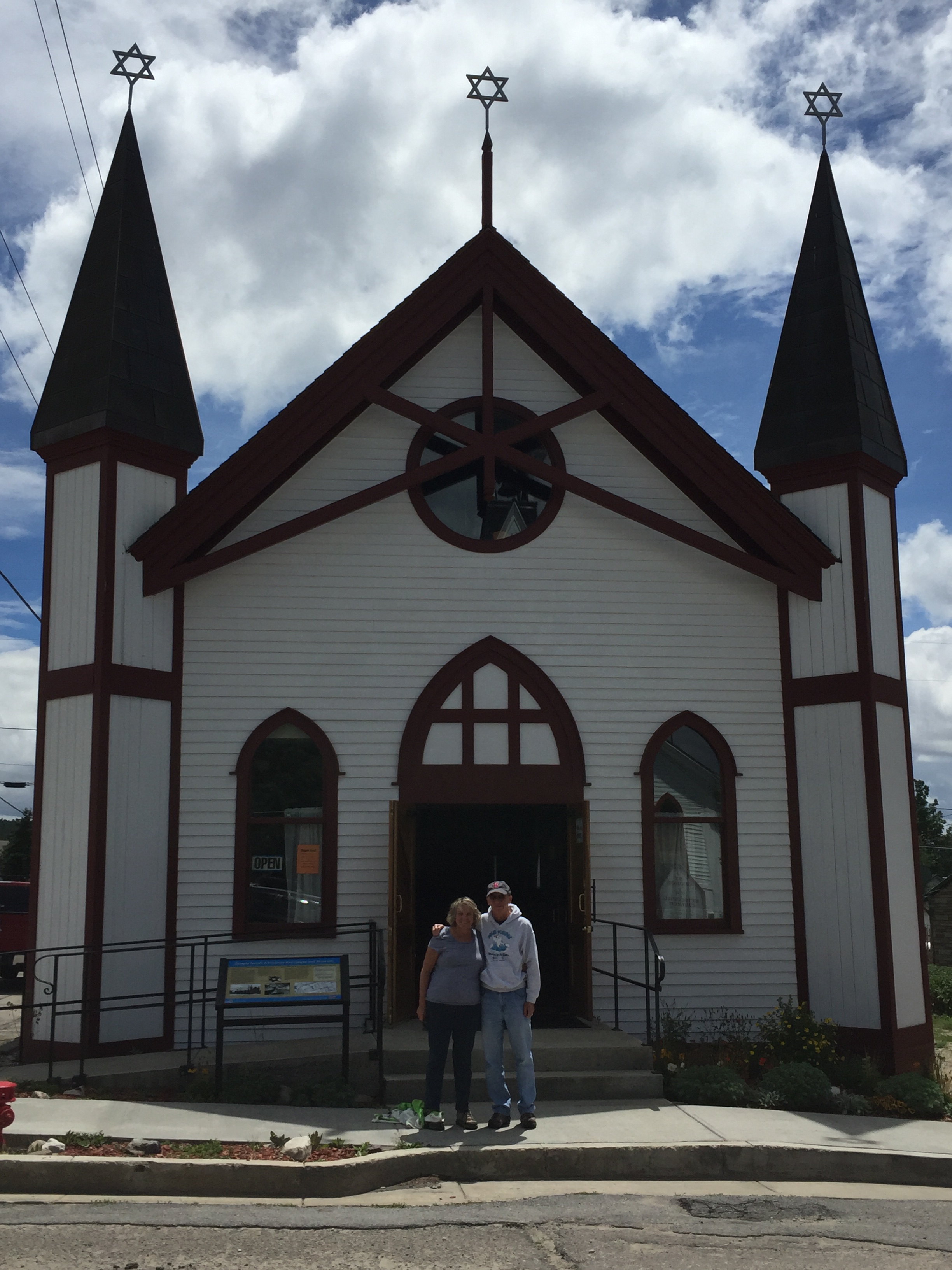
Larry and I pose outside the synagogue, now a museum in Leadville, Colorado

Rocky Mountain High: The Synagogue at 10,200 feet

While in Colorado for the summer, my husband Larry and I visited the town of Leadville, Colorado, during its Boom Day Festival, a celebration of the Old West. Gunslingers, burro races, mining skill contests, and over 100 food and craft booths filled the streets. We got ice cream cones and wandered down West Fourth Street, past a mining skills contest, where brawny men and women competed to see how many pounds of rock one could pile into a truck. And just down the street, we found the Temple Israel Foundation, a museum dedicated to a thriving Jewish community that existed in this Rocky Mountain city over one hundred and twenty years ago and the former site of a thriving synagogue.

Perched at 10,200 feet above sea level, Leadville is the highest incorporated city and the second highest incorporated municipality in the United States. It boomed in the late 1870s with the discovery of silver, resulting in an influx of migrants to this small mountain town. At its peak, the population of Leadville grew to approximately 30,000 residents.

Among the many groups of people attracted to the minefields in the high Rockies was a group of recent Jewish immigrants who migrated to the West and Colorado. Representing only 1% of Leadville’s population, the three to four hundred Jews came to Leadville for the same reasons as their non-Jewish counterparts: to improve their social and economic status, to find adventure, even to reinvent themselves. In 1879, the local opera house hosted Rosh Hashanah services, and in 1880, the Hebrew Benevolent Society purchased a cemetery for Leadville’s Jewish community. Soon after, the Jewish community built a synagogue and held its first service on September 19, 1884, the first day of Rosh Hashanah 5645.

For the next thirty-eight years, Temple Israel served a surprisingly large and active Jewish community. As a booming mining town, Leadville’s residents had amble opportunities to spend their earning on clothing and household goods, liquor, sex, and gambling. Leadville Jews provided services including dry goods stores, wholesale liquor and tobacco businesses, saloons, gambling houses, opera houses, and even brothels.

More well-known members of Temple Israel included two German immigrants, David May, the founder of May department stores; and Leopold H. Guldman, philanthropist and founder of Denver’s Golden Eagle Dry Goods Company. Benjamin Guggenheim, a first generation American and heir to the famous family’s fortune made in Colorado mines, was better known for his chivalry and death aboard the ill-fated Titanic. 

Despite its remote location, Leadville was a modern industrial city. Jewish dry goods merchants offered the latest European fashions to the ladies. The better off gentlemen often sported diamond studs to accent their wardrobe.

By the first decade of the twentieth century, the boom was over, and the town’s Jewish population declined. In 1912, the last recorded event, a wedding, took place.

From 1914 through 1937, the synagogue sat shuttered and unused. The synagogue was converted into a single family residence, and the building took on several other non-religious functions, the last as four rental apartments.

In 1983, Bill Korn, a New York City native, relocated from Boulder to Leadville to take advantage of low real estate prices and proximity to great skiing. He purchased and was in the process of renovating several properties when he learned of the former synagogue and its overgrown cemetery. Motivated by his own German Reform Judaism roots and his belief in Martin Buber’s command, “If not you then who? If not now then when?” he explored ways to obtain both properties.

In 1987, the Temple Israel Foundation was incorporated “to acquire, historically rehabilitate, and maintain” the building. Korn purchased the synagogue in 1992.

For the next several years, Korn used the four apartment rental incomes to pay off the mortgage. The Foundation obtained a grant from the Colorado Historic Fund. Finally, ninety years after the temple shut its doors, renovations to bring the building to its former glory began. The Denver chapter of B’nai Brith led volunteer efforts each June to maintain the cemetery grounds and replace markers. In 2001, the cemetery was reconsecrated, allowing Jewish burials to resume. In 2012, a permanent exhibition opened that documents pioneer Jewish life with a collection of artifacts about Leadville, its resident Jews, Temple Israel as a synagogue, and life in a mining town in the 1880s and 1890s.

While not providing regular services, the building, with its Torah and bima, is now open for special events. Today, there are, according to Korn, approximately 80 to 100 Jewish people in the entire county. Bill Korn oversees the museum, and from May through October, two full-time staff members work as both guides and researchers.

Over 3200 people visit the museum each year, said Korn. They come not only from surrounding Colorado towns but also from all over the United States and even Israel. Korn said his most special guest was the granddaughter of Leopold H. Guldman, whose emotional response to the museum brought tears to Korn’s eyes.

Larry and I celebrate Rosh Hashanah each year in Kissimmee, Florida, elevation 49 feet above sea level. During the High Holy Days, however, we pass to reflect on the lovely synagogue in the highest incorporated city in America. We will think about Bill Korn and his generous efforts to bring Temple Israel to life for future generations. And we think about the long-ago Jewish congregation in Leadville celebrating Jewish life high in the Rocky Mountains.

Originally published September 29, 2016. Updated May 26, 2025.

Oregon Holocaust Memorial

What Makes Us the Same? Trip to Shoah Museum Inspires Writer to Find Commonality

oregon-holocaust-memorial

On a recent visit to Portland, Oregon, Larry and I visited the Holocaust Memorial. A pathway strewn with bronze sculptures of unfinished lives—a violin, a teddy bear, a torn prayer book, —brought us to a curved wall. Two columns were engraved with the brief history of the events that led to Hitler’s rise and its unfathomable consequences on Europe and the world. Plaques etched with memories from survivors are placed on a wall representing barbed wire. One read “As I looked back, my mother turned her face to avoid mine and my little sister gave me a frail and knowing wave;” another, “The fear has never left me.”On the back of wall were carved the names of family members of Oregonians who were lost in the Shoah. Below the names was the following statement:

Our precious life rests not on our ability to see what makes us different, one from another, but rather on our ability to recognize what makes us the same. What ultimately defines us is the moral strength to believe in our common humanity, and to act on this belief.

These words struck me especially hard on that beautiful June afternoon. Larry and I had flown out of Florida just days after the Orlando Pulse tragedy. As I stood in front of the memorial, I was overwhelmed with grief for all those lost in the Shoah.  I also thought of those innocent lives lost to another madman who could only focus on differences and destroy so many lives with another act of senseless violence.  I began to reflect on my own live  and question as to whether I had done enough to focus on “what makes us the same.”

As a child, I knew I was different from most of the people in our small upstate New York town. Along with one other family, we were eleven Jews in a Christian town, an overwhelming .5% of the population. There were a few anti-Semitic instances: A teenage boy yelling “Heil Hitler!” and giving me the Nazi salute as the six-year-old me played innocently on my front yard; “lost” invitations to parties by those my parents tagged as anti-Semites; whispered jokes about my Jewish nose that went unnoticed by my teachers. For the most part, however, the people Keeseville embraced us, shared their Christmas trimming with us; came over for matzoh brie around our formica covered kitchen table. We focused on what we have in common.

Although exposed to diversity on our family’s visits to New York City , as a student at University at Albany, and through—as always— countries and cultures explored through reading, my everyday encounters rarely took me far from my white, Judeo-Christian environment. This changed, however,  when I took a teaching position with the Capital District Educational Opportunity Center

The EOC, a  division of Hudson Valley Community College, offers tuition-free academic and workforce development opportunities to disadvantaged and educationally under-prepared New York State residents sixteen years and older. Through my interactions with staff and students, I learned to appreciate many different cultures and backgrounds and their personal struggles. A Muslim pharmacist,  after being imprisoned in her native country for giving medicine to a Christian, disguised herself as a Bedouin to flee to Egypt then to Albany. A young man had escaped with his family as one of the Vietnamese boat people. Both completed our GED and College Preparation Program and  then graduated from Hudson Valley Community College. One of my fellow instructors had overcome a troubled background in Schenectady’s inner city to graduate from the cosmetology program, open his own salon, and then come back to the EOC to instruct hundreds of cosmetology students in the technical and life skills to succeed in his chosen field.  I may have taught my students essay writing and grammar and study skills, but the people I encountered at the EOC taught me about courage and dignity and overcoming incredible obstacles. Our differences were secondary to our common goal of creating a better life for ourselves and our families. We all believed in our common humanity and acted on those beliefs. Even when I moved out of the classroom and into an administrative position, my greatest joy was meeting with students, having them share their stories with me, and promote the EOC through its many different success stories.

In the past few weeks, our country has experienced numerous tragedies that resulted from actions by those who failed to believe in the common humanity. Orlando, Florida. St. Paul, Minnesota. Baton Rouge, Louisiana, Dallas,Texas. The list of cities where incidents of senseless violence continues to grow.

“There may be times when we are powerless to prevent injustice,” wrote the late Elie Wiesel, “but there must never be a time when we fail to protest.” My protests may not take me to the streets, but it will take me to the written word, where I hope I can make a difference.

But maybe, it must start with children. When we lived in Clifton Park, our next door neighbors were an interracial couple—he a Caucasian from Massachusetts and she a Whitney Houston look-alike from Jamaica. We shared our yards and our lives with them and their four children who had inherited their mother’s brown eyes, mocha skin, and curly hair. One day, Julie and Katie, who were the same age, were shopping for matching lockets.  When we brought the jewelry up to the counter, Julie, my blue eyed, blonde haired daughter, announced to the sales clerk, “I know we look like twin sisters. We’re not. We’re just best friends.”

Best friends. Or just friends or neighbors or fellow citizens. Whatever it takes, let us all strive to recognize what makes us the same, to prevent injustice, to repair the world. Tikkun Olam. Amen.

Originally published July 22, 2016. Revised April 2025. 

Photo of Oregon Holocaust Memorial courtesy of Wikimedia Commons.