Category Archives: Parenting

Exercising My Options

IMG_2159

Here I am hiking the Stone Bench Trail, Williamstown MA. Note I am NOT wearing my Fitbit cuz I lost it at the movies the night before this picture was taken.. It has been recovered and will be on my wrist again soon!Growing up in Upstate New York in the 1950s, I never thought much about exercise. I walked to and from school every day, swam in Lake Champlain in the summer, and biked leisurely through the apple orchards outside of town. A couple of my close friends played on a girl’s intramural softball team. With  my hand-eye coordination, I wisely sat on the bench and watched. And gym class? All I remember were those ugly red bloomers we were forced to wear while hurling ourselves over the saddle horses or jumping on a trampoline while our classmates “protected us” by standing along the sides. (I bet that exercise is not part of any gym class in this century!)


Growing up in upstate New York in the 1950s, I never thought much about exercise. I walked to and from school every day, swam in Lake Champlain in the summer, and biked leisurely through the apple orchards outside of town. A couple of my close friends played on a girl’s intramural softball team. With my hand-eye coordination, I wisely sat on the bench and watched. And gym class? All I remember were those ugly red bloomers we were forced to wear while hurling ourselves over the saddle horses or jumping on a trampoline while our classmates “protected us” by standing along the sides. (I bet that exercise is not part of any gym class in this century!)

It was not until I married Larry that I actually began to incorporate regular exercise into my daily routine. Larry was a high school runner. Once he began working for New York State, he met with a group everyday at lunch to do a loop around the State Campus. Although I had no interest in pounding the pavement, his interest in keeping fit encouraged me to do something every day: a bike ride, a walk; video work-outs with Jane Fonda, Charlene Prickett, and Step Reebok.

Over the years, we expanded our exercise options. Around 1990, we purchased our first of several road bikes on which we racked thousands of miles riding throughout Saratoga and Albany country. While living in Clifton Park, we faithfully rode the stationary bike that was in our family room, albeit with two different mindsets.  Larry was intense and focused, pushing the limits of the resistance and rotation settings. I, on the other hand, viewed it as a great way to get to watch movies or reruns of The Big Bang Theory while getting in my mileage. To be honest, I tried to bike when he wasn’t home to avoid his encouraging me to “go faster.” If he did walk into the room, I sped up and started gasping for air. That usually placated him enough to convince him I was working out. Once he left the room, I slowed down and got back to my show.

We also took advantage of the Pacific Fitness trainer that we had set up in our basement in 1996. Larry used it three times a week barring injury or travel. Even though I knew weight training is important for post-menopausal women, I used it in fits and stops, making excuses. After all, I reasoned, I am not interested in winning a Mrs. Universe contest! When I joined the YMCA a few years before we moved. I decided at that point that Zumba and kickboxing classes were enough for toning. For the most part, however, we certainly got our money’s worth out of most of our fitness purchases.

Not to say we haven’t had a couple of misses. The most obvious failure was my purchase of two hula hoop. One was the classic 1950s plastic design. The other, at the suggestion of my Weight Watcher’s instructor, was a super deluxe weighted model. No matter how hard I tried, I never got beyond one rotation on either hoop. Larry, however, was a natural, and he showed off his incredible hip action several times before I gave both hoops to our six-year-old great-niece. She, like Larry, was a natural.

Larry and I had different approaches to keeping track of our exercise. Larry has always used pre-measured running routes and the cyclometer on his bike. For ten years I used a clunky pedometer that attached to my waist band to track my daily steps, especially on long trips where we do a great deal of hiking. I once had to retrieve it when I left it on the plane after a six-hour cross-country flight. The flight attendant’s wry comment? “Bet you didn’t rack up many steps flying over the Great Plains.”

A few years ago, I was given a Fitbit Zip, a compact step/mile tracking device that clipped to my bra. When synched with my iPhone, it gave me progress updates on my 10,000 step-a-day goal. One day, I was in my kitchen when my phone dinged. “Congratulations! You have reached your goal of 10,000 steps!” read the banner. My initial thrill of accomplishment was quickly squelched when I realized I wasn’t even wearing my Fitbit. I had “reached my goal” because I had left the device on the clothes dryer. The vibrations from the machine gave me a quick, easy, no-sweat 8000 steps—No, I didn’t count it. Soon after this incident, I forgot to unclip the Fitbit from my sports bra, and I washed it along with the rest of my laundry. Goodbye, Fitbit! I replaced it a more expensive model that was worn on the wrist, thus avoiding another wash day wipe-out.

While wearing the Fitbit on a trip to Jamaica, I averaged around 12,000 steps a day by morning walks around the hilly grounds and by participation in pool volleyball games. I’d love to tell you that I came back thinner, but I guess all that walking didn’t negate the five course dinners, the wine, and the chocolate martinis for dessert. It took me a few weeks to lose the seven pounds I gained.

One of the features that attracted us to our home in Florida were the miles of bike and walking trails, two large fully equipped fitness centers, and numerous swimming pools where I can do laps. We left all our equipment behind except our outdoor bikes. And my Fitbit. Like Pavlov’s dog, I have become addicted the ding of my iPhone that lets me know I reached my goal. Speaking of which, I am currently five hundred steps short and it’s eleven o’clock at night. Time to quit writing and start jogging in place.9501, 9502 9503……

Wrong Way Shapiro

Larry and I met at a Purim party forty-two years ago. He was King Ahasuerus to my Queen Esther. All in all, it has been a successful match and a successful marriage. However, Larry has told me that if he realized how directionally impaired I was when he first met me, he is not sure if he would have pursued the relationship. In other words, if his Queen Esther had had to find her way to the palace, King Ahasuerus still would have been married to Vashti.

Larry is one of those people who is endowed with the ability not only to follow directions perfectly but also to intuitively know what direction he should go when lost. I don’t know if he is part bloodhound, but he knows when to turn right, left, or whatever and get us where we are supposed to go.

I, on the other hand, can get lost going through a revolving door. It doesn’t matter where I am going, I need specific, detailed instructions, including street names, recognizable landmarks—the Walgreens on the corner; the elementary school on the right; a Target store on the left—and exact mileage between all of them. And I would still screw up.

You would think things would improve with the invention of the GPS. Initially even that failed me, as demonstrated by my first attempt to use to navigate my way to a business breakfast south of Albany. The machine kept rejected the address I typed in, so I simplified the address to just the name of the road. The directions down the expressways were excellent. When I turned on to River Road, however, an annoying female voice—whom I already named Mappie— chirped, “You have arrived at your destination.” I yelled at her, “No, Mappie! I am not there yet! You need to get me to the building” I was now lost and encountering another problem. If there was a speed limit posted on River Road, I couldn’t find it. I didn’t know if it was 30 or 55 miles per hour. I erred on the side of safety and kept my speed to around 30. A couple of cars got on my tail and passed me, and I just kept looking for the building.

Suddenly, I saw a policeman’s flashing lights behind me. I pulled over, rolled down my window, and asked the policeman if I was speeding. He said, ”No ma’am, you were going too slow. You are a road hazard.”

“I am so sorry, sir, but it’s not my fault,” I explained. “It’s the stupid GPS! Mappie told me that I that I arrived at my destination, but she was wrong!” Thankfully, he took pity on me. “Look, lady, your building is a mile down the road on the left,” he said. “I’m not going to give you a ticket this time, but next time, print out the directions from MapQuest before you get into your car.”

Fortunately, Larry the Scout has been the designated driver for most of our married life. He was perfectly happy to drive while I would sit in the passenger seat, either reading a book or sleeping. After we retired, Larry and I started taking longer car trip, and Larry decided to give me more responsibility. On the way to Arches National Park, Larry insisted that I take out the map and keep track of the routes. Wrong Way Shapiro, who actually got lost going to my own apartment, found map reading a joy. Not only would I follow the map, but I also would plug in the GPS and accompany the two with one or two guidebooks. I kept Larry up-to-date on our location as well as geographic trivia. “We’re heading into Fruita, Colorado,” I reported. “Population is 12,724; elevation 4511 feet. Town is famous for Mike the Headless Chicken.”

I have unfortunately been known to rely too heavily on the route suggested by Google Maps without considering alternative routes. On a trip to Florida, Larry and I were driving up the West Coast from Sarasota to Dunedin. Google map took us on I 75 and west on Route 60, which put us right in the heart of Tampa and its gridlock. Larry insisted that he had told me that we were take 75 ABOVE Tampa and head west on 580. I either never heard him or his memory was wrong. The argument in our car could be heard all the way back to Sarasota.

Larry decided the only way to avoid future arguments based on the best route was to call up the directions on Mapquest before we headed out. I would then trace them on an AAA map. We used this combination on one of our last visits in Florida from the East Coast to Naples. We successfully navigated our way from Vera Beach, over the top of Lake Okeechobee (even finding a quicker route on the map not suggested by Mapquest), and down I75 to Naples. We made our left hand turn off 75, pulled confidently into the targeted community, and pulled triumphantly into the driveway. Unfortunately the wrong driveway. I had gotten the street name correct, but had written down the wrong house number.

Oh well. At least I didn’t have to act as the navigator for our plane back to Albany.

Cash Cow Cookies

I am not a foodie, and I certainly am not Julia Childs. However, I really enjoy my time in the kitchen. I have a few favorite standbys that I whip up frequently: spinach lasagna roll-ups, chicken in wine sauce, a hearty minestrone soup. The one dessert I am known for are what my friends have tagged “Marilyn’s World Famous Chocolate Chip Cookies.” I cannot figure out what makes them so special, as I just use the recipe on the back of Nestle’s Tollhouse chocolate chips package. But somehow, I am always asked to bring them whenever I am sharing a meal with family and friends. In 2015, they had to be especially good, because my World Famous Cookies were also going to be the World’s Most Expensive.

Chocolate chip cookie batter works best when prepared with a full-stand mix master so that the butter and sugar are properly creamed and the batter is sufficiently mixed. For over twenty-five years, I used my mother’s Sunbeam that she purchased in the 1950s and that I inherited when they moved out of our big house in Keeseville in 1981. As was typical of appliances of that era, that machine got me through numerous batches of cookies and sponge cakes and mandelbrodt. In 2001, however, the motor stopped working, and the technicians at our favorite small appliance repair shop said it was no longer worth fixing.

On the advice of my friend Lynn, a master baker, I replaced the machine with a KitchenAid. For the next thirteen years, the appliance, like its predecessor, faithfully churned out my limited repertoire of culinary delights. One day, however, when I was using the mixer to make a marble bundt cake, I realized the machine had only one speed: Spin-So-Fast-That-the-Batter-Flies- Out-of-the-Bowl-Onto-the-Walls speed.

I loaded the mixer into my car’s trunk and drove to appliance repair shop to drop it off to be repaired. To my surprise, I found the store, a possible victim of our throw-away-and-just-buy-new mentality, closed up tight. My Yellow Pages and internet search for small appliance repair people also came up empty-handed. I did, however, find websites that included YouTube videos for do-it-yourselfers. “Hey,” I thought to myself. “We’re retired! We have time, and we certainly can fix this machine ourselves.”

I ordered the two parts in question from the Internet. The first, the mixer sensor, was only six dollars and was considered by our YouTube expert as a minor fix. The second part, a fairly expensive speed control board, was recommended in case the simple fix didn’t work. I reasoned that always could return it if we fixed the mixer with the less expensive part.

Although we purchased the parts soon after it broke, I found over the next few months multiple excuses for not making the repair. I was on another diet and not baking as much. I found a simple one-bowl brownie recipe that required just a spoon. When I had company for dinner, I asked my guests to bring the dessert. However, that November friends extended an invitation to their annual latke dinner, and they were insistent that I bring my World Famous Chocolate Chip Cookies. We had procrastinated long enough.

A few days later, Larry and I pulled up the mixmaster from the basement, the parts from the hall closet, and the laptop from the office. We turned on the YouTube video and began disassembling the mixer to get to the area in which we believed the speed belt was housed. After twenty minutes of unscrewing every screw on the top of the machine, we found a different video that expanded the disassembly. Twenty minute and several tries later, we were still no closer to finding where to put the &*!@ belt. We searched the Internet again, found another video, and started taking apart another component of the machine. By that time, there was grease on the tablecloth, on our hands, and on our clothes, and the table was covered with over a hundred parts, nuts, and bolts. Eureka moment: the parts I had purchased were for a newer model than the one we were going to fix. And even if the replacement parts fit into the machine, we, like all the king’s horses and all the king’s men, didn’t know how to put all the pieces back together again.

“I know you hate to get appliances for Chanukah,” said Larry. “ But if you allow me to dump this whole mess into the garbage bin, you can just purchase a new one” “Agreed,” I said.

We threw the mess that used to be a stand mixer into the trash, After some time researching replacements, I ordered a beautiful deluxe Kitchenaid in espresso, one of the fifteen color options available. We were back in the cookie baking business before our Chanukah dinner.

Between the parts (that were only exchangeable within thirty days) and the new mixer, we invested over $400 to make the first batch of five dozen cookies. I brought cookies and cakes to several more Clifton Park events until I brought the Kitchenmaid down to Florida. My cookies are favorites down here as well. “These are the best chocolate chip cookies I’ve tasted since my mother made them in Buffalo fifty years ago,” one friend commented. Hopefully, my new mixer will be churning them out for many years to come.

Skorts, skirts, and kitty cat shirts: What are you wearing to school this year?

Pic2

Julie’s famous kitty cat shirt, 1986.

Every August, newspapers are loaded with advertisements for back-to-school clothes. Viewing the options is an experience for me: lacy tight tops, skinny jeans, and leggings for the girls; t-shirts and jeans for the boys. The choices are a far cry from what I wore to school in the fifties and sixties.

I can still remember the smell and feel of new clothes that I put on for elementary school. I always got a couple of new dresses, sweet cotton prints with Peter Pan collars worn with white anklets and sturdy Mary Janes. Since my September birthday always fell close to school opening, new school clothes were included in my presents. I felt a little cheated, as my siblings and friends were getting new clothes, and it wasn’t even their birthday.

By the time I entered junior high, I became more interested in fashion and studied Seventeen magazine all summer, admiring the “mod” look popularized by Twiggy and Jean Shrimpton. Upstate New York was not exactly the fashion capital of the world, but I tried. My stand-by outfit in the mid-sixties was a solid a-line skirt with a ribbed or “poor boy” sweater; a jumper with a turtle neck, or a blouse and a pair of ‘skorts,’ a skirt/pant combination. However, my favorite outfit was a short sleeve wool ‘Mod’ dress, orange with a white hem and white stripes running horizontally down each side. When I wore it, I felt as if I were one of those beautiful, skinny models.

Skorts were the closest I got to pants, as girls were not allowed to wear slacks to our school. My sister Laura and a group of her friends were sent home in their senior year, 1960, when they all came dressed in pants. This all changed in 1966 when one of Larry’s classmates at Saratoga Springs High School was sent home for “improper attire” when she wore slacks to school on a cold winter’s day. The school’s Board of Education decision was overturned by New York State Commissioner of Education, James Allen, who ruled in the student’s favor, freeing female students across the state to forgo dresses and skirts for the comfort of pants. Of course, what we wore, the tailored solid or tweed woolen styles of the 1960s, is a far cry from the leggings and torn jeans that are so popular now.

Once I had children, my job was to shop for them. Dressing Adam for kindergarten was easy. I got a number of Healthtex polo shirts and pant sets from Larry’s parents’ store in Schuylerville, and Adam was perfectly happy. As he got older, Adam switched to jeans and superhero or Star Wars tee shirts.

Then came Julie. Getting her dressed for school became a major battle each morning, especially in first grade. Over the summer, I had taken her clothing shopping, and we had selected several new outfits. When school started, however, she complained that nothing felt comfortable. Her preferred but limited wardrobe came down to one turquoise tee shirt with an imprint of three dancing cats on the front; two pairs of leggings, white with silver metallic stars in the fabric; two pairs of frayed and graying white socks with holes in the toes; and one pair of worn pink sneakers with ratty shoelaces. We had major fights for several weeks. I finally gave in as it wasn’t worth the time and energy. Every night, once she went to bed, I would wash and dry her “kitty cat” outfit, and every morning she put it back on. She wore that shabby outfit almost every day for an entire year.

When Larry and I went in for a teacher’s conference in the spring, I felt I had to apologize. “Honestly, Julie has other clothes, but she chooses not to wear them,” I explained. “Julie wears the same outfit every day because she is comfortable in it. I wash them every night, so she is always clean.”Julie’s teacher smiled and said that was common with first and second graders. Julie also hated to be warm, and she wore an unzipped light winter coat, usually with no hat and gloves, down to the bus, even if it was bitter cold outside. I finally gave up on that battle as well, deciding that she was smart enough to figure out if she needed to add extra layers.

Because of my experience with Julie, I’ve learned to appreciate outfits worn by other young children. When I see, for example, a little girl wearing a flowered top, plaid pants, a pink tutu overskirt, polka dot rain boots, and a tiara for good measure, I ask her if she picked out her own clothes and then compliment her on her good taste. My favorite picture of my great nephew captured his three-year-old self sitting in his car seat on the way to swim practice with his swim suit, his Spiderman pajama top, and cowboy boots. Guess who picked out his outfit for that day?

To this day, Julie hates the heat. She lives in Colorado at 9000 feet, which only has three months of summer. Yes, she is happy as a big horn sheep living in the mountains. To her credit, however, she has become a sharp dresser. Now when I visit her, she takes me clothes shopping, and I am happy with her suggestions. And, thankfully, not one of her choices has included dancing kitties or white leggings with silver metallic stars.

The old camp is destroyed; long live the new camp.

For most people, summer camp means children packing up a trunk and a knapsack and heading off for their own adventure while the parents had a few weeks of freedom.  For my family, “camp” has had a completely different connotation: It was a summer place on a lake. Before my mother Frances Cohen passed away, she recorded many family stories.  This is one of them.  Ironically, today, May 22, Jay and Leslie will be heading up for their summer at their new “camp”  on the same spot as the original purchased by my parents 48 years ago. Jay and Leslie’s new place is absolutely beautiful, but the most beautiful part is the sunset, the same view my parents enjoyed for so many years.  Marilyn Cohen Shapiro

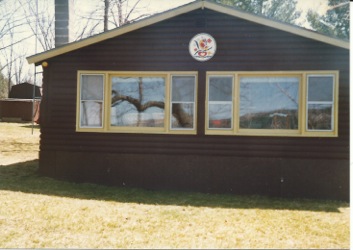
September 17, 2009, was a very bittersweet day for me.  That was the day the Cohen family camp on beautiful Lake Champlain was demolished. Personally it was a difficult day for me to realize that there was a huge pile of logs where our cottage was, where we had spend forty summers.  The cottage is gone, but all the wonderful memories will linger on. The good news is that it is going to be replaced with a beautiful new, modern cottage.

Let’s start from the beginning. Many of our relatives had camps on lakes in Northern New York and Vermont, and we enjoyed visiting them. We hoped that one day we would have one of our own.

In July 1966 we were told that a person we knew had a camp for sale in Willsboro, a very small town on Lake Champlain only 30 minutes from Keeseville.  That evening Bill and I went to see the camp.  The camp was very rustic, just a very large building made of logs that consisted of one big room. Two parts were sectioned off with thin wall boards for the two bedrooms. The wallboards did not reach the ceiling, so there was no privacy.  A large bar with benches for ten people separated the kitchen from the dining and living areas. The small bathroom was the only room that was completely enclosed. Bill asked me what I thought. I looked out on the lake. Just then the sun was setting. The view was magnificent. I said, “Buy it!” Bill was so surprised as I was the one who always said, “I’ll think it over.” By August 1966, we were proud owners of a camp on Lake Champlain.

A few weeks later we received the following letter from relatives downstate in Westchester County made us smile:

Dear Fran and Bill, Good luck on buying a camp.  But we are worried about you Fran. With a large family and working full time, we hope it won’t be too much for you.  Is it a boys’ camp or a girls’ camp?Love, Hilda and Morris

I guess Hilda was right.  I looked up the word “camp” in the dictionary, which defined a “camp” as a temporary place for children out of the city.

Although the camp needed lots of repairs and wasn’t my dream cottage, it was one of the smartest moves that Bill and I ever made.  The property was reasonable and we could afford it.  As our family grew, so did the camp. In 1968, we built on a large family room with huge windows facing the lake. Over the years we entertained lots of company and hosted lots of parties. All our children and our eight grandchildren enjoyed the camp for many, many years.

When Bill and I reached our eighties, we found it was too difficult to keep up the cottage and put it up for sale. We were so happy when our son Jay and his wife Leslie offered to buy it as it would still be in the family.

Ten years have passed. Jay and Leslie are now grandparents. Jay recently retired, and Leslie will join him soon. They plan on spending much more time in Willsboro.  So they are replacing the old camp with a beautiful new one. They are so excited and can’t wait until it is built.  The structure may be new, but the sunset will be the same.  May they enjoy many happy years in their new home on the lake.