Tag Archives: #Jewish

Bud Black, Interlocutor Extraordinaire

For the past five years,  people who came to services at Congregation Shalom Aleichem in Kissimmee, Florida, were met with an unusual but wonderful treat. They were greeted by a pair of musicians—Bud Black on the guitar (and occasionally the banjo) and Bill Willner on the snare drums. They played mostly songs from the 20s, 30s, and 40’s. Bud and Bill usually packed up their instruments about fifteen minutes before services began, but on occasion they would accompany Rabbi Karen Allen on songs from the Friday night service. 

John “Bud” Black career as a musician began in the 1930s as an 8 year old in bars near Pittsburgh, Pennsylvania. Bud’s grandfather Bert loved to drink even more than he loved the Pittsburgh Pirates. So he would tell his wife he was taking his daughter’s “little buddy”  to a game. Instead he took him to local taverns. Bud would play the ukulele that his grandfather had purchased for him.

While still in high school, Bud began playing the guitar professionally and performing on WKPA, Pittsburg’s hillbilly radio station. (Was this the station? It is now listed as a ministry station out of Lynchburg, VA) After graduating, Bud went into the US Air Force, where he worked on computers. After he completed his service, he took a job at RCA working on technology. Bud realized quickly that his first love was music and began working the nightclub circuit around Philadelphia and Atlantic City. 

By the age of ten, with a minimal training from one of his grandfather’s fellow barflies, Bud not only had added the guitar to his repertoire but also helped Bert make some money. Bud had an incredible ability to remember the name, lyrics, and artist of every song he played. As William Miller wrote in a 1997 article, Bert  took him from bar to bar, challenging anyone to name a tune his grandson couldn’t play. When they couldn’t “Stump the Musician”— which was often— Bert passed the hat.

Along the way, Bud married and had two sons, Scott and John. After his divorce, he had a relationship that resulted in the birth of  third son, Wes. .In 1986, the Delta Queen steamship company hired him as the ship’s “interlocutor,” where he would be able combine his talents as a musician, a comedian, and an entertainer. 

His fellow musicians regarded Bud as a walking music encyclopedia. His favorites were songs from the 1920s and 1930s,  but he also knew songs from “as far back as songs were recorded.”   And when he got bored singing the lyrics the “right way,” he would sing them backwards.  “Chattanooga Choo Choo” became “Agoonattahc, Oohc-Oohc;” “My Wild Irish Rose,” “Ym dliw hsiri esor.”

One of his friends remembered, “Bud was full of bull**, an entertainer and wonderful story teller. He took a 15 second story and turned it into an hour. But it was a stroll down memory lane.” 

“Bud had the largest record collection I’ve ever seen,” Howard Paul, a fellow musician on the Delta Queen, posted on Bud’s Facebook page. “He told an endless stream of jokes (clean and blue). For me, Bud was the missing link between vaudeville and nightclub lounge acts.”

Tim Aucoin, a fellow musician, stated on Facebook that he remembers afternoons playing together in the Texas Lounge on the Delta Queen. “Bud would say ‘Who wants to hear some country music? Great, how about a Lithuanian love ballad?’”

In 1989, Bud was performing on the second night of a three day cruise when Wendy Demby, a young woman on vacation from her job in New York City, approached him and expressed her admiration for his show. When she disembarked in New Orleans for the remainder of her week-long trip, Bud sought her out to share a few hours during a break in his job. Those few hours developed into a long distance relationship that resulted in Wendy moving down to The Big Easy. They were married in May 1990.

For the next ten years, Wendy maintained their home in New Orleans while Bud strummed his guitar and banjo up and down the Mississippi. Once a year, Wendy went along for the ride. In 1999, Bud retired from the riverboat but not from music. They moved to St. Cloud, Florida, when Bud took a job at Disney World, playing a various parks including in a roaming band in the Magic Kingdom.

Bud also entertained nursing home residents throughout the Orlando area. His music transported many to healthier, happier days. One time, after singing a song, a woman came up to him in tears. “My husband has dementia,” she said. “ But when you started singing that song, he started singing along. It is the first time he has spoken in years.” 

Wendy was Jewish and Bud was Christian, but they shared a mutual respect and appreciation for each other’s religion. They attended Sunday services at the Church of St. Luke and St. Peter in St. Cloud and Friday night services at Congregation Shalom Aleichem.  Initially, Bud played and sang with Norm Salinsky a former president, About five years ago, Bill Willner joined them. When Norm became ill, Bud and Bill began their routine before services. Bud had a collection of yarmulkes displaying  musical notes or Jewish holiday motifs—but his favorite was one embossed with his beloved Pittsburg Pirates’ logo. 

This past December,  Bud and Bill were planning to do some Irish songs for the March 15 service, which fell two days before St. Patrick’s Day. Unfortunately, Bud became ill in January and passed away on March 9, 2019, at the age of 88. 

At the memorial service at the Church of St. Luke and St. Peter, Reverend Longbottom played and sang some of Bud’s favorite songs, including many Irish tunes. The clergyman was joined by David Royer, who played Bud’s guitar. David was one of Bud’s first friends in the Orlando area, a friendship sealed by b’shert—David’s parents had sailed the Delta Queen and had spoken highly of a banjo player named Bud Black. In honor of Bud’s close connections to Judaism  and Congregation Shalom Aleichem, Wendy’s brother,Craig Demby said the Kaddish, the Jewish mourner’s prayer.

Bud’s son John passed away in 2011 from complications of diabetes.  His oldest son Scott, a talented musician in his own right, lives in China and was unable to attend the memorial service. His youngest son Wes, sharing news that his girlfriend Daniela was pregnant with what will be Bud’s first grandchild, were there to say goodbye, along with many other friends and family members.

One of Bud’s favorite songs, “Dusty Old Dust, written by Woody Guthrie in 1940, is a fitting epithet for this talented musician. “So long, it’s been good to know ya/What a long time since I’ve been home/And I’ve gotta be driftin’ along.” Drift gently, Bud!

A version of this article originally appeared in the Jewish World News, a bi-weekly subscription-based newspaper in upstate New York.

Sources:

Miller, William. “Buddy Black, The Delta Queen’s Colorful Interlocutor.” Vantage. March/April 1997. Pages 10-11.

Lind, Angus, “Life’s a song from way back for Bud Black.” (New Orleans)  Times Picayune. September 4, 1991. Pages E1,E5.
Measure for Measure: What Goes Around Comes Around?

Hindus and Buddhists call it Karma. Germans call it Schadenfreude. But do Jews have an expression to express fate or to express pleasure derived by someone from another person’s misfortune? The closest corresponding phrase is “midah k’neged midah,” —“measure for measure.” One’s actions and they way they affect the world will eventually come to that person in ways one might not necessarily expect.

In a 2017 dracha, Rabbi David Wolfe described two Biblical passages from Bereishit (Genesis) that demonstrate this concept. In the first passage, Jacob takes advantage of his father’s age and blindness to fool Issac into believing hat he is his older twin Esau. As a result, he receives his older brother’s birthright/blessing.

Years later, Jacob falls deeply in love with Rachel. Agreeing to work for seven years for her father Laban, Jacob finally joins his bride under the chuppa. When he wakes up from the wedding night, however, Jacob realizes that under that heavy veil was Leah, the older and less desirable of the sisters. Rabbi Wolfe then calls on a midrash to explain the aftermath. Understandably, Jacob is very upset and demands to know why Leah tricked him. Leah ’s response: “You fooled your father into thinking you were your brother; I fooled you into thinking I was my sister.” In other words, what goes around comes around. 

Just past midnight, on Friday, October 2, President Donald Trump tweeted that he and the First Lady had tested positive for COVID-19.The president’s diagnosis came after he spent months playing down the severity of the outbreak that has killed more than 215,000 in the United States and hours after insisting that “the end of the pandemic is in sight.” He has downplayed the virus again and again. More egregiously, this cavalier attitude has been passed on to his supporters. Republican leaders have incorporated this non-scientific approach into their politics, resulting in dismissing the need for masks and social distancing; opening up cities and states way before it was deemed safe by experts to do so; and touting the “success” of such operations that in truth do not exist.

After initially experiencing some of my own Schadenfreude, my Yom Kippur prayers of repentance kicked in. I sought out the high ground, which I saw in the Book of Proverbs: “If your enemy falls, do not exult; if he trips, let your heart not rejoice” So summoning up my best self, I hope that the president has a “Refuah Shleimah,” a complete recovery. I hope even more that this experience changes how he views COVID-19 and its impact on those not able to take a one mile plane ride to the country’s top hospital after experiencing “mild symptoms.”

My husband Larry and I have seen our lives upended, as have our extended family and our friends. Aborted trips. In person visits replaced with FaceTime calls. Cancelled bar mitzvahs, graduation parties, weddings, Zoom funerals. Limited visits with relatives in nursing homes.

But what we have experienced is nothing compared to the physical, emotional, and financial impact it has on others. On March 31, 2020, my friend Kathy, who had returned from a cruise “under the weather,” sent out a FaceBook post that she was being admitted to the hospital for what she believed was bronchitis. Within two days, she was hooked up to a ventilator. Her brother Bryan kept us informed daily on social media, describing Kathy’s ordeal in ICU in which she almost died several times. When she was finally breathing on her own, she spent several more weeks in rehab. She returned home two weeks ago, only to be rushed back to the hospital for more surgery related to complications of COVID.. As I said, I hope for the president’s recovery, but I wish he could experience just a fraction of what Kathy has been through.

Kathy has survived, but at least seven people in our community have succumbed. In the Orlando, Florida, area, thousands have lost jobs as Disney and other theme parks, Central Florida’s main employer, have seen low attendance. The ripple effect has closed many of our area’s restaurants and other businesses. 

So, I know I join many Americans who hope that the Rose Garden Debacle, which lead to innumerable cases of this fast-spreading disease, will result in policy changes from President Trump and his supporters. Will the federal government finally organize a national response? Will masks and social distancing be mandatory everywhere, even when the president and like-minded Republicans are in attendance? Will first responders be finally given all needed supplies, including personal protective equipment (PPE) and enough tests? And will all leaders take a harder look at returning to Phase 1 protocols?

Or maybe I am just dreaming. On Sunday, October 4, I watched in disbelief as news stations covered the president’s commandeering a motorcade to greet his supporters outside of Walter Reed Hospital. Let us put this ten minute joy ride into perspective. Because of COVID, millions of us cannot see people we love. Because of COVID, thousands have had to lie in hospital beds with no contact with relatives. Because of COVID, many have DIED alone. But the president thought nothing of spending thousands of our tax payer dollars to get the adulation he cravenly requires. And he thought nothing of the danger he put his secret service staff (who were subsequently  put in quarantine) and others to pull off this publicity stunt.To use the words of a popular meme on the Internet: I don’t wish this virus on anyone. I hope the president has a speedy recovery.And I hope he gets demolished at the ballot box. That will be for me “midah k’neged midah,” the most satisfying measure for measure.

A version of this article originally appeared in the Jewish World News, a bi-weekly subscription-based newspaper in upstate New York, in October 8, 2020, issue.

Source: https://www.sinaitemple.org/worship/sermons/toldot-training-hands-esau-voice-jacob/s

Why I am not voting for Donald Trump

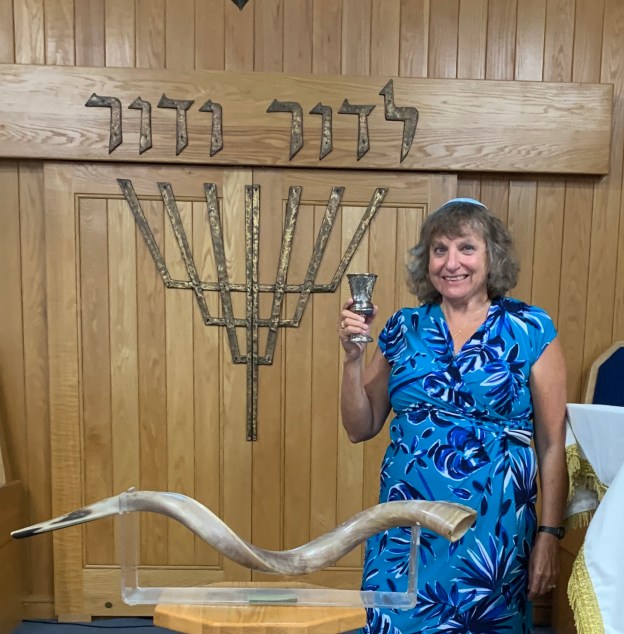
Marilyn Cohen Shapiro reciting Kiddish at Congregation Shalom Aleichem, Kissimmee, Florida

This article is in response to “Donald Trump: Social Justice President” (Rabbi Sanford Olshansky, Heritage Florida Jewish News, Aug. 28, 2020). 

The High Holy Days will be very different this year for all of us.

Rather than meeting fellow congregants in our synagogues, we will be Zooming. As the first day falls on Shabbos, Reform Jews will have to wait until the closing moments of Yom Kippur to hear the sound of the shofar over the Internet. Holiday meals will be lonely affairs as most families are practicing social distancing. Fasting on the holiest day of the year will be made even more difficult when people are not sharing the experience with others.

It did not have to be this bad. Other countries are opening up. Because of this administration’s failure to address the COVID-19 pandemic and — worst yet — its attempt to call it a “hoax,” the United States has over 6 million confirmed cases and over 189,000 deaths as of Sept. 4, with an upsurge expected this fall. Employment is at 8.4 percent overall (compared to 4.7 percent under Obama) but much higher among Blacks (13.0 percent), and Hispanics (10.5 percent). Both small businesses and large corporations are facing closures or uncertain futures. 

The president and his followers have made a health issue a political issue. The country has been torn apart on the issue of wearing a piece of cloth. “The dispute over masks embodies the political dynamics of the campaign,” writes Tara McKelvey in a BBC news article. “It also reflects a classic American struggle between those who defend public safety and those who believe just as deeply in personal liberty.” Meanwhile, all respectable medical personnel view masks as our first defense against the virus.

For those fortunate enough not to have suffered devastating health or economic effects, the impact of the pandemic still has been emotionally difficult. Parents of children fear sending their children to school. Nursing home residents cannot see their families. Grandparents cannot see their grandchildren. Six months into the pandemic, people are feeling lonely, isolated, depressed. 

Meanwhile, since George Floyd’s murder, the United States has come face to face with its long history of systematic racism, and the president has only fueled the flames. His comments and policies have impacted Latinos, Muslims, Blacks, Dreamers, Africans (“shit-hole countries”), Asians (“kung fu” flu), and Jews. Even the disabled — including those who suffered physical or emotional injuries as a result of their military service (“losers” and “suckers”) — have been the target of the president’s disrespect and scorn. 

Jews and non-Jews alike have questioned why I don’t support Trump as he is “good for the Jews.” His history of anti-Semitic comments prove clearly to me that he is not. In 2017, the president stated soon after the white supremacist protests in Charlottesville, Virginia that there was “good on both sides.” His inability to denounce neo-Nazis demonstrates to me that the lessons of World War II and the Holocaust mean nothing to him. Later that year, after the massacre at the Tree of Life synagogue, Trump’s initial reaction was to criticize the synagogue. “If they had some kind of a protection inside the temple … maybe it could have been a very much different situation.” In August 2019, he accused American Jews of being “disloyal” to Israel by voting for Democrats. In December 2019, speaking at the Israeli American Council referred the dual loyalty cliché, and then went on to call Jews involved in real estate “ brutal killers, not nice people at all.” As recently as last week, Mary Ann Mendoza, a Trump supporter was pulled from the RNC line up after protests of her promotion of anti-Semitic and QAnon conspiracy theories on her Twitter Feed. 

The president is the antithesis to every moral tenet of Judaism. He is a bully, a liar, a cheat, a womanizer, and a self-absorbed, unempathetic narcissist who has no respect for anyone who does not fawn over him — unless they are despots. 

His June 1, 2020, photo in front of what is considered the “Church of Presidents” is one the most egregious example. In the middle of peaceful protests, law enforcement officers used tear gas and other riot control tactics to forcefully clear peaceful protesters from Lafayette Square and surrounding streets, creating a path for the president and senior administration officials to walk from the White House to St. John’s Episcopal Church. Reverend Gini Gerbasi, the rector, had helped organize more than twenty priests and lay volunteers to provide water, food, and hand sanitizer as a “peaceful presence in support of protesters.” As they were packing up before the 7 p.m. curfew, armed riot police carrying riot shields entered the churchyard, forcing everyone to evacuate. Minutes later, the president and his entourage entered the square. Brandishing an upside-down, back-facing Bible, Trump posed for photographers for what he perceived was his “law and order” demeanor.

The publicity-stunt-gone wrong met with overwhelming condemnation. Rev. Gerbasi’s comments reported in the Washington Post were especially hard hitting. “People were protesting the fact that their government had been enslaving, incarcerating, overlooking and brutalizing them for generations — and the government brutalized them again,” she stated in a Washington Post article. “Religious people, who were literally wiping away the protesters’ tears, were driven off the church property with brute force and fear. All so that Trump could use the church as a backdrop and wave the Bible like a prop. It was beyond offensive. It was sacrilege.”

“We need our President, and all who hold office, to be moral leaders who help us to be a people and nation living these values,” stated Bishop Michael B. Curry, Presiding Bishop of the Episcopal Church. “For the sake of George Floyd, for all who have wrongly suffered, and for the sake of us all, we need leaders to help us to be ‘one nation, under God, with liberty and justice for all.’” Donald J. Trump is not that president. The only path for our country and democracy is for the overwhelming numbers of Americans to recognize this failure and vote for Joe Biden on Nov. 3. Then, and only then, can all of us sound the Shofar in the future with peace, joy and hope.

Marilyn Shapiro lives in Kissimmee, Fla. This article was first published in the (Orlando) Heritage Florida Jewish News on September 18, 2020.

A version of this article originally appeared in the Jewish World News, a bi-weekly subscription-based newspaper in upstate New York.

Being Born: The World, The Jewish World, and me!

Happy Birthday to me! Happy Birthday to The Jewish World! And Happy Birthday to the World!

It was Labor Day—how fitting!  On Sept. 3, 1950, as my mother’s doctor had a noon golf date, Frances Cohen accommodated his schedule by delivering me a little after 9 a.m.

The Jewish World came along 15 years later. Inspired by Jewish community leaders with the idea that a newspaper would strengthen the community, Sam Clevenson published its first issue for Rosh Hashanah 5716 on Sept. 23, 1965. He believed it would help unify the Jewish communities of Albany, Schenectady, Troy, and the surrounding area. After his passing in 2008, his children, Laurie and Jim, took the helm, packing the paper with more local news, adding a dynamic web site and weekly e-newsletter to expand the readership.

What’s in the ‘World’
The bi-weekly covers local religious events and a wide range of local, national, and international news that impacts and strengthens our Jewish community. It is also a valuable source for happenings in the world of art and culture. Over the years, I have clipped recipes, jotted down the names of books and movies, and have learned much about the world through a Jewish lens.

The recent rise of Jew-hating has made our local newspaper even more important. “For 54 years The Jewish Worldhas monitored perils to your existence,” Jim Clevenson recently said. “We finger the foes of freedom, the nemeses of peace, while celebrating the successes of our crusaders for justice, black and white, Jewish and Gentile.”

‘There goes my heart’
While my husband, Larry, and I had been longtime subscribers and readers, my personal connection to The Jewish World began in 2013. While covering the Capital District Hadassah’s special events banquet, I visited the office in Schenectady to speak to Jim Clevenson. In my pre-retirement life, I had worked in public relations as both a volunteer and as part of my job at the Capital District Educational Opportunity Center, a division of Hudson Valley Community College. Jim asked if I would be interested in writing news articles for the paper. I countered with an offer to write personal columns based on my many years as an upstate resident. My first article, “There Goes My Heart,” was published Aug. 15, 2013. Laurie and Jim (and readers) must have liked it. Over the past seven years, I have published 148 articles in Sam Clevenson’s brainchild.

Since Larry and I moved to Florida in 2015, I have expanded my horizons by becoming a regular contributor to the Heritage Florida Jewish News. My articles have been posted on numerous websites, the Jewish War Museum, Growing Bolder cancer survivors website, the US Pickleball Association, and most recently the Australian-based Jewish Women of Words (I have gone international!) I have compilations in two books, There Goes My Heart (2016) and Tikkun Olam: Stories of Repairing an Unkind World (2018). Two books are in the queue: Keep Calm and Bake Challah, a third collection of essaysand Fredyl’s Stories, family stories that I co-wrote with my mother, Frances Cohen (Of Blessed Memory). My blog, theregoesmyheart.me, presents my stories as well as articles about my writing adventures.

My articles, books, and blog would not have been possible without the help and support of Laurie and Jim Clevenson. They have provided the space in the paper plus advice and guidance.

The lonely ‘Zoom’
This month, The Jewish World and I also share our birthdays with the world. Rosh Hashanah 5781 begins on Friday, Sept. 18. Of course, the High Holy Days will be very different this year for most of us. Rather than meeting fellow congregants in our synagogues, we will be “Zooming.” As the first day falls on Shabbos, Reform Jews will have to wait until the closing moments of Yom Kippur to hear the sound of the shofar over the Internet. Holiday meals will be lonely as most families are practicing social distancing. Fasting on the holiest day of the year will be made even more difficult when we are not sharing the experience.

But I will still celebrate. I will bake round challahs, roll matzoh balls and drop them in simmering chicken soup, and cook up my traditional chicken, roasted potatoes, and candied carrots. Larry and I will do a brachah over the wine asking for a sweet, better year ahead. After we have finished our Zoom service, I will pull out the most recent Jewish World and catch up on what is happening from the only local paper that focuses on Jewish news—what you need to know.

It’s not just the virus
Before Corona-19 we were already a polarized nation crazed with resentment of blacks, Jews, and foreigners. Now we’ve heard echoes of ‘The Jews have poisoned the wells’! The Jewish World promotes Jewish life and culture, and stands for Jewish traditions of rationality and love. We believe good people must stand together to encourage and facilitate light. This is our mission and duty as Jews.

What you can do
To celebrate The Jewish World’s 55th birthday, I ask you to support the paper you are holding in your hands or reading on-line. Renew your subscription. The Clevensons shared with me that a new office staffer is managing the database, and non-payers may find their mailboxes a little emptier on every other Friday.

Give subscription gift certificates to your kids and friends! To carry on the Clevenson legacy call Cynthia Traynahan in the office, (518) 344-7018. She knows all the special discounts.

With Corona-19 disrupting most businesses, The Jewish World needs extra help: visit GoFundMe at gf.me/u/xunxx5.

I also request that you keep in touch with me! I love to hear from readers. E-mail me at shapcomp18@gmail.com , via my Facebook page at Marilyn Cohen Shapiro, Writer, or on Twitter at @shapiro_marilyn. Thank you!

The Jewish World, September 15, 2020

Keep Calm and Bake Challah

Every Friday afternoon since the corona virus has turned our world upside down, I have been baking fresh challah. I revel in the process: the measuring, the gradual rising, and especially the eating. But it has become so much more. As Roche Pinson wrote in her book, Rising: The Book of Challah, “We make challah from a place of commitment to nourish ourselves and our families in a way that goes beyond mere physical feeding and watering.”

Even though I can’t remember ever baking a challah before,  two recent encounters with fresh-out-of-the-oven loaves motivated me. Last August met my future daughter-in-law’s parents in their home at their weekly Shabbat dinner. Along with the candle lighting and the kiddish, we all joined in the prayer over Carol’s freshly baked challah, a tradition she has maintained for decades. The taste of her delicious bread stayed with me throughout the coming months.

On one of the last services at our synagogue in Kissimmee before services were suspended, we congregants enjoyed home baked challah made by Liz Ross. The daughter of a Jewish mother and an Inuit chief, Liz had discovered her spiritual roots as an adult. As the only Jew in  Unalakleet, Alaska, her only choice was to make her own challah to accompany her holiday meals. Years of experience yielded a wonderful, sweet bread. 

On that first quarantined Friday, I decided a home made challah would be a perfect comfort food.  I pulled out my friend Flo Miller’s challah recipe that I had stored in a recipe file for years and gathered all the necessary ingredients: yeast, flour, sugar, butter. I mixed and kneaded the sticky dough with my KitchenAid’s dough hook and covered it with a cloth tea towel. After it had risen, I shaped the dough into three challahs, brushed on the egg wash, and let it rise again.  Once out of the oven, Larry and I dropped one of the loaves over on the doorstep of a friend who was spending Shabbos alone in  as his wife was in isolation in the memory unit of a nearby nursing home. 

As the two loaves waited under my mother’s challah cross stitch covering, I lit the Shabbat candles that we had placed in my Grandma Annie’s brass candlesticks. Larry recited the Kiddish over the Manischewitz wine, and then we both recited the HaMotzei over the warm braided bread. We sat down to our first Shabbat dinner in quarantine. 

The following week, Larry and I headed to Publix at 7 a.m. as part of a “seniors only” shopping trip. I immediately headed to the baking aisle to stock up on my bread making supplies.  I obviously was not the only one baking. Yeast, like toilet paper and hand sanitizers,  had completely disappeared from the shelves, with flour, sugar, and eggs in short supply. We grabbed what we could and headed home.

Fortunately, the flour, sugar, and egg situation improved. Initial attempts on purchasing yeast online, however, were miserably unsuccessful. Amazon offered a three-pack of Fleischmann’s for $25, price gouging at its worst. I sent out an all-points bulletin on FaceBook, and three friends dropped off some packets they had in their cupboards. They each got a challah in return. Soon after, Amazon offered a one-pound bag of yeast. Despite the fact it was twice the normal price, I snapped it up.

Thus began my Friday ritual of making the bread and giving one or two of my loaves to others. As a thank-you for two homemade masks. As a “Mazel Tov” on finishing chemotherapy. As a wish for safe travels to their summer home.  If the bread came out of the oven too late for delivery before sundown, we dropped it off the next day with a suggestion to warm it up, toast it, or make it into French toast.

Each week, I tweaked the process. Too much flour made the bread tough. An extra egg yolk made for a richer taste. Covering the bowl with a tea towel and then loosely wrapping it in a garbage bag helped in the rising. Slamming the ball of dough on the counter a few times removed extra gases—and relieved tension! Raisins were a wonderful addition. Creating a challah with six braids or more will take more practice.

One night, when an afternoon nap killed chances for my normal bedtime, I went on YouTube and found a series of  challah baking videos made by Jamie Geller, the “Jewish Rachel Ray.” An Orthodox Jew who made aliyah to Israel in 2012 with her husband and six children, Jamie’s  demonstration added a spiritual component that touched me. Although she is a professed “shortcut queen,” Jamie said she eschews a dough hook in favor of kneading the bread by hand to infuse her love into the loaves. She uses that time to pray for her children, her family, for people in need of r’fuah sh’leimah [complete healing].” 

The  next Friday, I used an electric mixer to start the process but then turned the dough onto my floured countertop and began kneading. Like Jaime, I prayed for my children and grandchildren, who are physically so far away but always in my heart. I prayed for the wellbeing of my friends and family. I prayed for my friend Kathy who is on her way to recovering from COVID-19. I prayed for Minnie, a beautiful baby born at 29 weeks who will be spending her first weeks of life in a NICU unit. I prayed for Jesse, who just lost his wife Heddy to cancer. And I prayed for all those impacted by COVID-19, the sick, the grieving, the lonely, the unemployed, the hungry. Was it my imagination, or did the challah taste especially sweet, especially delicious that Friday night?

This week, the need for prayers is even greater. Along with the pandemic and devastating unemployment numbers, our country is marked with racial strife and protests—both peaceful and violent. So this Friday, I will knead my challah dough with additional prayers —for George Floyd (May his memory be a blessing) and his family, for our country, for the future of democracy. And as the beautiful, sweet braided loaves rise for the final time, I will call my elected officials to repeat the words of Jonathan Greenblatt, CEO of the Anti-Defamation League, “We stand in solidarity with the Black community as they yet again are subject to pain and suffering at the hands of a racist and unjust system…. Systemic injustice and inequality calls for systemic change. Now!” Blessed are You, Adonai our God, Sovereign of all, who brings forth bread from the earth. Amen

A version of this article originally appeared in the Jewish World News, a bi-weekly subscription-based newspaper in upstate New York.

Marilyn Cohen Shapiro, a resident of Kissimmee, FL, is a regular contributor to the (Capital Region NY) Jewish World and the Orlando Heritage Florida Jewish News. She is the author of two compilation of her stories, There Goes My Heart (2016) and Tikkun Olam: Stories of Repairing an Unkind World. (2018). Both books available in paperback and e-book format on Amazon. You can read more of her stories on her blog, theregoesmyheart.me. 

“This too shall pass.” Meanwhile we sit tight and alone.

As we tread  carefully through the fourth month of the coronavirus pandemic, the emotional and physical devastation this plague has caused is felt acutely by so many. As our days of sheltering at home continue, it has become much more real, much more personal, much more frightening.

My husband Larry and I are feeling the impact, as I suspect many of you are. Our community already has had two confirmed deaths from the virus. Kathy, a friend from my writing group who had been sick with bronchitis, posted the following message on a on March 30 on her Facebook page: “I have pneumonia and am in the Poinciana Medical Center where I am getting fantastic care. Take care. Be well.” Two days later, her brother Brian Joyce posted that she had been diagnosed with COVID-19 and was on a ventilator. His daily updates report the news that she is still fighting for her life.

Friends and family are all sharing stories of people they know who have been diagnosed with the corona virus and those who have lost the battle. A longtime congregant of our synagogue in Upstate New York succumbed to the virus this week. My son’s brother-in-law’s grandfather in California died after contracting the virus from his daughter. Each day the numbers continue to climb.

Although most of my friends are retired, many have children on the front line as medical staff or first responders. They post and text pictures of their son or daughter in full protective gear or—worse yet—reused masks and garbage bags for scrubs. Originally, it was believed that the virus mostly attacked the elderly and those with underlying conditions. That “reassurance” no longer works, and my friends are worried that their children or grandchildren will contract it.

Any medical procedure becomes a cause for serious concern and even panic. A friend scheduled for cancer surgery was terrified that he would develop the virus and would be told he must cancel. Meanwhile, his wife had to drop him off at the hospital and pick him up two days later. She couldn’t physically be there for him.

Another friend, also diagnosed with cancer, was told by her Florida doctor that the surgery would be postponed until the pandemic had subsided. Fortunately, she was able to find a doctor in her home town of Pittsburgh who could operate within the week. She and her husband made a hasty trip up for the procedure. I am happy to report that her surgery was a success.

Last week,Larry was involved in a bicycle accident when he slipped on some wet pavement. His primary physician insisted Larry go to the emergency room for a tetanus shot and for potential stitches for the gash on his elbow. I freaked out, fearing he would contract the virus in the waiting room. “Please don’t go,” I begged. “Stay home. I’ll stitch it up myself.” That freaked him out. Wearing a surgical mask, he left for the hospital, where he was immediately ushered into a sterile examining room. He came home two hours later, tetanus shot administered and wounds bandaged—none requiring stitches. He had only the highest praise for the medical staff.

Two days after Larry’s ER visit, friends were anxiously awaiting the birth of their first grandchild. The impending delivery had made more stressful as it was uncertain whether their son could be in attendance as some New York City hospitals were not allowing any partners in the delivery room. Everyone was relieved to learn that he could accompany his wife during delivery, but the planned birth was still fraught with worry. If either the expectant parents had symptoms, would she have to deliver alone? And would she or the baby contract the virus while in the hospital? Thankfully, the baby was born without complications. The proud grandmother sent me a picture taken in the hospital of the father dressed head to toe in scrubs and a surgical mask gingerly holding the swaddled baby in his gloved hands. All that was visible were the father’s proud eyes. 

The coronavirus has taken much from us, but the inability to congregate, to be with those we love, to hug one another in times of joy or sadness, is the most painful. In normal times, we come together to celebrate the birth of a baby, to support ill friends, to say goodbye to a beloved friend or relative. During this time of a “new normal,” grandparents cannot hold their newborn grandchild. Friends and family cannot celebrate birthdays, weddings and bar mitzvahs. High school and college students cannot celebrate graduations. Jews cannot gather around a huge table or meet in a large room to hold a seder. Most tragically, family and friends cannot even help those who lost a loved ones to grieve, to offer hugs and human touch. 

One day, in the unforeseeable future, the corona virus will be behind us. We will gather together and hug each other tightly and even plant kisses on each other’s cheeks that are wet with tears of joy. We will hold our friends and family not only in our hearts but also in our arms.

On Friday, March 20, for the first time since serving as our spiritual leader, she did not conduct Shabbat services at Congregation Shalom Aleichem in Kissimmee. The synagogue, like thankfully churches, mosques, and other religious meeting places, were closed due to the pandemic. In a letter sent to the entire congregation, The rabbi suggested the following:  At 8:00 p.m. that evening, “when we would all prefer to be together in the sanctuary, let’s do two things that are emblematic of the worship service:recite the Sh’ma and Mi Shebeirach prayers.”

Like Rabbi Allen, Larry and I could not be together with other members of our congregation.. Instead, we set the table with white linens and good china and crystal wine glasses. We lit the Shabbos candles, said Kiddish, and ate the delicious warm challah I had made from scratch. We recited the Sh’ma. Then we prayed for all of those—too many to even count— in need of healing.

Mi shebeirach imoteinu, m’kor ha-bra-cha l’avoteinu./Bless those in need of healing with r’fu-a sh’lei-ma./The renewal of body, the renewal of spirit,/And let us say Amen.

Stay well. Stay safe. Stay home.

A version of this article originally appeared in the Jewish World News, a bi-weekly subscription-based newspaper in upstate New York, in the April 16, 2020, issue.

A version of this article originally appeared in the Heritage Florida Jewish News, a weekly subscription-based newspaper in Florida, in the April 17, 2020, issue.

Why Is This Passover Different Than All Other Passovers? Adjusting to the “New Normal”

One of Judaism’s most important holidays officially begins with the first seder onApril 8. Pesach in the Time of Corononvirus, however, will be very different.

During these difficult times, I think of my parents, Fran and Bill Cohen. .As did many of the Greatest Generation, they went through several challenging times.In 1919, the Spanish flu was raging throughout the world. My mother, born in 1917, fell deathly ill. The family doctor saved her life by making a deep incision into her right lung to drain the fluid. 

To help in her recovery, my grandmother Ethel left New York City with her daughter for Alburgh, Vermont. They stayed for several weeks with Ethel’s brother Paul and his wife Bertie at their home on Lake Champlain. One of their visitors was Ethel’s step-mother’s sister and her grandson Wilfred Cohen. Fran and Bill didn’t meet again until their blind date in 1939. They were married in August 1940. When anyone asked her as to how she got the huge scar on her back, she loved telling people how she survived the flu and met her future husband—all before her second birthday.

Several other cataclysmic events shook their world. The Great Depression, World War II, news of the Holocaust, the atomic bomb, the Cold War I am sure at times they were afraid—for themselves and later for their children and grandchildren. 

As I write this, we are in the second week of our own national crisis. Larry and I worry about our friends and family—especially our own children.Thankfully, my daughter-in-law delivered our grandson days  before the mass shutdowns in San Francisco were enforced. Adam, Sarah, and the baby are now “sheltered in place” in San Francisco. My heart broke when we had to cancel our trip out to meet the baby. It broke even more when I realized that Sarah’s parents, who only live a mile from them, have only seen him through a window when they have dropped off supplies, including a fresh baked challah for his first Shabbat. 

Summit County had the first case of the virus in Colorado. A young man who had skied in Italy before his next planned trip to the Rockies recovered in a hospital only a mile from my daughter Julie and her family’s home. They returned from a week’s vacation with us to closed resorts, schools, and businesses. They too are in mandatory “shelter in place” mode. They are telecommuting between keeping our granddaughter busy with both educational and fun activities, including learning about the height of a giraffe, the life of a butterfly, and the hands-on steps of baking a challah. 

As residents of Florida, Larry and I are not yet under the same mandatory restrictions as California, Colorado, and other areas of the country.  But restaurants, non-essential businesses, then even DisneyWorld and Universal are now closed down.In our fifty-five plus community, all activities and events have been cancelled or postponed.Most of the people here are respectful of the six foot distance rule, which we practice on our frequent bike rides, walks, and conversations with friends from one end of a driveway to the other.We give each other virtual hugs and then head home.

For the rest of the day, we do what we can to keep busy. Larry and I often sit on our lanai, reading books doing the puzzles, and watching birds dive into the pond behind our house. Larry spends a great deal of time Googling great moments in sports and watching reruns of his favorite shows. I spend an inordinate amount of time on FaceBook and watching Great Performances on PBS. We call and text with friends. We watch television. On the first Friday of the “new normal,” I made a Shabbos dinner, complete with wine and a delicious freshly baked challah—my first since moving down her from New York.

The best part of every day is FaceTiming with our family, an almost daily treat that began on March 10, just before the world changed. Larry and I were planning to go to a play that  was being put on by our local theater guild—what was to be our last outing before our own lockdown. Julie, who was very worried about our contracting the virus, begged us to stay home. She must have shared her fears with her brother. Shortly before Larry and I were to leave. Adam FaceTimed with us and offered us a sweet deal: If we didn’t go out, he would keep the camera on the baby. For the next hour, we watched our six day old grandchild poop and pee and eat and sleep and poop some more. With all due respect to my friends in Deathtrap, it was one of the best performances we had seen by a leading actor in our lifetime.

Despite the impact the pandemic has had on our lives, I feel very grateful. Grateful for good health with no underlying conditions. Grateful for the current health of extended family and friends.Grateful for our life in Florida with its abundant sunshine. Grateful for modern technology that allows us to connect with our family and friends, to stream shows and movies, to download library books onto our electronic readers. Grateful that we are retired and not dealing with working at home or—worse yet—possible unemployment.

We also feel grateful to have a fully stocked refrigerator and pantry, as not all people have that luxury. Those individuals in our surrounding neighborhoods who are losing income due to the shutdowns could especially use some help. The refund we received from the cancelled Shalom Club seder went to the local food bank. As our synagogue had already deposited the check, the board called everyone who was attending to ask if their money could go to the same place. Scott Maxwell In a recent column in the Orlando Sentinel, Scott Maxwell offers many other ways to give to veterans, hungry school children, and the homeless. My favorite of his suggestions: “Did you hoard? Pay it forward.” And we call all follow the Center for Disease Control’s guidelines and STAY HOME.

So why is this Passover different from every other Passovers? We certainly will not be emptying our house of chometz, as we have stocked up on many dry goods that certainly don’t follow strict Kosher guidelines. Community, seders have already been cancelled. Relatives and friends who usually have a houseful for the holiday will have only two or three at the table, possibly enhanced virtually thanks to FaceTime or Zoom.

No matter, I will make a seder for the two of us. In the days that follow—if we can somehow get more than the two dozen eggs per family limit at the local supermarket—we will feast on sponge cakes, matzoh brie, and Passover popovers. Most importantly, we will FaceTime with our family and give each other virtual hugs. And Larry and I will pray that the coronavirus will pass over all of our homes and leave us, like our ancestor, safe, healthy, and free from fear.

A version of this article originally appeared in the Jewish World News, a bi-weekly subscription-based newspaper in upstate New York, in the April 2, 2020, issue.

Tu B’Shevat! Time to plant a tree or two!

See to it that you do not spoil and destroy My world; for if you do, there will be no one else to repair it’” (Midrash Kohelet Rabbah, 1 on Ecclesiastes 7:13)

Would you like to celebrate Tu B’Shevat in a meaningful way? Plant a tree—or two—or be part of the Trillion Tree Campaign. No matter how many you plant, you will be doing your part for the environment.

Although there are still doubters, climate change is a real threat to our future. According to the United Nations’ Intergovernmental Panel on Climate Change, the world has 11 years to take dramatic policy action and shift away from fossil fuels to avoid the worst effects of climate change. Reports like that keep me up at night.

In his 2019 book Falter: Has the Human Game Begun to Play Itself Out? ,Bill McKibbon describes the present as a bleak moment in human history — and we’ll either confront that bleakness or watch the civilization our forebears built slip away. Okay, that information keeps me up at night AND gives me nightmares!

I can despair, or I can take action. As Jew, I am called to the social justice theology of Tikkun olam, the perfecting or the repairing of the world. This principal keeps me strongly anchored to my religion. Full disclosure: When I attend services, I love the music and the flow of the prayers. Often, however, prayers that praise God are not as important to me as prayers that call me to action. And some holidays call us to action more than others. One such holiday is Tu B’Shevat. 

Long before the first Earth Day in 1971, long before the first American Arbor Day was held in Nebraska in 1872, and long before the Spanish village of Mondoñedo held its first arbor plantation festival in the world in 1594, Jews celebrated Tu B’Shevat The holiday, which originated in the Talmud, was based on the date chosen for calculating the agricultural cycle of taking tithes from the produce of the trees, which were brought as first-fruit offerings to the Temple in Jerusalem. Although the holiday fell out of practice after the destruction of the Second Temple, kabbalists in the Middle Ages revived the holiday, adding the practice of holding a seder in which Biblical foods, including wheat, barley, grapes, figs, pomegranates, olives, and dates, are eaten.

For those of us who care deeply about the future of our planet, 

Tu Bishvat offers a Jewish connection to contemporary ecological issues. Modern Jews view the holiday as the opportunity to educate Jews about their tradition’s advocacy of responsible stewardship of God’s creation, manifested in ecological activism. 

And one such way is to plant trees. Many American and European Jews observe Tu Bishvat by contributing money to the Jewish National Fund, an organization devoted to reforesting Israel.Founded in 1901 to buy and develop land in what was then the Ottoman Palestine, the JNF has planted over 240 million trees in Israel along with other environmental achievements including the building and development of dams, reservoirs, and parks.

More recently, planting trees has taken on a global focus. Inspired by Wangari Maathai, founder of the Green Belt Movement whose goal included organizing women in rural Kenya to plant trees, the Trillion Tree Campaign has already resulted in the planting of 13.6 billion trees in 193 countries. 

According to a recent study released by Dr. Thomas Crowther and fellow scientists at ETH Zurich, a Swiss University, planting billions of trees across the world is one of the biggest and cheapest ways of taking CO2 out of the atmosphere to tackle the climate crisis. As trees grow, they absorb and store the carbon dioxide emissions that are driving global heating. New research estimates that a worldwide planting program could remove two-thirds of all the emissions from human activities that remain in the atmosphere today.

According to Crowther, the impact of planting billions of trees across the world is “mind-blowing.”one of the biggest and cheapest ways of taking CO2 out of the atmosphere to tackle the climate crisis. Best of all, it is “available now, it is the cheapest one possible and every one of us can get involved.”

In January 2020, members of the World Economic Forum, which was held in Davos, Switzerland, announced the creation of 1t.org, aimed to unite and promote reforestation efforts worldwide. It will  several other established initiatives including the UN Decade on Ecosystem Restoration 2021 -2030; the Bonn Challenge, Trillion Trees Initiative, and the Global Partnership on Forest and Landscape Restoration.Even President Trump, while a sceptic of climate change, has signed on, stating he wanted to show “strong leadership in restoring, growing and better managing our trees and our forests.” 

I am not naive enough to believe that my making contributions to JNF or other agencies committed to reforestation will single-handedly solve the climate crisis. I will do my best to further reduce my carbon footprint by driving a hybrid car, bundling errands that require driving to use the least amount of fuel, and using energy-efficient appliances and light bulbs. I will continue to recycle despite changes in recent policies in many areas that limit what we can put in our bins. (I still feel guilty every time I throw plastic and glass containers in the garbage!) I will continue to read, study, write and advocate for the environment. And I will vote for politicians who share my concerns for our planet.

“It’s the little things citizens do. That’s what will make the difference,” stated Wangari Maathai, who won the Nobel Peace Prize in 2004 for her environmental efforts. “My little thing is planting trees.” If we can choose to do our own “little thing,” we may be able to keep our planet healthy. After all, as expressed in a popular meme, “There Is No Planet B. “

A version of this article originally appeared in the Jewish World News, a bi-weekly subscription-based newspaper in upstate New York, in the February 6, 2020, issue.

Sources: 

Say Yes to the [Wrong] Dress!!

Our son Adam had his first date with Sarah on December 25, 2018. They got engaged on June 23. By the time my husband Larry and I met Carol and Dick, Sarah’s parents, in August, they had the rabbi, the October date, the venue, the DJ, and the photographer all lined up. All that was left to do was for them to send out the invitations and for all of us to figure out what we would be wearing. 

In August, Sarah found a beautiful long sleeve white lace dress. At the same store, Carol and Sarah’s sister Molly found their dresses; a long gold brocade for Carol and and a black off-the shoulder top with a lovely flowered patterned for Molly. Julie purchased a beautiful teal green dress on E-Bay, the same place she had found her wedding dress twelve years before. 

When Sarah and Adam asked our granddaughter to be flower girl, The Frisco Kid was thrilled—and prepared. “I will wear my Elsa dress” she announced. My daughter Julie gently explained that rather than her Frozen costume, Mommy would be buying her a special dress for her important role in the wedding. “Okay,” she said. “I will save the Elsa dress for MY wedding!”

Like my granddaughter, I originally planned on wearing a dress I already owned. I had purchased a cocktail dress the previous December for our community’s Shalom Club Ball.It was my favorite color—midnight blue—, and the v-necked sleeveless design fell perfectly on mid-knee. When I shared my decision with my maj jongg group, they objected.

“Your son only gets married once,” said Sharon, who led the charge. “You have been waiting a very long time for this! Get a new dress!”

Soon after this discussion, Larry and I celebrated our 45th anniversary by going out to dinner at a restaurant in one of Orlando’s largest shopping center. I suggested to Larry that we leave early so that we could look at suits for him(Adam and my son-in-law Sam had  already  purchased new suits) and at dresses for me. 

When we perused the men’s department at Macy’s, Larry refused to even try on a suit.”I don’t need a new one,” he said. “The one I have in the closet is fine.” His only concession was to agree to have a tailor remove the pants’ cuffs, definitely no longer in style.

I had better luck—or maybe a better attitude—in the women’s department. After several fails, I tried on a more sophisticated version of the midnight blue dress I had worn to the Shalom Club Ball. Sleeveless with a diagonal neck line, it had a beautiful silver broach on the right side. The saleslady who was helping me agreed with me that was perfect for the evening event. She suggested it would look even better if I also invested in some (expensive) shapewear that would smooth out some of my bumps and lumps. As the chances of losing twenty pounds by the wedding were slim, I agreed. Okay, the dress wasn’t a Size 10, but when I pulled the whole thing together— I looked pretty amazing, and Larry agreed. 

I asked the salesperson to snap a picture on my iPhone, which I sent to my mah jongg group. Within minutes, my phone was dinging like crazy. 

“Yay! You are going to look gorgeousssss!”

“You are one SEXY MAMA don’t play safe go for bold n sexy!”

“You go girl!”

Then the text messages took on a life of its own, where I became to topic of discussion.”She needs shoes to match the dress.”

“[Hair] updo would make it look better.”

“She needs new makeup.”

This discussion continued the following Friday at Mah Jongg. One by one, my “fairy godsisters”:helped me accessorize by shopping in their closets. Beautiful silver sandals. A glittery handbag. A midnight blue bracelet. “Sapphire” hanging earrings.

They had one more suggestion—a trip to Sephora. After a first class make-over, I dropped over $100 on makeup, including foundation, blush, and an eye shadow palette with some silver glitter. I was set!

I wasn’t going to risk a chance of losing the outfit on our flight out to San Francisco. So three days before we left, I packed everything I needed in my carry-on. I carefully placed the plastic clothing bag protecting the dress on top of the shoes, handbag and undergarments. Fortunately, there were no flight problems on our way out, and I hung the entire outfit in our hotel room closet.

That evening, Larry and I met Adam and Sarah for dinner. To our surprise, Sarah showed us Wedding Dress Number Two. She felt the simple white sheath reflected more of her personality than the original Seventies-design.

The days leading up to the wedding were a whirlwind of total happiness and joy. Friends and relatives flew in from around the country. Many took advantage of the beautiful weather and the San Francisco location to tour the area. The night before the wedding, Larry and I hosted a welcome dinner at Sarah’s parents’ home,

The morning of the wedding, my siblings and I took a bus tour of San Francisco while Larry and Adam had professional shaves. We all got back to the hotel in plenty of time to get ready. I put on my new make up, spent a little more time on my hair, slipped on my shape wear, buckled up my beautiful silver sandals, put on my sapphire earrings and bracelet, took the dress out of the plastic bag, and slipped it over my head.

“Larry, would you please zip me up?”

Larry finished knotting his tie and turned his attention to me.

“Marilyn, that is NOT the dress you bought for the wedding,” Larry said. “That is the Shalom Club Ball dress.”

I looked in the mirror. He was right. After all that, I had packed the WRONG dress. Not the dress I bought for the wedding and had spent three weeks accessorizing. Nope, it was the dress I originally was going to wear.

“I can’t believe I brought the wrong dress!” I cried. “I can’t believe I brought the wrong dress!”

In ten minutes, the Uber was coming to pick us up. There was no way in the world I could fly back to Florida and grab the right one. I shook my head and accepted the inevitable.

“I guess I will be wearing this dress to the wedding!” Fortunately, both were midnight blue with silver accents. The only touch needed  was a necklace to fit into the v-neck of the dress. Fortunately, my niece Laura had brought a sapphire and diamond necklace on a silver chain. Perfect!

When Larry and I arrived the wedding venue, we saw Sarah in her beautiful Wedding Dress Number Two and Adam in his new suit. Soon after, Carol and Dick came into the restaurant. Rather than wearing the dress she had purchased in August, Carol decided to wear the dress her own mother had worn at Carol and Dick’s wedding 48 years before.. 

Julie, Sam, and The Frisco Kid came in next. My granddaughter looked like a fairy princess in her pink and white flower girl dress and flower garland.”The onlywomen wearing their first choices were Julie and Molly.  The men, inlcluding Larry whose old suit was perfect for the occasion, also hadn’t switched out their choices.

To say the wedding was special is the understatement of the year. I may have brought the “wrong” dress, but Adam had married the right person—a smart, caring ,independent woman who was beautiful inside and out. And, in the end, that is all that matters.

A version of this article originally appeared in the Jewish World News, a bi-weekly subscription-based newspaper in upstate New York, in the October 31, 2019 issue.

A High Holiday Romance–or Two

The High Holidays are a special time, but it is even more special when family—and a little romance—are part of the season. 

In 1951, Larry’s father Ernie, a World War II veteran, was called back into the US Army. Larry’s mother Doris, along with Larry and Larry’s older sister Anita, moved from Schuylerville, New York,to Syracuse,  her hometown, to live with her mother Rose and brother Asher during Ernie’s deployment. 

Larry, who turned three shortly after their move, remembers riding the family coal truck with Asher and tagging along with Bubbie when she went to her card games. Relatives and friends, filled the house, including meal times, as Bubbie was a wonderful and plentiful cook. 

This was especially true during the Jewish holidays, a tradition that continued after Ernie returned home. Doris, Ernie, Anita, Larry, and later Marilyn and Carole would pile into the car before each holiday to share huge meals around a crammed dining room table in the flat on Jackson Street.

By the time Larry had completed his bar mitzvah, Bubbie Rose found making the huge dinners for the entire family for High Holidays was too much. Doris took over responsibility for not only the meals but also for opening up her house to friends and family. Doris spent weeks preparing the food, and the table showed it. Matzah ball soup, chopped liver, brisket, chicken, kishki, potatoes, kugels, several vegetables, honey cakes—it was a feast that was repeated on the evening before Kol Nidre. Then Doris would outdo herself with the Break Fast.

The 1973 High Holiday season especially stands out for Larry and me. In March 1973, Larry and I met at Jewish singles Purim party. We both knew fairly quickly that the connection we made over hamantaschen was special. We dated throughout the summer, and six months after our Purim meeting, we were both ready to commit. On a beautiful day Indian summer day. Larry took me to  romantic overlook at the Saratoga National Battlefield. As he was about to pop the question, he got stung by a bee. Man plans; bees sting. Oh well! Larry felt terrible, but I was clueless. 

Rosh Hashanah fell only a few days after the bee debacle. Larry and I turned down offers for a ride home from services. While walking home, Larry talked hypothetically about where we would live, how many children we’d like, our future dreams together. I finally kiddingly asked him if this was a proposal. He said “Soon.”

When we got to Larry’s house, we said hello to the family who were about to sit down for dinner. Larry and I went into a bedroom to drop off Larry’s tallit and my purse. Larry said, “Will you marry me?” I said yes. We started to kiss when Corky, the Shapiro’s wire haired terrier, jumped up and licked my face.

As I wiped Corky’s saliva from my lips, Larry and I made a pact: We would keep our engagement a secret until after the holidays. Larry’s father’s birthday was on Yom Kippur. We would announce our engagement at the Break Fast.

The next week  went by slowly, especially for me, who wanted to shout our news from the rooftops. After Yom Kippur services ended, Larry and I called my parents to tell them of our engagement. We then sat down with Larry’s family for-the-Break Fast dinner.

We brought out dessert and birthday cake. Ernie blew out the candles and opened a couple of presents. Then Larry was ready for our big announcement.

“Dad, I have a present for you too!”

“What?” said one of his sisters. “Another stupid tie?”

“No,” said Larry. “I am giving you a new daughter-in-law. Marilyn and I are engaged!” Everyone was thrilled. My now future father-in-law regarded it as one of his best presents ever. 

Larry and I were married on September 8, 1974. A few weeks later, we attended High Holiday Services with Larry’s family. After the last shofar blast we went back to the Shapiros  for their annual dinners, a tradition we maintained for almost twenty wonderful years. 

When Larry’s parents passed away only eight months apart in 1994, Larry and I hosted a Rosh Hashanah dinner at our home in Upstate New York for over twenty years until our move to Florida. Since our move so far from family, we have shared Rosh Hashanah dinners with our friends at each other’s homes. and our Break Fast with our fellow worshippers in the synagogue.

This year, the High Holidays are about creating new memories and celebrating another romance.  On a visit from his home in San Francisco this past January, our usually reserved son told us that he was “kinda sorta seeing someone,” a woman whom he had taken out for Chinese food on December 25. As Larry and I had similarly experienced many years before, Sarah and Adam both knew fairly quickly that the connection they had made over fortune cookies was special.They dated throughout the winter, and only six months after their Asian dinner, they were both  ready to commit. On a beautiful summer’s evening, Adam took Sarah to a romantic overlook in Bernal Heights. Fortunately, no bees ruined their moment. Adam proposed. Sarah accepted! They were engaged!

Adam and Sarah will be getting married in San Francisco in October 2019,on the same day as the 46th anniversary of the day Larry and I announced our engagement and what would have been Ernie’s 100th birthday. Life has come full circle. 

After the wedding, Larry and I will remain in San Francisco to attend Yom Kippur services with Sarah, Adam, andSarah’s parents. The six of us will share a pew in the synagogue. After the last shofar blast, we will all go back to Sarah’s parents’ house for their annual Break Fast, an event that will include Sarah’s Grandma Minnie’s blintzes. “As we prepare for this time of reflection, renewal and rebooting of our spiritual lives,” read their invitation, “ we wish you L’Shanah Tovah Tikatevuh!” And we wish our newlyweds much health, love, and happiness.