Author Archives: Marilyn Shapiro

Unknown's avatar

About Marilyn Shapiro

After thirty five years in education, I have retired and am free to pursue my lifelong dream of becoming a freelance writer. Inspired by my mother, who was the family historian, I am writing down my family stories as well as publishing stories my mother wrote down throughout her life. Please feel free to comment and share.

Beating the Odds: Tony Handler outruns cancer.

Eric Lagerstrom, a 29 year old from Gresham, Oregon, may have been the official male top finisher in the 2018 St. Anthony’s Triathlon, which was held on a beautiful April day in St. Petersburg, Florida. However, in the pack of over 3000 participants was an individual that many considered the true winner. Seventy-nine year old Tony Handler had completed his 300th triathlon since his “terminal” diagnosis thirty-five years earlier. “I beat Mr. Cancer again,” said Tony with satisfaction.

Waiting at the finish line, as she had done almost every time before, was his wife, Narda, his childhood sweetheart from Newark, New Jersey. “I think I missed only five races in his entire triathlon career,” said Narda

None of this seemed it would be possible thirty-five years earlier. In 1983 Tony was driving Narda and friends home from an evening out when he was seized by excruciating abdominal pains.  His friend took over the wheel and drove Tony directly to the hospital. The doctors in the emergency room determined that his stomach had ruptured and immediately operated.

Death Around the Corner?

Two days after the surgery, Tony was transferred to the National Institutes of Health (NIH) in Bethesda, Maryland. The doctors there gave the Handlers the devastating news: Tony  had pancreatic cancer and had at best two more years to live.

Tony, who was forty-five,  refused to accept the diagnosis. After several more surgeries, he was chosen to participate in clinical trials at NIH with nineteen other patients who shared his rare form of cancer.  A willing “human guinea pig,” Tony endured hours of medical protocols, innumerable experimental drug treatments,  and seven surgeries.

While undergoing the  regimen, Tony saw an article that stated  the city of Baltimore was hosting the Bud Lite Triathlon in July 1985.   “I  thought this would be a good way for me to fight the bleak prognosis.” 

Against the Odds!

Tony was not new to athletic competitions. Born in 1939 in Newark, New Jersey, to first generation Jewish  parents, he had participated in Weequahic High School’s cross country and swim teams, serving as the latter’s captain.

Cheering him on in the stands was Narda Mandell. Shortly after his bar mitzvah at Congregation B’Nai Jeshrun in Newark, Tony had met twelve-year-old Narda and they soon became a couple. “I was—and still am—his biggest fan,” said Narda.

After Narda completed high school and Tony completed his stint in the army, Tony and Narda were married on September 27th, 1959. Narda worked as a receptionist in a bank until their first son was born.

 In 1960, Tony was hired by IBM and spent the next 12 years working and going to Rutgers at night to earn a business degree.  Tony received a promotion to IBM’s  to its Washington DC office, and they moved to Crofton, Maryland, to be closer to the company’s Washington office. In 1983, they were living what appeared to be an idyllic life when their world was turned upside down.

Tony was determined to survive. He set his goal to compete in the 1985 Bud Lite Triathlon. Initially, he could only do a slow walk/run.  As his stamina increased, he began running two, five, ten miles. “Running made me feel as if I were fighting back,” said Tony. He dusted off his bike and rode the Maryland countryside. He found a local pool, donned goggles and a Speedo, and began swimming competitive laps for the first time since his high school swim team days. 

The Main Competition

On July 1, 1985,  Tony completed the Baltimore triathlon, which combined a one mile swim, 24.8 miles of bicycling and 6.2 miles of running. Tony was far behind the winning time of one hour and 55 minutes, but he had won a personal victory. “I only had one competitor,” said Tony, “and that was Mr. Cancer.”

Unfortunately, Mr. Cancer wasn’t done with Tony. He faced multiple bouts with six different kinds of cancer, including pancreatic, liver, prostate, and skin cancers, and twenty-one surgeries. 

Through it all, Tony continued his job as an IBM consultant. The management at the company were supportive, never hesitating in giving the time he needed to have the multiple surgeries and finish his recovery. After work and on weekends he continued to work out and participate in triathlons across the United States. “I needed victories wherever I could find them,” said Tony. “Every time  I crossed that finish line, I felt like I beat Mr. Cancer again.”

The Marathon Continues

In 1988 Tony received a promotion to senior consultant and was transferred to Tampa, Florida, where he continued to compete.

By the time he was approaching his sixtieth birthday, Tony had completed 200 triathlons. He set his goal even higher by signing up for the 2000 Florida Ironman Triathlon.  A back injury that was unrelated to cancer forced him to cancel. But in 2001, he completed the Panama City-based competition, which was composed of a 2.4-mile swim, a 112-mile bicycle ride and a marathon 26.2 mile run. He felt such a sense of accomplishment, he did again when he was 62.

When he retired from IBM in 2003, Tony and Narda moved to Solivita, a 55 plus active adult community located in Central Florida. 

Playing It Forward

As a cancer survivor, Tony was determined to “pay it forward.” Soon after their move, he organized the first annual community-wide three mile walk/run in Solivita to raise money for the American Cancer Society (ACS). Beginning in 2012, several Solivita clubs joined together to establish an annual Relay for Life event that supported ACS. Tony’s run/walk was folded into the community’s umbrella fundraising efforts. As of 2018, the combined efforts have raised over $700,000, of which $60,000 was raised by Tony’s walk/run event.

His story of survival and his fundraising have earned Tony state and national recognition. In 2013, Tony qualified to compete in the National Triathlon Age Group Championship in Milwaukee. At the concluding banquet, Tony was given  an award for being the  “Most Inspirational Athlete.” In 2015, Tony qualified to represent the United States on Team USA at the World Age Group Triathlon Championship in Chicago.  

In 2016, Tony was the recipient of the  “Geriathlete” award at the Growing Bolder Awards banquet in Orlando, Florida. He, along with other Central Florida seniors, was lauded for  “pursuing his passions and living lives of purpose while making a difference in the lives of others.    

Determination and Exercise

Sadly, Tony is the only surviving participant of the twenty original participants in the 1983 NIH clinical trials. Doctors at the Moffitt Cancer Center continue  to track Tony’s progress and oversee his life-saving medications and monthly chemo injections. His remarkable medical history has been the subject in professional journals and conferences. Researchers agree that what Tony often calls his “crazy exercise routine”appears to have been a factor in his longevity.

Along with their busy life in Central Florida, the Handlers enjoy the pleasure of three sons, one living in Maryland and the other two in Florida with their wives and five grandchildren. In May, 2023, he celebrated his 84th birthday and the fiftieth anniversary of his diagnosis by riding 84 miles on his bike.

Tony views the St. Anthony’s Triathlon as another victory against Mr. Cancer, a fight he hopes to continue waging for as long as his body is able to.

“I beat the odds,” said Tony. “I just hope my story is an inspiration to other cancer patients to “NEVER GIVE UP.” 

Handlers

Narda and Tony Handler

Patriot Weissman was POW in World War II

548740566.520012

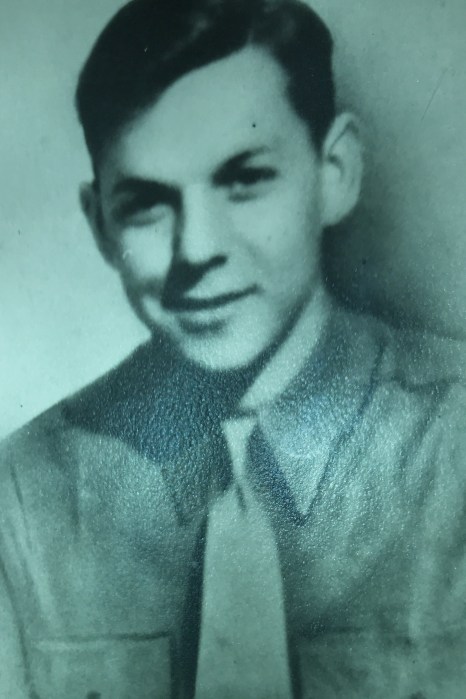
Staff Sargent Melvin Weissman

Melvin Weissman didn’t have to fight in World War II. 

As a machinist for an essential industry, he needed permission from his company to even enlist. He was first rejected by the army as he had flat feet. But the twenty-two year old was determined to fight for his county.

Undeterred, Melvin, along with several of his friends, tried to enlist in the United States Army Air Corp. This time, he was accepted, flat feet and all. When he said good-bye to his family, Weissman was overcome with emotion. “I knew I would never see my father again,” Weissman later told his daughter Diane Silverman. 

After basic training, Weissman was assigned as a flight engineer flying B-17s with the USAF, 94th Bomb Group, 331st Squadron, out of Bury-St. Edmunds, England.

Worries of a Jewish GI

Weissman had grown up in Brooklyn, the son of Nathan and Dora Weissman, Jewish Russian immigrants. He knew that “H” for Hebrew,  Jewish designation on his dog tags could cause a problem if he was captured by the Germans. He requested that his tag be changed to “P” for Protestant, to be worn on each bombing missions. 

Weissman and his fellow soldiers flew ten successful missions over Germany. On his eleventh mission, however, the plane was hit. He and several soldiers jumped out the plane safely; others lost their lives when the plane crashed.

When his parachute brought him into enemy territory, Weissman realized that he had accidentally worn the dog tags with the Jewish designation, the letter  “H.” He quickly tossed them away before a ten year old German boy found the scratched and bruised solider and turned him over to Nazi soldiers.

During his interrogation, Weissman was asked questions in English from a commander. In the same room, behind a screen, was another commander telling the interrogator in German what questions to ask the captured soldier.  Because his parents spoke Yiddish in their house, Weissman understood the Germans and knew the questions ahead of time. To further hide his Jewish identity, he gave his name as “Veismann,” a more German form of his Jewish name.

Weissman was sent to Stalag 17-B, where he remained a prisoner of war from January 11, 1944, to May 3, 1945. While he was in prison camp,  a neighbor of the Weissmans heard a blurb on the radio that Staff Sargent Melvin Weissman had been captured. His father, who was in failing health, said the he would believe this was true only when he heard from his older son.  A letter finally came to their Brooklyn address on April 2, 1944. Nathan Weissman died the next day.  Weissman’s premonition had come true. “My aunts told me he was just waiting to hear that Melvin was ok.” said Diane

In April 1945, as the war was coming to a close, 4,000 of the POWs at Stalag 17-B began an 18-day march of 281 miles to Braunau, Austria. The remaining 900 men were too ill to make the march and were left behind in the hospitals. These men were liberated on May 9, 1945. Those who survived the death march were finally rescued by American troops.

J is for ?

Weissman and his fellow liberated soldiers were shipped home to New York City. While sailing, Weissman was taken ill. When he arrived, he walked down the gang plank where doctors, pulling him aside, put a giant yellow J on his shirt. When he asked how they knew he was Jewish, they laughed. “We don’t know if you’re Jewish,” they said. “But we DO know you are jaundiced.”

Weissman spent three months in a hospital in New Jersey recovering from his imprisonment and subsequent illness. When a rabbi came in to tell Weissman that his father was dead, Weissman said, “I know. My mother and sisters never mentioned him in his letters, but I knew I was saying my last goodbye to him when I left for basic training.” 

Once he was healthy, Weissman returned home and got a job as a machinist for Templet Industries in Brooklyn, New York. He met Sylvia Laskowitz in January 1948. They were married six months later, on June 27, 1948. Their daughter Mona was born fifteen months later, and their second child Diane was born in 1953. 

Diane remembers a happy childhood, marred only by quirks that she attributes to his status as a POW. 

PTSD

“Dad was not a very trusting person except for his wife and two daughters,” said Diane. Although he never spoke about his war experiences while she lived home, Diane remembers hearing her father cry out in his sleep. She often found him sitting on the edge of the bed, covered in sweat. Diane did her best to soothe him, to try to help him move past his nightmares. 

By 2007, Sylvia, his wife of 58 years,  and Mona had both passed away. Weissman had severe heart problems and reoccurring bouts of  post traumatic stress disorder (PTSD) As he was no longer able to live alone, Diane and her husband Mark moved him into their home in Clifton Park, New York. More war stories started coming out. Weissman talked about his time in the camp. Conditions may have been difficult for American soldiers, but he spoke sadly of the treatment given to Russian and Polish POW’s. He also recounted his long days on the death march and his rescue. 

By 2010, Alzheimers had set in, and Weissman became very combative, “a tortured soul.” After some violent episodes in which he threatened Diane physically, Diana and Mark made arrangement to move him to Albany Stratton VA Medical Center. Three days before he was to make the move, Diane found her father dissolved in tears. “What is wrong, Daddy?” Diane asked. 

“I killed a man!” sobbed her father. 

“Do you mean in the war? Do you mean you killed a German soldier?” 

“Yes.”

“Daddy, if you didn’t kill him, he would have killed you. And you never would have been married to Mom or had your daughters, your four grandchildren, and the great-grandchild you have on the way.” 

This calmed him. It was also the last coherent conversation Diane had with her father. Hero’s Way, the hospice unit of VA Hospital, provided the care the exhausted and haunted ex-GI needed in his remaining days. Seven weeks later, on September 11, 2011, Melvin Weissman quietly passed away. His great-grandson Judah Benjamin Rome, who was given the Hebrew name Moshe Dov after Melvin and a paternal great-grandfather, was born November 22, 2011.

Noting Veterans’ Efforts

For several years, Congregation Beth Shalom had had a low-key breakfast on the Sunday before Veterans Day. Soon after his father-in-law died, Mark asked Diane if she wanted to honor her father by having them sponsor the breakfast.

Diane agreed, but only on her own terms. The danish and coffee were accompanied by huge plates of Diane’s luchen kugel, homemade quiche, and fresh fruit. Between seventy-five and one hundred members of the congregation and their guests, many themselves veterans,  attended the elaborate brunch for the next six years until the Silvermans moved to Connecticut in 2016.

Diane still has the American flag that was draped on her father’s coffin, and she proudly displays it on the wall of her living room. “I brought it to every Veterans Day brunch, and I proudly display it on the walls of our home,” said Diane. “It is my way of remembering an American Jewish GI, a former prisoner of war, and the best dad in the world!”

Originally published in The [Capital District] Jewish World on May 31, 2018 and the Heritage Florida Jewish News on June 1, 2018

Belarus Holocaust Memorial Project

How does one keep the memory alive of the 800,000 Belarusian Jews killed during the Holocaust? For two Jewish families with links to Florida., along with a couple from England, the answer was simple: One monument at a time. 

In the first half of the twentieth century, the Jews in Belarus were its third largest ethnic group in this Eastern European country. The population of cities such as Minsk, Pinsk, Mahiliou, Babrujsk, Vitsyebsk, and Gomel was more than 50% Jewish. Tragically, some 800,000 Jews—80% of the Jewish population—together with transports of Jews brought for extermination from the remaining communities in Western Europe, were killed in Belarus during the Holocaust. Many were killed by mass shootings, or “Holocaust by bullets,”  in which executioners massacred the victims in their own villages before the eyes of the neighbors.

In 2006 Dr. Michael Lozman, a Capital District orthodontist,  introduced Dr. Warren Geisler, a Capital Region dentist, to the Holocaust By Bullets in Belarus. As a one time partnership they, together with personal donations with the help of community donations as well, built a memorial to the 433 victims of the Holocaust in Grozovo, Republic of Belarus. The late Dr. Miles Kletter, a Capital District dentist and philanthropist as well as a dear friend of Geisler, generously donated to the site.

“Miles and Warren felt strongly about the injustice of the Holocaust and the tragedy of the Shoah,”said Marilyn Kletter. “They knew more needed to be done to remember the victims and serve as a warning to the future generations of what hate and bigotry can create when the people fall silent.”

Kletter researched and located Michael and Diana Lazarus in London, England, who had been building these memorials since 2003 through their Simon Mark Lazarus Foundation. After multiple discussions, Miles and Marilyn Kletter and Warren and Beverly Geisler and their respective families each formed foundations in 2008. Their donations, together with the Lazarus family, would be placed into what was called the Belarus Holocaust Memorials Project (BHMP) through the American Jewish Committee in New York City. 

These three foundations, together with Jewish communities and organizations across Belarus, established the Committee for the Preservation of Holocaust Victims’ Memory in the Republic of Belarus. The Committee, comprising dedicated and steadfast members of the community’s representative bodies, provides crucial support in identifying the locations and coordinating the construction of Holocaust memorials. 

In 2012, Cary and Joni Kletter, the son and daughter of Marilyn and Miles Kletter, took over their father’s work when Miles died of cancer. They are involved with BHMP on many levels: facilitating the foundation’s financial involvement, designing and managing the BHMP website; traveling to Belarus for ceremonies; coordinating with officials in Belarus; and working on the content and layout of the website.

The Geisler family is no longer is involved with the BHMP as Geisler is now   dealing with serious health issues. The Kletter children now manage the project. “The Geisler family was part of an incredible existential exercise into replacing the lost humanity on the ground,” said Geisler. “It was an incredible learning experience bonding with the Belarus Jewish Community. I walked the talk. No regrets.”

Beverly and Warren Geisler and Marilyn Kletter now split their time between homes in Upstate New York and Florida,  in West Palm and in Boyton Beach respectively.

Through research and the help of those individuals who lived in the area during the war, over five hundred mass killing sites have been identified. The number of Jews that died at each site ranges from 2  to thousands. Each year, the Belarus Holocaust Memorial Foundation selects up to six sites to place a memorial. As of May 2018, 110  Holocaust memorials designed by Belarussian architect Leonid Levin have been erected at Holocaust massacre sites in cities, towns and villages throughout the country. The goal of the BHMP:  To have memorials at every site.

At each killing site, a black granite tombstone, set on a flagstone platform mounted on a pedestal. Each contains inscriptions in three languages – Belarusian, English and Hebrew – stating that this monument was erected in memory of the victims of Nazism. Where known, names of the victims are noted.

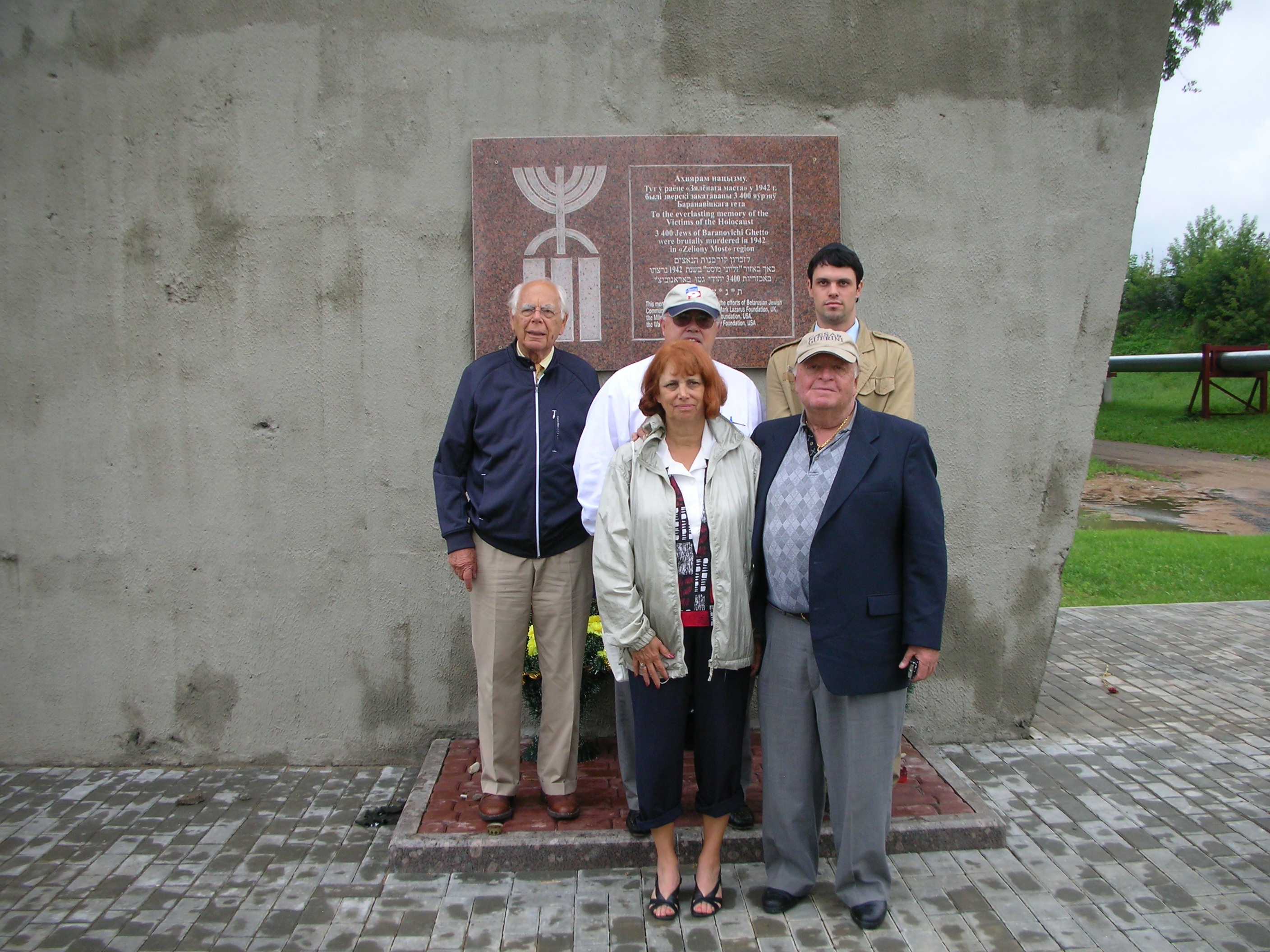
On July 26, 2009, a plaque was placed on a bridge abutment by a river  where 3,400 Jews  from the Baranovichy Ghetto were pulled off the cattle cars, shot, and dropped in the river in the Zeliony Most region. Another memorial has been placed in a rolling field near Bagerovo, Belarus, village  in which where approximately 4,670 Jews were forced to strip to their underwear, lined up, shot and buried in an anti-tank trench.

Dedication ceremonies drawing hundred of people are held at each killing site upon completion of the memorials. Many are from Belarus: representatives of the local authorities, members of the Jewish community, and representatives of Jewish  organizations functioning in the region. The Israeli ambassador to Belarus as well as ambassadorial staff members from Germany, United States, Great Britain, Israel, and the United States have also attended. Kletter said that at a dedication in 2017 the ambassador from Germany to Belarus publicly apologized to him and all the attendees for the atrocities that were committed.

Representatives of the Geisler, Kletter and Lazarus families have attended every ceremony, “Families suffered unspeakably tragic losses in Belarus during the Nazi occupation,” said Cary Kletter. “It is our earnest hope that knowledge of these memorials, in the cities, towns, villages, farmer’s fields, and forest clearings, the very sites where the massacres took place, will afford some small comfort.” 

Geisler said one his most unforgettable moments was when the last living survivor of the Minsk ghetto came to a dedication. After introducing himself, he thanked Geisler and BHMP for what they are doing to make sure that the Holocaust would not be forgotten.

Those who lost relatives or witnessed the atrocities also attend. A member of one of the grieving families said, “Now we have somewhere where we can stand to remember and mourn.”

Participants in the ceremony light candles in memory of the victims, say prayers, including Kaddish and El Malei Rachamim, and place flowers and stones on the monument. “It is a Jewish value to honor the dead,” Kletter said. “I feel like I am fulfilling a mitzvah.”

Geisler stated that there is urgency to build more of these sites as survivors and witnesses to these crimes of humanity pass on. Along with the 500 recognized sites in Belarus, more than 1,200 exist in the Ukraine alone. “There should be a memorial for the people, a memorial for where it happened,” said Kletter. “If nothing is done, these locations are lost to history.”

The rise of anti-Semitism in Europe has been disconcerting, noted Dr Geisler. In 2014, the Belarus Government requested that a memorial be placed at a site where 2,500 children from the Orsha Ghetto were killed in November 1941 soon after their brutal separation from their parents. The dedication was attended by numerous Belarus government officials and was broadcast on national television. Within a short time, the site was burnt and vandalized. Although it was rebuilt, the specter of hatred remains.  

“Let the world know this insanity must never be tolerated again,” said Geisler at one of the many dedications he has attended. “ Hundreds of years from now,  visitors of future generations coming to these  killing sites will bear witness to what happened.”

Further information regarding the Belarus Holocaust Memorials Project can be found at its website http://www.belarusmemorials.com.

Remaining part of bridge where 3,400 Jews were shot and thrown into river. Geisler and Kletter families.

A Grand master in tennis and life—Lazar Lowinger

Belgium. Romania. Paris. Cuba. Boston. Montreal. Florida. Lazar Lowinger may be considered the ultimate Wandering Jew. But his life is more of a testament of a very talented, intelligent, and generous mensch.

Lazar’s father Julius, a Romanian jeweler, and his mother Manya Gilburd, a Ukranian, met in Cuba, where they both had come to join their families. After they were married, they planned to emigrate to America. 

In 1933, however, Julius accepted a position as a jeweler with a prestigious company in Belgium. Lazar, their only child, was born soon after. In 1936, with Hitler extending his grasp on Europe, the Lowingers returned to Julian’s native Romania to be closer to his mother and, according to Lazar, “in search of a better future.” Ironically, Marshall Ion Antonescu, who was later executed for war crimes, protected the Jews from being deported to concentration camps.

Life was still fraught with danger. While living in Bucharest, the Lowingers’ house and courtyard were repeatedly damaged by Allied Forces bombs. “Every day, I got up, went to school, and prayed that our house would not be destroyed and my family and I would not be killed,” Lazar recalled seventy years later. The family survived in part through Julius’ resourcefulness by using the gold coins he had hidden away to buy food, always difficult to obtain in the war-torn county.

Once the war ended, the family decided to return to Cuba. After a six month stay in Paris while awaiting their visas, the three emigrated in 1946. Two years after their move, Julius and Manya divorced. In 1950, Julius moved to Montreal; and sixteen year old Lazar and his mother moved to Boston where Manya’s brother was a butcher. 

A self-admitted poor student, Lazar dropped out of school and enlisted in Army’s Special Services Unit. While stationed in Alaska, he obtained his GED . Upon completion of his military service, he enrolled in Boston University then transferred to Sir George Williams in Montreal. He returned to Boston and was accepted to Suffolk Law School, graduating and passing the Massachusetts Bar Exam in 1962. 

Lazar’s credentials, as well as his linguistic abilities—he was fluent in Yiddish, Romanian, French, Portuguese, and Spanish—were beneficial in his job search.He was hired by Elijah Adlow, Chief Justice of the Boston Municipal Courts, who sought a Spanish-speaking lawyer to appoint as counsel for the increasing Spanish population in the Boston area. 

As the first Spanish speaking lawyer in the Commonwealth of Massachusetts. Lazar made his reputation as the “Spanish Speakers’ Lawyer.” Throughout his law career, including establishing his own practice, Lazar defended a wide range of clientele, from those seeking workmen’s compensation to those accused of murder. 

In addition, Lowinger wrote for El Mundo, the Boston-based Spanish newspaper. He also hosted two radio programs: a Spanish “Ask Your Lawyer” and a “coffee hour“in which Lazar debated with other Boston lawyers. Lazar and his wife Audrey Schwellung, whom he married in 1965, settled in Newton, Massachusetts with their two sons Jeffrey (1966) and Brian (1968), despite offers to relocate to Florida with its larger Hispanic population. “I liked being a big fish in a small pond,” said Lazar.

Lazar loved law, but he loved tennis as much, or even more. Immediately following the end of World War II, Lazar had played table tennis and a version of squash at a Jewish youth center. Lazar was encouraged by a wealthy friend of his father to play tennis. At first Lazar was not interested—he thought tennis was for girls— but he quickly fell in love with the game. 

Lazar carried that love across the ocean. He won his first championship at the St. Lawrence Tournament in Canada while a student at Sir George Williams College. He also played in tournaments in law school as well as with fellow attorneys and local judges in Bench and Bar. “I never won a tournament against a judge,” said Lazar. “That was intentional!”

In 1989, Lazar, who was fifty-two years old, was invited by his friend and Macccabian Hall of Fame tennis player Irving Levine to try out for the United States men’s Maccabi team. When he didn’t make the cut, Lazar went to Puerto Rico and organized the Puerto Rican Maccabi team. 

In 1991, Lazar participated for the first time as a member of USA Maccabi tennis team. Lazar has gone on to represent his country six more times, initially in the Masters (Ages 35 to 65) division. Heralded by the Boston Jewish Advocate as the ‘Maccabi Maven,’ Lazar moved up to the Grand Master’s Division(Ages 65+) in 1998. 

“Grand Masters has no age limit,” said Lazar. “I will be playing until they put me in a casket,” His two most recent medal, a gold and a bronze, were earned in the 2017 Games, when Lazar was eighty-two years old. 

Lazar has also participated in several Maccabi Pan-American Games. In 2015, Lazar was invited to his native Cuba to join the team that played in the 13th Annual Games in Santiago, Chile. He won two silver medals, Cuba’s first in that age category and Lazar’s sixth. 

At his first Maccabi Game, Lazar met Marilyn Glaser who had volunteered as a nurse for the USA team in the two previous competitions held in 1981 and 1985. They connected again as friends over the next twenty years, he as the competitor, she as the volunteer. When Lazar was widowed in 2011, Marilyn sent him a note of condolence. Their friendship, based on their mutual love of the games and the close proximity of their homes in Florida, soon blossomed into a romance. They now share a home with their dog Malka in Solivita, a fifty-five plus community outside of Orlando. Marilyn, former president of the community’s Shalom Club, is the current president of Congregation Shalom Aleichem, the local synagogue. Weather and health permitting, Lazar still plays tennis at least five days a week. 

Although Marilyn lived in Israel for six years, Lazar’s mutual connection and love for Eretz Yisrael grew as his role as visitor and competitor. “Every time I go to Israel for the games,” said Lazar, “I feel like I belong there.” 

 “Building Jewish Pride through Sports” is the Maccabi USA’s motto, one that Lazar has taken to heart. While taking responsibility for his own expenses incurred during the Games, he has raised over $60,000 for other American athletes. “My participation and my support of Maccabi USA is my way of expressing my Jewishness,” the Grand Master tennis champion stated. 

Lazar also is a generous supporter of Israel’s Tennis Centers, the largest social service agency for Israel children. ITC serves more than a half million children and their families since its first center opened in Ramat Hasharon in 1976. With 14 centers on the country, primarily in underprivileged communities, the not-for-profit Centers use tennis to promote the social, physical, and psychological well being of their students, to develop coaches, and to maintain the courts and facilities.

Are there more competitions in Lazar’s future? He hopes to participate in next Pan Am Games, set for Mexico City in 2019. He will be 85. Stay tuned….

10 decades of memories: Patriarch Geisler to note 100th birthday

Southern Florida, will be rocking on May 17. On that day, Morty Geisler, a veteran of World War II and a successful businessman, will be celebrating his one-hundredth birthday. Dr. Warren Geisler, a retired Albany dentist and one of his six surviving children, shared stories about his beloved father. 

Mortimer Arthur Geisler was born on May 17, 1918, in Harlem, New York,  to Maxwell and Anna Grossman Geisler, both immigrants from Poland.Eighteen months later, Maxwell died in the Great Flu Pandemic. Life was tough for the family. Geisler grew up in a two bedroom walk-up with his mother, younger brother, and grandfather. They were supported by his grandfather and Anna’s three brothers.

Geisler, however, was bright and resourceful. After graduating high school at fifteen years old, he took a job as a stock boy in a haberdasher store. He made ten dollars a week, half which went to his mother.

In 1942, Geisler married Sylvia Sheer.  A year later, he was drafted into the army, where he, like many Jewish GI’s, Geisler encountered anti-Semitism. When some “Southern boys” began picking on him, he complained to his captain. Geisler never had any problems again. 

Geisler and six thousand other soldiers were shipped over to England. The soldiers were piled ten high in bunks in the bowels of a Liberty ship, which he remembered as a “floating cork.” Geisler and his division landed on Omaha Beach on June 9, three days into what would be known as D-Day.  He then followed General Patton’s 3rd Army through St. Low to Pont de Masson relieving Bastogne and crossed the Rhein and Ruhr Rivers on the way to Magdenburg where he joined General Simpson’s 9th Army on the way to Gottinger. His division was involved in closing the pocket in Hamm where 100,000 Nazis were captured and surrendered.

In May 1945, Geisler’s division entered Dachau concentration camp two days after its liberation. “My father witnessed the ferocity of the evil that the Third Reich had created,” his son Warren, a retired dentist from Albany, New York. ”Those images are still seared into his being until this day” 

“Thousands of corpses were scattered through out the camp,” said Geisler. “Survivors, mostlyJewish, were lice infested, walking skeletons. Still in their striped uniforms, these hollow-eyed slouched over beings managed to still smile as they thanked us GI’s for saving them.”

The war was still not over for Geisler. His division advanced to Pliessen, Czechoslovakia, where they faced off on the banks of the Elbe River against Soviet forces which kept  them from invading Czechoslovakia. Two weeks later he was transferred to Paris where he met up with his brother Maxwell and his recent French bride.

In October 1945, Geisler shipped out on the Queen Mary with 14,000 other GIs back to New York City. Five days at sea with seasickness was the tour du jour. My father never missed a meal and stayed top side for four of the days at sea. Once stateside he was honorably discharged two weeks later. The war and its battles were over.

Geisler found a job as a hosiery salesman for Ma-Ro Corporation, where he became its youngest national sales manager. In 1959, Geisler and  three other salesman opened Proudfoot Hosiery. As the eventual sole owner, Geisler licensed the first National Football League’s tube sock and the first non-slip sock. His company won the licensing for the 1980 Moscow Summer Olympics. He eventually sold the company, working for the corporations that carried his lines. He retired at 85.

Geisler and Sylvia had four children, Steven, Warren, Edward, and Jayne.  The Geisler was active in the Jewish community and were responsible, along with other Jewish World War II veterans for the founding of Temple Beth Emeth, a conservative synagogue in Hewitt, New Jersey. “They all wanted to work and provide for their families in a religious setting safe from the hell of the war’s mass murder and genocide,” said Warren. All three sons were bar mitzvahed there. Geisler was also a member of the Knights of Pythias, a fraternal organization that provides philanthropic work for numerous causes.

Sylvia passed away in 1971. A year later, he married Enid Friedman, a widow who had three children, Iris, Daniel, and Paul. While enrolled at Princeton University, Paul, a natural athlete and president of the college’s Big Brothers/Big Sisters,  was diagnosed with Ewings Sarcoma, an aggressive form of bone cancer. After his death, the devastated parents donated a library in Paul’s name at the Israel Tennis Association(ITA) in Kyriat Shemona, Israel. 

Geisler’s experiences in the war, Sylvia’s volunteer work for the American Red Cross, and Paul’s legacy instilled in the six surviving children a sense of service and provided a cornerstone for philanthropic  work for the entire family. 

Geisler now lives in an independent living facility in Tamarac, Florida. Although he himself says he is “slowing down,” he paints (a skill he learned when he was ninety years old) and watches sports and operas. He and his 94-year-old friend Evelyn Mitchell step out often for dinner, she in her stiletto heels. “She drives; I buy,” quipped Geisler.

Seventy-three years later, however, the images Geisler encountered in Dachau continue to haunt him. “When I was growing up,  I remember tapping him on the shoulder to wake him up,” recounted Warren. “I immediately stepped back in fear as he jumped up as he were still defending himself.”  When asked to be video-taped the research department of Yad Vashem the world Holocaust memorial Jerusalem, he refused. “He still has nightmares,” said Warren, and he could not relive the horrors.

Geisler is devastated by the atmosphere of hate and intolerance seen today in the world, especially his beloved United States. “I want my children and grandchildren to understand that we are a great people, a great country,” said Geisler. “I worry how the new generation will survive all the current animosity.”

Meanwhile, the Geisler family is planning a big party later this month. His six surviving children as well the eleven grandchildren and five great grandchildren will be there to celebrate the life of what one of the surviving members of The Greatest Generation.

“Many GIs did their duty and sacrificed their lives, limbs, and even their sanity as asked by this nation,” said Warren. “May those who have died either in the war or as long-time veterans rest in peace.”

Geisler himself looks back with gratitude. “I’ve lived a long, wonderful life,” the centenarian said. ”I’ve had two wonderful marriages and seven wonderful children. I am truly blessed.” 

Happy Birthday, Morty. May you live 120 years.

Jewish World, 

Pictures are available through the following link: http://jewishworldnews.org/10-decades-of-memories-patriarch-geisler-to-note-100th-birthday/

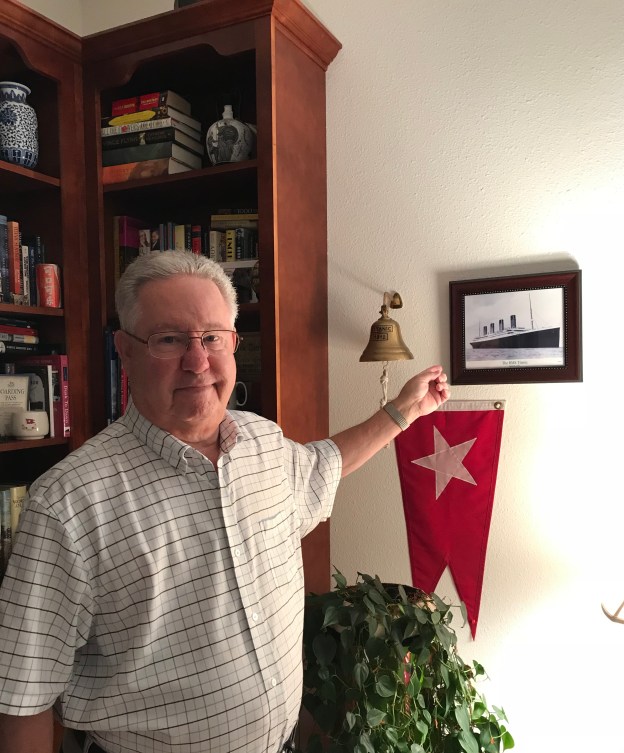
The Titanic Fanatic

On March 28, 1956, nine-year-old Steven Mattis sat mesmerized in his living room in Philadelphia as Kraft Theater’s adaptation of A Night to Remember unfolded. Based on the non-fiction book of the same name by Walter Lord, the one hour television production told the story of the maiden voyage of the RMS Titanic. At first enthralled by the beautiful ship, the glamour of the first class passengers, and the contrast to the third class passengers circumstances, Mattis’ fascination turned to horror as he viewed the shocking climax: Three hours after hitting an iceberg, the British ocean liner sank into the North Atlantic Ocean. Over one thousand five hundred men, women, and children perished. 

It was a life-changing event. That night, Mattis cried himself to sleep. “I realized that my parents could not save me from all of life’s dangers,” he remembered.

In the years that followed, Mattis spent much of his spare time reading and researching everything he could learn about the doomed voyage. His interest in the supposedly “unsinkable ship” has expanded over six decades. More recently Mattis has thrilled innumerable people who have listened to his lectures on the subject. 

The Titanic did not play into his professional career. For thirty-seven years, Mattis taught Spanish, first in Philadelphia and then for seven years in Fort Lauderdale,Florida. In 2005, Mattis moved to Solivita, an active 55+ community in Kissimmee. A seasoned traveler—he has been on 117 cruises so far—he joined Solivita travel club and  spent the next twelve years organizing and leading trips for its members. His travels have taken him and the travel club groups to China, Tahiti, Antarctica, Alaska, Hawaii, the Mediterranian, and safaris in Africa.

In April 2012, Mattis participated in the 100th Anniversary Titanic Memorial Cruise. The MS Balmoral, which sailed out of Southhampton, England, retraced the doomed liner’s fateful journey. For Mattis and many of its 1308 other passenger—seventy relatives of people who had died onboard or who had survived—the highlight was the moving memorial service. The ship sailed to the site of the sinking to be there exactly one hundred years to the hour. The commemorative ceremonies began at 11:40 p.m. on April 14 when Titanic struck the iceberg and ended at 2:20 a.m., April 15, when she sank under the sea. 

The following fall, Mattis presented a talk with accompanying slides on his “trip of a lifetime” to Solivita’s Travel Club.Before embarking on  a cruise on the Amazon the following year, Mattis posted a question to fellow cruisers: “Would any of you be interested in hearing my Titanic lecture?” The response was overwhelmingly favorable. Over forty people showed up at that first lecture. The cruise director, impressed with the depth of knowledge and passion Mattis conveyed, encouraged the “Titanic fanatic” to add additional lectures to his repertoire and offer the package on future cruises. Mattis and his best friend, Andy Miller, complied, adding three more lectures.The rest, as Mattis says, was history.  

Starting with groups in Solivita and local libraries, Mattis expanded his audience to multiple cruise lines, including Azamara, Royal Caribbean, Silversea, Princess and Celebrity. His audiences have been as large six hundred people, often growing over the length of the cruise as favorite word of mouth reviews spread throughout the ship. 

Mattis’ lectures are —no pun intended—a tip of the iceberg regarding people’s interest in the ill-fated voyage. Traveling expeditions, numerous museums, special events, television shows, and eight movies still draws crowds. (Mattis himself has seen A Night to Remember fifteen times and James Camerons’ Titanic close to fifty.) 

What brings people to Mattis’ lectures on a cruise ship when they could be sunning by the pool or learning how to fold napkins? Mattis believes that this is a story into which people can put themselves. Mattis said that the fact that the Titanic took close to three hours to go down puts people into the story.”’Who would I have been in the Titanic?’ people ask.” Mattis said. “Would I have been a hero? A villain? A first class passenger steeped in elegance? A third class immigrant in steerage?” 

The irony—the pure tragedy—also sparks peoples interest. “There was great hubris by both the designers and the captain in thinking that a ship—with a shortage of lifeboats for partly esthetic reasons—could be unsinkable and could run at full speed at night through ice fields after warning after warning of the danger.”

Mattis often  tailors his lectures to his audiences, as he did in 2015 when he gave a lecture on Jews on the Titanic for Solivita’s Shalom Club. Mattis, whose family belonged to Brith Israel, a conservative synagogue in Philadelphia, takes pride in the way prominent Jews handled their fate on the ship. 

As did many passengers, Benjamin Guggenheim, the fifth of seven sons of the wealthy mining magnate Meyer Guggenheim, initially did not realize the fatal consequences that would result from the ships’s collision with the iceberg. “We will soon see each other again! It’s just a repair,” he said to the women and children he and his valet were helping into lifeboats. Once he realized that he and many others would not survive, he returned to his cabin and donned his evening wear. “We’ve dressed up in our best and are prepared to go down like gentlemen,” said Guggenheim. Mattis said later accounts described the billionaire and his valet as last seen seated in chairs in the foyer of the Grand Staircase sipping brandy and smoking cigars, ready to accept their fate without fear or hesitation. Their bodies were never recovered.

Two other Jews who lost their lives on April 15, 1912, were German-born Isador Strauss, politician and the owner of Macy’s Department Store, and his wife Ida Strauss. The couple were on the Titanic traveling back from a winter in Europe. Once it was clear the Titanic was sinking, Isador refused to get into a lifeboat, stating firmly, “I will not go before the other men.”  Ida handed her fur coat to her maid, Ellen Bird, as she left the lifeboat, said, “As we have lived, so will we die, together.” In what eye witnesses later described as a”most remarkable exhibition of love and devotion.” Isidor and Ida were last seen on deck arm in arm.

Broadway producer Henry Birkhardt Harris was more successful in convincing his wife, actress Renee Harris to board a lifeboat without him. Earlier that day, Renee had broken her arm in a fall on the Grand Staircase. Convincing her that he could not save himself as well as his disabled wife, Henry refused a seat and also perished. His widow, who became New York City’s first woman theatrical producer, remarried three times and lived until 93. 

Not all Jews were first class passengers.Leah Rosen Aks, emigrating to America from London, was on the Titanic with her infant son Phillip. Leah and her son were separated in the confusion when they were being loaded on the lifeboats. “Filly” was thrown into another lifeboat; the inconsolable Leah was soon placed on Lifeboat 13. Soon after Carpathia rescued the survivors, Leah was walking on the deck when she recognized her son’s cry. However, the woman who had caught Phillip, regarding the baby as a “gift from God,” claimed it to be her own. In a scenario rivaling King Solomon, Leah pleaded her case to the Carpathia’s captain. Only when Leah was able to identify a distinguishable birthmark on his breastbone was Phillip returned to his birth mother. Leah and Phillip were reunited with her husband Sam in New York. They later had a second son, Harry, and a daughter, Sarah Carpathia—named after the rescue ship.

Mattis also related another note of Jewish interest: The Titanic had a kosher kitchen. On board was a “Hebrew” chef, a non-Jew from South Africa, who had trained with a rabbi in Southhampton on previous White Line cruises. A kosher option was available to all passengers, including those in third class.

Over one hundred years later, all the passengers are gone, not only those that died but those who survived. Millvina Dean, who was two months old when the vessel hit the iceberg, died in 2009 at the age of 97. 

Mattis regards the time he spends sharing the Titanic’s stories as his contribution to the legacy of the ship. “The fact that this story stays alive and is of interest to so many brings me joy,” says Solivita’s own Titanic Fanatic.

Originally published April 19, 2018. Updated May 26, 2025.

By Her Students She Was Taught….

The Parkland shootings, which took place in nearby Broward County, took place almost three months. I, along with many others, are trying to process this tragedy. Friends, family, former teachers, and current students are still sharing their thoughts with me, and those will be the topic of a future article. Meanwhile, I am sharing an article reflecting my own experience teaching a college preparation course almost twenty-five years ago:

May 28, 1993,  was graduation day at the Capital District Educational Opportunity Center, a division of Hudson Valley Community College which offers a wide range of programs and educationally  and economically disadvantaged adults.

During and after the ceremony, there were laughter, tears, and the inevitable thanks that we teachers receive from our students for the time we spent with them in the classroom. My college preparation students tanked me for guiding them through their term papers, helping them improve their study skills, and making sense out of difficult reading passages. What my students don’t realize is that I, as an adult educator, have learned as much from them as they learned from me.

I have learned about determination. Two and a half years ago, Michael was lying in a hospital bed, recovering from a construction accident that nearly killed him and ended his career. Rather than curing the powers that be, he decided, twenty years after finishing high school, to rebuild his life by pursuing a college degree.

“I’ve always believed that God never closes a door without opening a window,” Michael wrote in one of his essays. His window was going back to school. Despite the pain of his injuries, a long commute from Know to Albany, and family responsibilities, Michael came every day, motivated, determined, and optimistic that he would reach his goal. That same determination will serve him well at Hudson Valley Community College come September.

I have learned about courage. Sharon is a recovering agoraphobiac, a woman afraid to leave the shelter of her home. The first day of class, she learned that an oral presentation was a requirement of the course. She was terrified. Coming to school was enough of a challenge; speaking in front of a class was nearly impossible. The last week of class, however, her face white but determined, her hands gripping the podium for emotional and physical support, Sharon gave her speech to her supportive classmates. When she finished, the class broke into spontaneous applause.

I have learned about progress. Carmen was a D student at Colonie High School. Returning to our program at the age of thirty, he was convinced that he would barely complete my course. “I don’t think I deserve to pass,” he said. “I am not sure if I am smart enough to handle college.” His final essay belied his own belief. His piece on what was needed to succeed in college was nearly letter perfect and showcased the progress he had made this semester. “You deserved this A. You can succeed in college,” I wrote on his paper.

I have learned to be tough. Carol, a recovering addict who spent a friend time as a homeless person on the streets of Albany, a student who was repeating my course after failing in the fall, thanked me for taking off points every time she turned in a paper late. “It is important for me to take responsibility when I fail.” She also advised me to stop listening to the recovering addicts’ sob stories and start coming down hard on them for not completing assignments. “We know how to bulls**t you,Marilyn. Don’t listen,” she advised me.

I have learned about compassion. On the days that I was tired and ‘soul weary,’ as one of my  perceptive students said, the students cared about me. “Get some sleep Marilyn. We can wait for our papers.”

I also saw their compassion for each other: the student groups, the impromptu tutoring, the support that gave each other either in learning how to use the computer or in keeping up spirits when someone failed a test.

The students have given of themselves: a perspective comment, a good argument, a family story, and anecdote, a journal entry letting me know they are enjoying may class. I read essays about a very special Christmas, a child’s birth, a grandmother’s death, homeless families in bus depots, and numerous stories of recover.

I have been given much more. They have shared something of their lives. As a result, they have enriched me as both a teacher and a person. For this, I thank each one of them.

Who Made the Hamantaschen?


DSC_0037One of the nicest parts of our community in Florida is our diversity. Often, while I am working out in my exercise class or enjoying a concert or eating in our small bistro, I am struck by the number of people from all cultures, ethnicities, and countries that live here. An example of our melting pot was seen in the Shapiro’s Who-Made-the-Hamantashen Tale.
In May 2016, my husband Larry and I purchased tickets for a Flores de Mayo celebration that was being sponsored by our community’s Filipino Club. I had met several of its members through my cardio ballroom dancing class, and they had hyped up the event for several weeks before the May event. “Lots of fun! Great music,” one of the organizers told me. “Just bring a dish to share with your table.”

Although not familiar with Flores de Mayo, I knew of Cinco de Mayo, the Hispanic celebration held every year on May 5 that involved food and colorful costumes. We bought the tickets and made arrangements to sit with our friends Farida and Abdul whom we first met at a cocktail party for new residents of our fifty-five plus community.

Farida and I reconnected at the cardio ballroom class and struck up a friendship. She mentioned casually that she was involved in ballet when she lived in Egypt. One day, she shared a picture on her iPhone—a stunning portrait of her as Odette, a princess turned into a swan by an evil sorcerer’s curse in Tchaikovsky’s Swan Lake. Faridah was not just a dancer, she was a prima ballerina for an Egyptian ballet company. “Faridah,” I commented,” you are a ballet dancer like Billy Joel is a piano player!”  Not only was she involved in dance. Her daughter-in-law, a beautiful, vibrant Hispanic woman, taught the class.

I put the event on our calendar for the date in May and tucked the tickets away until I grabbed them on our way out the door that evening. When we arrived at the venue where the event was being held, the lobby filled with women in elaborate Filipino costumes and men in suits. For a moment I thought I was at a formal ball, not a Flores de Mayo program. When we entered the ballroom, we breathed a sigh of relief. Everyone in the audience was dressed in Florida casual—tropical shirts and shorts for men; capris or skirts and nice tops for the women.

We rushed to claim our two seats just as the formal program began. Filipino couples  began filing into the room, each group behind a large icon of the Blessed Virgin Mary. No, Flores de Mayo was obviously not related to the Hispanic holiday. Adapting quickly, we sat back and enjoyed the pageantry, the costumes, and the musical and dance entertainment that followed.

I later learned that Flores de Mayo is held each May to celebrate the finding of the True Cross in 320 C.E by Helena of Constantinople and her son Constantine the Great, emperor of the Roman Empire. The Santacruzan, which we had observed, is the ritual pageant held on the last day of religious Catholic celebration.

Once the program was over, we were able to say hello to our table mates. What struck me immediately was the diversity represented not only in the room but at our own table. Larry and I were enjoying a Filipino celebration of the Blessed Virgin Mary with Velma, our next door neighbor who was African American; our friends who had emigrated from Egypt and whose son was married to our Hispanic cardio ballroom instructor; and our down-the street-neighbor Nancy, whose last name spoke clearly to her husband’s Polish ancestry. We all unwrapped our “potluck” snack items: my hummus and chips; Velma’s fruit platter; Farida and Mohammed’s dukkah, a popular Egyptian dip made up of herbs, nuts and spices; and Nancy’s hamantashen.

Hamantashen??

“Nancy,” I asked. “Did you make the hamantashen?”

“Yes,” she said. “An old family favorite.”

“I didn’t know you were Jewish,” I said.

“I’m not,” she said. “My mother got the recipe from her German neighbor.”

“And she was Jewish?”

“No,” Nancy said. “She was Christian like us. She told my it was an old Russian recipe.”

So here were Larry and I, two Jews, at a table celebrating a Filipino Catholic holiday with an African American, two Muslims whose grandchildren were half Hispanic, and a Christian who made the best hamantashen I had ever eaten. Who knew?

The following March, I was in Colorado doing baby sitting duty for my granddaughter during Purim. Larry called me to tell me that someone had dropped off a plate of hamantashen. He didn’t recognize the woman, so I asked him to describe her.

“She is a woman about your age and your height with grey hair,” he said.

“That describes half the women in our community,” I said. “Maybe it was someone from the Shalom Club.” I listed a number of names with no success.

It wasn’t until I returned that I realized who had dropped off the hamantashen. While getting ready for my cardio ballroom class that was being taught by the Hispanic daughter-in-law of my Muslim friend, I spotted Nancy lining up in the back of the room.

“Nancy, did you bring hamantashen over to Larry last week?” I asked.

“Yes,” Nancy said. “I don’t think Larry recognized me.”

“No, he didn’t,” I said. “But he loved them and even saved some for me. How did you know it was Purim?”

“What’s Purim?”

It didn’t matter. Nancy’s hamantashen, no matter what her background, are the best. And her hamantashen will be served in our home this Purim. Chag Samaech!

A present-day Shabbos goy in Kissimmee

DkMVcT9VSEOPrz8DCpkOuQ

Cindy and Ruben Vazquez own Bellissimo Hair Salon in Kissimmee, Florida.

As I settled into my chair at the Shalom Club table at Solivita Club Expo, I put my pocketbook on the empty chair from the Bellisimo Hair Salon which was located next us. A few minutes later, a young Hispanic man asked me to move it so he could sit down.

“Hope you don’t mind,” he said.

“No problem!” I said. It’s your chair. And I put the bag on the floor.

A Shanda!

“It would be a “shanda” to put that nice bag on the floor!” he exclaimed.

I took a closer look at the speaker. He certainly looked Hispanic, not someone who is familiar with the Jewish word for shame or disgrace!

“Shanda!” I said. “Are you…errrr..are you Jewish?”

“No,” he said. “Better than that! I was a Shabbos goy on Long Island!”

For those who are not familiar with the term, a “Shabbos goy” is the Yiddish term for a non-Jew who performs certain types of work which Jewish religious law prohibits the Jew from doing on the Sabbath. And Ruben Vazquez, the son of Puerto Rican parents who came to New York in the 1960s is a self-acclaimed proud Shabbos goy!

A Warm Welcome

Ruben’s parents were born in Yabucoa Puerto Rico, and came to the Bronx in 1952 .  Ruben, their only child, was born in 1972. Ruben’s father, Ruben Vazquez Baez, was a professor of administration at City College in New York as well as a high school teacher at Park West on 50th St Manhattan. His mother, Gilda Vazquez was a supervisor at the Bank of America at the World Trade Center.

When Ruben was six, his family moved to Bayswater in Far Rockaway, Queens, on the border line of Long Island. At first, the Vasquez family was apprehension when they realized they were the only Hispanics—and the only non-Jews—in a modern Orthodox neighborhood. The first week they lived there, however, Mrs. Weiss brought them a pie. “Welcome to the neighborhood,” the rabbi’s wife exclaimed.

Ruben became friends with many of the children in the neighborhood. He remembers his friends and him using the yarmulkes as Frisbees. “The adults would not have been happy if they realized our game,” said Ruben.

 Learning the Rules

Ruben also began learning the complexities of the dietary laws. One day, he wandered into a friend’s garage while munching on a roast beef and cheese sandwich.

“Do you want half my sandwich?” Ruben asked his friend.

“No thanks,” his friend replied. “We don’t mix milk with meat.”

Ruben took the cheese off half the sandwich and offered the revised snack to his friend.

“Err…no thanks, Ruben,” said his friend. “I’ll pass.”

To earn money, Ruben started mowing lawns for his neighbors. He made more friendships and learned more about the “black hats.” They began to rely on him.

 A New Job

One Saturday, one of his friend’s mothers knocked on the Vasquez’ door. “Ruben, Moishe left the television set on in the upstairs bedroom. Do you think you could take care of it for me?”

Ruben gladly went over to turn off the set. Soon after, other Jews in the neighborhood were knocking on his door, discreetly mentioning hinting at some task that Ruben could “remedy.” His reputation as the Shabbos goy was set.

Meanwhile, Ruben was picking up many of the Yiddish expressions that peppered the conversations of his neighbors. They flowed off his tongue as easily as those who spoke the language of the “Old Country” regularly. He not only avoided sharing his sandwiches, but also understood the traditions that governed his adopted community.

 Cosmetology

When Ruben was going into is senior year of high school, his father asked him what he would like to study after his graduation.

“Cosmetology,” was Ruben’s quick reply. He had a great uncle and an aunt who were in the business, and Ruben had spent a great deal of time in their shops. “You can do anything you want—after college,” his father told him.

His first two years at Queens Borough Community College, Ruben studied liberal arts with a self-admitted minor in “looking for girls.” By his junior year, however, Ruben realized that he was interested in religion. A Catholic raised in a community of Jews, he completed a bachelors in theology. Over the next few years, he was involved in missionary work and even did some Pentecostal tent revival meetings. In between all of this, he got his certificate in cosmetology from the State of New York under an apprenticeship program.

He soon met Cindy Peguero, a transplant from Florida who also had a cosmetology degree. The two of opened two salons in Five Towns, Woodmere and Bensonhurst (Ragtime Brooklyn). They were also professors at Academy of Career Training and used their expertise to become platform artists and educators around the world , including Paris, England, Italy, Japan Thailand, South and Central America.

Jewish Clientele Again

In their shops in Woodmere, Ruben and Cindy catered to their modern Orthodox clientele. Ruben became an expert at cutting the hair and beards of the Orthodox men. He knew how to follow the Jewish rules on shaving, which were based on Leviticus: “You shall not round the corners of your head, neither shall you mar the corners of your beard (19:27)” .This involved very specific guidelines on how to shave the back of the neck and under the chin. Although most of the men didn’t wear payot, the long sidecars or sidelocks, the hair could not be cut above a certain spot on the cheekbone. Ruben could not work on the women’s hair (“That was a shanda!” said Ruben). That job fell to Cindy , worked with the women to cut their natural hair and fix their wigs.

Move to Florida

Ten years ago, Ruben’s parents retired and moved to Kissimmee, Florida. Ruben, Cindy, and their two children were spending more and more time in Florida. The visits increased when Ruben’s mother was diagnosed with cancer. The Vasquez’ decided to move south to be close to both their families. Ruben’s mother passed away in 2010. Ruben’s father has since remarried.

In 2016, Cindy and Ruben opened up Bellissimo’s, a salon down the street from a fifty-five community. They no longer are taking care of the modern Orthodox, but people from Solivita—many of them Jewish—have become their customers.

“Baruch HaShem!” said Ruben. With G-d’s help, my business will continue to grow!”

Originally published in The (Capital District) Jewish World, February 8, 2018

Floridian Shapiro notes her Tu B’Shevat refuge and credits its creator Edward Bok

IMG_1554

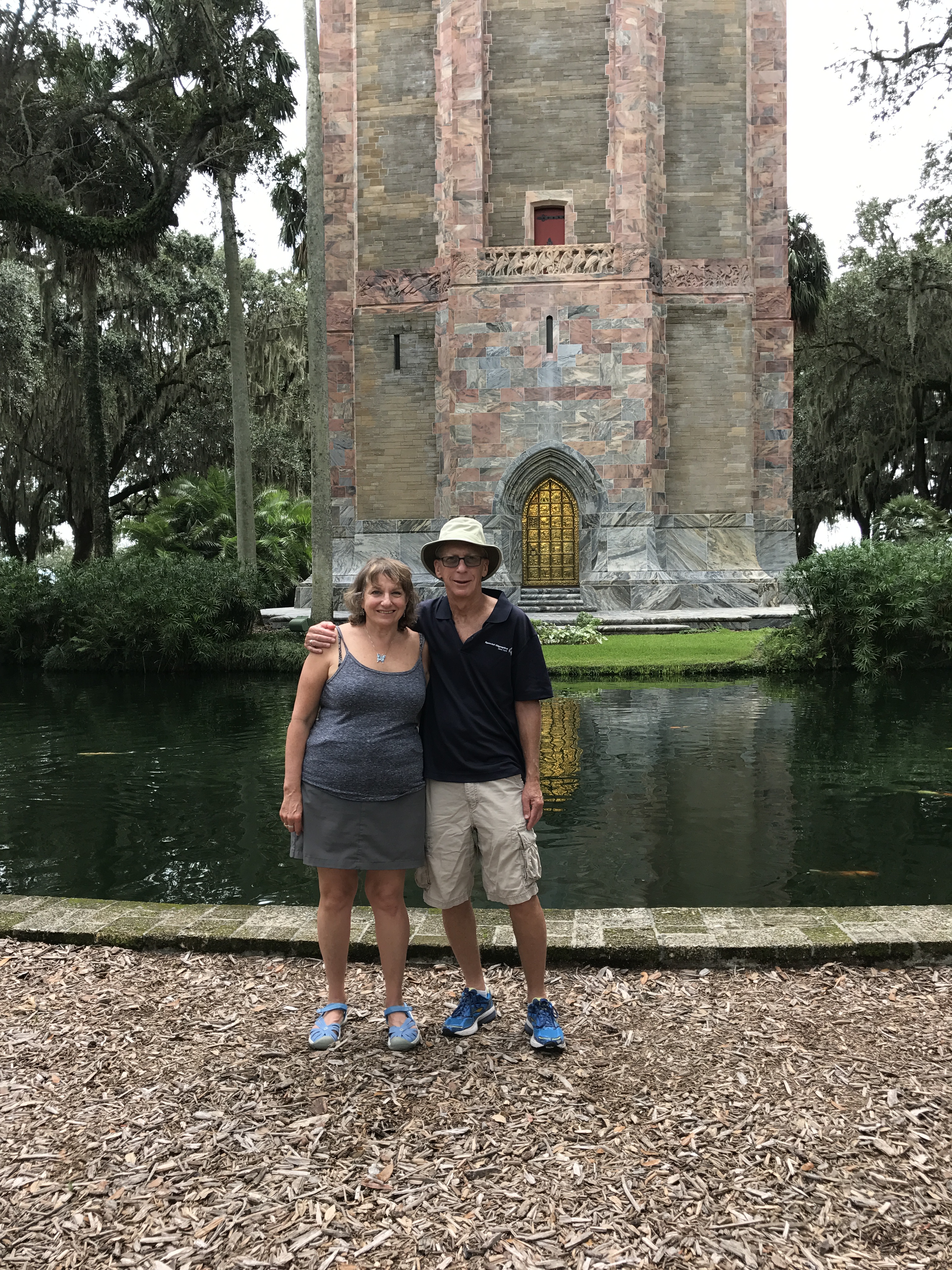
Larry and I in front of the Singing Tower carillon at Bok Tower Gardens.

Jews annually celebrate Tu B’Shevat, the day in which it is believed “trees come of age.” For those of us who live in Central Florida, there is no more fitting a place to honor the Jewish “Earth Day” than at Bok Tower Gardens. The sixty-acre sanctuary in nearby  Lake Wales was the gift of Edward Bok. Bok, the son of impoverished Dutch immigrants became a successful publisher, a Pulitzer Prize-winning author, a humanitarian and an advocate of world peace and the environment.

From Rags to Riches

Edward William Bok was born in Den Helder, Netherlands, in 1863. After a series of bad investments brought his father to financial ruin, the family immigrated to Brooklyn, New York, in 1870 to start a new life. Bok senior enrolled the children in school the day after they arrived in Brooklyn although neither of his sons could speak a word of English. 

Financial woes continued, and the family found itself in dire poverty. The two sons worked tirelessly to support their mother, who had lived most of her life with servants, by taking over all the household chores, picking up coal on the streets to light their fire and cook their food, and washing the windows of a bakery shop after school to supplement their father’s income. 

By 13, Edward Bok quit school and became an office boy for Western Union Telegraph Company.The youth used every spare minute in self-study, With his paltry savings, bought encyclopedia and studied to absorb its information.

Bok made an Horatio Alger journey in the publishing world. His rapid ascent included positions at the Henry Holt and Company, Charles Scribner’s Son, The Brooklyn Magazine and as co-founder with his brother, of the Bok Syndicate Press. In 1889, at the age of 26, he was hired as editor of Curtis Publishing Company’s The Ladies Home Journal. In 1896, he married the boss’s daughter, Mary Curtis, and they had two son. 

During his thirty year career, Bok used his position to champion causes, including social and environmental issues.

From Rags to Riches

By 1919, the 56-year-old self-made millionaire had achieved his two goals of education and achievement. He retired from the Journal, and wrote his autobiography The Americanization of Edward Bok, which won the 1921 Pulitzer Prize. It was now time to pursue his third goal: service to his country.

Throughout his life, Edward had been guided by his grandmother’s mantra to “make you the world a bit better or more beautiful because you have lived in it.” In the next several years, Bok used his wealth to create several awards, including the American Peace Award.

Edward also to help the world environmentally. During his family’s visits to their winter home in Lake Wales, Florida, he had often wandered up to nearby Iron Mountain,(a notable Florida “peak” at 298 feet above sea level) to view the vistas and the sunsets. Although acreage was initially targeted for development, Edward purchased the land to establish a place that would “touch the soul with its beauty and quiet.”

Sanctuary

In 1922, Edward commissioned Frederic Law Olmsted, Jr., an American landscape architect whose credits included the National Mall, the Jefferson Monument, and the White House grounds, to carry out the task. Under Olmsted’s direction, a year later, the barren sandhill had been transformed into a subtropical garden filled with trees, flowering bushes, flowers, and a reflecting pond that attracted squirrels and over one hundred varieties of birds. 

Not yet satisfied, Bok wanted to bring the gift of music to his garden. He commissioned architect Milton B. Medary and stone sculptor Lee Lawie to design and construct a 205-foot neo-Gothic and art deco Singing Tower carillon, one the world’s largest and, according to many carillioners, the most acoustically perfect bell tower in the world.

In December 2015, Larry and I visited Bok Tower Gardens for the first time. Impressed with its beauty, we took out a membership and have returned again and again—by ourselves or with family and friends. Sometimes we just walk through Olmsted’s well-designed garden paths, which offer hidden recesses, contemplative resting spots, picturesque vistas and breathtaking views of the Singing Tower. Each season brings its own beauty, including spectacular displays of azaleas, camellias, and magnolias.

Dutch Tikkun Olam

More often than not, we take a tour given by one of Bok Tower Gardens many volunteer guides. Each visit has brought greater appreciation for this hidden gem—its history, its flora and fauna, its music, its architecture, and more insight into the genius and generosity of Edward Bok. 

On the pathway leading into the gardens is an arch which is inscribed with Edward’s grandmother’s admonition to “make the world a bit more beautiful.” Each time I see those words, I think how closely they reflect tikkun olam, the Jewish concept that suggests humanity’s shared responsibility to heal, repair, and transform the world.

.Edward’s beautiful garden, stunning carillon, his sixty-five acres of trees and flowers and bushes and vistas, is his legacy, his gift, his way of making the world a better place. 

And in today’s political climate, I also think of how the son of impoverished Dutch immigrant contributed so very much to Central Florida and his chosen country. To Edward Bok and every other immigrant who has come to our country to find a better life and who, through their journey made our country better—I say thank you. 

Sources include The Edward Bok Legacy by Margaret Smith, Bok Tower Gardens website, and Wikipedia.

Originally published in The (Capital District)  Jewish World, January 25, 2018