Author Archives: Marilyn Shapiro

Unknown's avatar

About Marilyn Shapiro

After thirty five years in education, I have retired and am free to pursue my lifelong dream of becoming a freelance writer. Inspired by my mother, who was the family historian, I am writing down my family stories as well as publishing stories my mother wrote down throughout her life. Please feel free to comment and share.

A survivor’s story: “I live every day as a blessed person.”

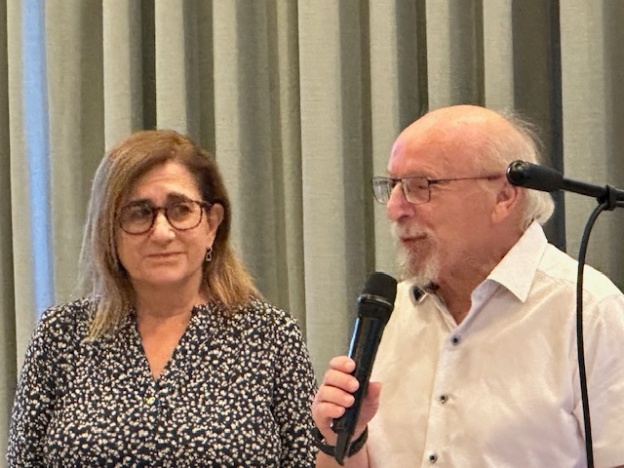
On May 5, 2024, our community’s Shalom Club held its annual Holocaust Remembrance, or Yom Ha’Shoah, event. Lou Ziemba’s story was one of the highlights of a moving, unforgettable evening.

Born  in wartime Poland, Ludwig“Lou” Ziemba is  a retired successful businessman, a polyglot a descendent of “Jewish  royalty’” and a Holocaust survivor. 

Lou’s story begins in Poland. Rabbi Menachem Ziemba, was the chief rabbi of Warsaw, a renowned holy figure in the Ger sect of the Chassidic movement, and a key player in the 1943 Warsaw Ghetto Uprising through his pleas that urged inhabitants to fight against their captors. 

“In the present we are faced by an arch foe, whose unparalleled ruthlessness and total annihilation purposes know no bounds,” Rabbi Ziemba told the Warsaw Ghetto inhabitants. “Halachah [Jewish law] demands that we fight and resist to the very end with unequaled determination and valor for the sake of Sanctification of the Divine Name.”

One of Rabbi Ziemba’s nephews was Henoch, son of his brother Moshe. Henoch was a bit of a non-conformist intellectual who spoke several languages and wandered around Europe. Henoch married a woman who was not approved of by his Chassidic family and thus he was no longer recognized by his large family in Warsaw.

As the Nazis rose to power, Henoch experienced both his wife and children being executed by the Nazis. Grief-stricken, Henoch returned to Poland and settled in the industrial city of Lodz, the second largest Jewish community in prewar Poland, after Warsaw.

With the outbreak of World War II and the German invasion of Poland, the life of Polish Jews deteriorated through a series of draconian laws imposed by the Nazis. In February 1940, after even more severe anti-Jewish measures were instituted, the Germans established a Jewish ghetto, initially trapping 164,000 Jews into a few city streets in a neglected northeastern section of Lodz. The widower Henoch Ziemba was one of those people. 

Soon after his arrival in the Lodz Ghetto, Henoch met and married 20-year-old Golda Farber, almost two decades his junior. Golda may have been small in stature, but she was, in Lou’s words “a firecracker” and “a force of nature.” Almost immediately, Golda became pregnant. For reasons lost in the family lore, Golda turned for help to Mordechai Chaim Rumkowski, who Primo Levi later wrote “morally ambiguous and self-deluded.”

To organize the local population and maintain order, the German authorities established a Judenrat,” or Jewish Council in the ghetto. The Germans appointed Rumkowski as the “kapo” of the Lodz Ghetto, whose job it was to oversee the day-to-day living as well as to decide who would live and who would die. Rumkowski was responsible for sending untold numbers to their deaths.

Known mockingly as “King Chaim”, Rumkowski was granted unprecedented powers. Rumkowski transformed the ghetto into an industrial hub for the Nazis, producing uniforms, wood and metalwork, and electric equipment. Rumkowski felt that, as long as the ghetto served a purpose by supporting the Nazi effort, the workers would avoid deportation to the gas chambers. His methods, however, were brutal: He oversaw the slave labor of anyone over 12 years old to work 12-hour days despite abysmal living conditions and near-starvation rations.

In his biography of Rumkowski, Yehuda Leib Gerst described this complex man. “Toward his fellow Jews, he was an incomparable tyrant who behaved just like a Führer and cast deathly terror to anyone who dared to oppose his lowly ways. Toward the perpetrators, however, he was as tender as a lamb and there was no limit to his base submission to all their demands, even if their purpose was to wipe us out totally.”

Furthermore, Rumkowski used his position to his own benefit. He singled out his political enemies for death and deportation to the death camps, and also deported those who had the capacity to rise up against their capturers. In contrast, those whom he favored were showered with extra provisions, medicine, rations, and safety.

For reasons lost to history, one of those receiving his benevolence was Golda Ziemba. With Rumkowski’s help, Golda was able to hide her pregnancy. A son, Ludwig, was born on September 9, 1942. 

 In late summer, Rumkowski was given orders to select 24,000 for deportation. Believing that the inhabitants’ survival depended upon their employment, he made the decision to hand over their 13,000 children under ten and their 11,000 elderly over 65 years old. He addressed the parents of Łódź as follows. “In my old age, I must stretch out my hands and beg: Brothers and sisters! Hand them over to me! Fathers and mothers: Give me your children!”

Again, for unknown reasons, Rumkowski worked with the Ziembas to save their infant son. He and Golda arranged for baby Ludwig to be hidden in a garbage truck. Once outside the Ghetto, he would immediately taken by a Polish farmer, whose family would raise him as their own in their Christian home. “It’s a miracle,” said Lou. “There were very, very few children who survived the Lodz Ghetto.”

As the war continued, conditions in the ghetto deteriorated, marked by a growing number of inhabitants being sent to the extermination camps. By summer 1944, as the Soviets came closer, the Nazis rounded up every remaining Jew they could find, including Rumkowski and his family, for mass extermination in Auschwitz’s gas chambers.Before their deaths, however, a group of Jews beat Rumkowski to death, a fitting ending for a man who many Jews regarded as bad as Hitler and his Reich. 

On January 19, 1945, the Soviets liberated the Lodz Ghetto. Over the course of last four previous years, over 220,000 had people passed through its gates. There were only 877 survivors, including Golda and Henoch Ziemba, who had managed to hide during all the deportations.

Golda and Henoch’s first stop after liberation was to reunite with their now three-year-old. son. Ludwig didn’t recognize or understand the emaciated but overjoyed strangers who spoke in Yiddish. Despite the Polish family’s reluctance to give up their “son,” his biological parents -against all odds- had returned. 

The Ziembas were the only three members of the family to survive. Rabbi Menachem Ziemba and the four hundred members of the family who had been trapped in the Warsaw Ghetto were all murdered by the Nazis.

Relocated to a German Displaced Persons camp, the Ziembas were soon a family of four. Lou’s sister Esther was born while Lou was away recovering from tuberculous in a German convent, where he learned his third language, German. 

So, to summarize Lou’s first 8 years of life, Lou was born a Jew during a period of extermination, hidden by a resourceful mother, taught Polish by a non-Jewish Polish family, taught German by nuns in a convent, recovered from TB, and taught Yiddish and right from wrong by his parents in a German DP camp. He never had to go to school, get circumcised, or even brush his teeth the entire time.

After a five year wait, the Ziembas immigrated to New York City in 1950. By the time he was nine years old, now known as “Lou,” was working alongside his mother at her small women’s shop in the Bronx that sold undergarments. His bar mitzvah was held in 1955, thus learning yet another language—Hebrew. Before Lou could be Bar Mitzvah’d, however,  there was one order of business that had to be taken care of at the local hospital, “a small snip of the tip.” Lou was heard screaming from every floor of the hospital “I DON’T WANNA BE A JEW!!!

When he was twenty-one, Lou opened a men’s clothing store down the street from his mother’s shop. As his business grew, in part because of Slax and Jax’s inventory of the newly popularly “blue jeans,” he convinced his mother to sell her store and join him in business. They soon opened three more stores.

However, as shopping malls sprang up, Lou realized the negative effect on his businesses. He sold them and went into the home construction business.  He, his wife Maxine (“Cookie”) Noble and their two children moved to “New City,” an affluent suburb of New York City. 

In 1999, the long years of his dedication to work took a toll on his marriage, and the couple divorced. Soon after, Lou met and married Beth Landa who happened to be related to his son-in-law. After the couple’s retirement in 2015, they moved to Florida, settling in Solivita, a fifty-plus active adult community in Kissimmee in 2023. 

“I’m aware of how lucky I am to be alive,” Lou says. “I live every day as if I’m a blessed person. I enjoy life too much not to do that.” 

Sources

Thanks to Lou Ziemba and Beth Landa for providing the interviews and information for this article. 

Cousins, Jill. “A Survivor’s Saga.” Lake Mary [Florida] Life.Winter 2017.

https://en.wikipedia.org/wiki/Chaim_Rumkowski

https://en.wikipedia.org/wiki/Łódź_Ghetto

https://en.wikipedia.org/wiki/Menachem_Ziemba

https://encyclopedia.ushmm.org/content/en/article/lodz

Memories Lost and Found

On February 27, 2007, my cousin Ellen called to share the sad news of the passing of her mother and my aunt, Nesbeth “Nesh” Hurwitch, The funeral was to be held in Queens, New York, on a Wednesday. My sister Laura would fly into Albany, and then my husband Larry would drive her, my mother, and me the three hours down to New York City. My father, who was 93, would not make the trip.

Nesh was my father’s younger sister, the third child of Annie and Joseph Cohen. She had always been my favorite aunt, and I think I may have been her favorite niece. She was funny and caring and generous. I had spent time with her, her husband Lou, and my cousins Ellen and Stuart in their cooperative apartment in Queens over Christmas holidays and summer vacations.I have fond memories of Freedomland, an amusement park in the Bronx; visits to Big Apple tourist attractions; and numerous times waiting in line for Radio City Music Hall events. When I had a summer job in the city between my junior and senior years in college, I stopped by for dinners and visits. 

After my Uncle Lou passed away, Nesh not only survived but flourished. She went back for her GED, her high school equivalency diploma  and even took some college classes. She traveled the country and the world. Her last few years were a slow, sad, decline, where she was confined in bed with round-the-clock aid provided by Poppy, a warm, caring Jamaican woman. To add insult to injury, she was diagnosed with pancreatic cancer, the same illness that had taken her husband several years before, and she died soon after that latest medical blow.

When my mother, sister and I got to the funeral home, Ellen approached Laura and me with a request. Would we please share a few words about our aunt?

I usually am good at putting together words on paper, but I was not great at extemporaneous speaking. What could I say? I reached into my brain for a fond or funny memory.

By the time Ellen asked me to speak, I was ready. In December  1964, I said, my mother, my younger sister Bobbie, and I met up with Aunt Nesh and our cousins in front of Radio City Music Hall for their Christmas show. Along with the showing of Father Goose, the movie starring Cary Grant and Leslie Caron, we would t: Rockettes in a line, dazzling sets, wonderful music.

We arrived by 10 am for the 12 noon show and began our two hour wait. I was, unfortunately, not a happy camper. The temperature was in the thirties, and I remember hopping from foot to foot to keep warm. I grumbled and moaned and complained as only a fourteen-year-old teenager could do. I remember everyone else holding up well, but I probably made my party miserable for the whole time. 

The irony, I shared, was that when we returned home to Keeseville, our tiny town in Upstate New York, Father Goose was playing at the Rex Theater. Less than half a block from our house, there were no lines, no wait, and, as it was the custom around the holidays, we got a plastic net Christmas stocking filled with candy with our twenty cent admission. Thirteen years later, I stood in front of a room filled with family and friends and recounted that special time with Aunt Nesh as I froze my toes off in New York City.

Laura also spoke, sharing moments with  Aunt Nesh, her humor, her kindness. Once the funeral was over, Larry began the two hour drive to the cemetery in New Jersey where Aunt Nesh would be buried. 

“You know, Marilyn,” said my mom. “That was a great story, but it wasn’t true.” 

“What do you mean?” I asked.

“Aunt Nesh wasn’t with us when we went to see Father Goose in 1964,” my mother said. “I had taken you and Bobbie down to the City for the Christmas break. We were staying with Grandma Ethel and Uncle Joe. Aunt Nesh, Ellen, and Stuart weren’t with us.”

Oh dear! I wanted to honor my aunt, and I had created a alternative universe! I was embarrassed, so embarrassed that I didn’t share my “mistake” with Ellen until years later. During the pandemic,, Ellen arranged a weekly Cousins Zoom, where my four siblings, Ellen, her brother Stuart, and our other paternal first cousin Joyce came together each Tuesday to talk about our family. It was on one of those calls, when I got on early before everyone else signed in, that I told her the truth about my “eulogy.” 

She didn’t remember joining us on that cold winter day many years ago. And it wasn’t as much a story about Aunt Nesh as it was about me. But that was okay. We were creating new memories on our Zoom calls. And that seemed to make it all right. 

Cousins Ellen and Stuart and Aunt Nesh

On Passover miracles

“There are only two ways to live your life. One is as though nothing is a miracle. The other is as though everything is a miracle.” Albert Einstein

The story of Passover, more than any other Jewish holiday, is all about miracles. A burning push. A staff that turns into a serpent. Ten plaques, each one worse than the previous one. The parting of the Red Sea. Manna coming down from heaven. Moses receiving the Torah. 

I have experienced what I consider miracles in my own life. Meeting Larry at a Purim party over fifty years ago. Holding our son and, three years later, our daughter, in our arms. Seeing flashes of ourselves and our children in our three beautiful grandchildren.

Just this past month, I experienced my own mini-miracle. On my fiftieth birthday, Larry gave me a pair of diamond earringsOnce I had second holes pierced into my ears, I put them on and only took them off to clean them. About ten years ago, I lost one of them when the backing came off. Six months and one earring replacement later, Larry found it when he swept our garage. I happily chalked it off to an amazing stroke of good fortune. 

I thought my luck ran out on Friday, March 31, 2024. While eating dinner at a restaurant with friends, I realized that I had lost one of my diamond earring again. I had no idea when and where. In the middle of the night? During an aerobic session at the Palms, our community’s recreation center? An hour later, while doing laps in the community pool? That evening, walking into the restaurant? Or anytime in the last week, the last time I remember feeling it on my earlobe?

I made a couple of phone calls to the appropriate places and did a thorough sweep of my house, car, and garage. I then resigned myself to ever seeing it again. I tried to be philosophical. It’s only stuff, I told myself. Friends had loss their entire house to a fire a year ago and were yet to even have a roof. Other friends had lost spouses and—worse yet—children to illness and accidents and suicide. I certainly was going to get past a lost earring. 

Exactly a week to almost the moment that I felt that empty space on my earlobe, as we members of Congregation Shalom were settling into our seats for the Shabbat services, my phone rang. “Marilyn, this is Anita at the Palms. I want to let you know that we found your earring!” A cleaning person, who was ironically on her last night on the job before moving an hour away, found my earring stuck in her mop. When I picked it up the next day, the backing was obviously missing and the post was bent. But my diamond was still intact. Luck? No, I consider someone finding my earring—and turning it in to lost and found— a miracle. 

More importantly, through my writing, I have been able to share stories of other people’s miracles. My great aunt Lillian Waldman was fired from her job at the Triangle shirtwaist factory a week before a tragic fire snuffed out the lives of 146 garment workers. Born and raised in Bialystok, Poland, Harry Oshinsky faced innumerable obstacles as he navigated a three year journey over three continents, arriving in Brooklyn, New York in 1916. 

Along with immigrants’ stories, I also shared miraculous stories from World War II and the Holocaust. United States Army soldier Melvin Weissman survived a plane crash and the subsequent sixteen months in a German POW camp, using his knowledge of Yiddish to provide needed information to his fellow prisoners. Galina “Golda” Goldin Gelfer and her father spent two years hiding in a Russian forest with Soviet partisans, living as did the real-life Jews portrayed in the 2008 movie Defiance. Seven-year-old Estelle Feld Nadel, hours away from being deported to Auschwitz after being captured by Nazis, escaped from a prison cell and found shelter and refuge in the home of Righteous Gentiles. By his own account, Albert Kitmacher credited his survival during the Holocaust with five miracles that snatched him out of the jaws of death. Eva Geringer Schloss, along with her mother, survived Auschwitz/Birkenau and recently held her first great-grandchild. 

As I write this, parts of the country are now experiencing a total eclipse. Scientists can provide a logical, calculated explanation, but even they were celebrating this once-in-a-lifetime moment. Dr. Charles Liu, Graduate College/Staten Island, called the totality of the April 8, 2024, event nothing short of a ridiculous coincidence of cosmic proportions. The astrophysicist, an award winning educator who hosts the LIUniverse podcast, offered up on YouTube his own rendition of a Cat Stevens song: “We are going to see a moon shadow, moon shadow, moon shadow. Looking and laughing in a moon shadow.” 

Moses and the Israelites may have experienced a solar eclipse through the ninth plague. God tells Moses, “ Hold out your arm toward the sky that there my be a darkness upon the land of Egypt, a darkness that can be touched.” (Exodus 21) to stretch forth his hand that a darkness might be placed over Egypt, a darkness that could be felt.”  The darkness encompassed the Egyptians for three days, but the Israels “enjoyed light in the dwellings.” In those circumstances, the eclipse must have been viewed it as a miracle, a message from God.

No matter what, this Passover, I will hope for miracles. I hope that my friends who have been diagnosed with terminal cancer will go into complete remission. I hope that scientists will find a way to deal with climate change and global warning. And most of all, I hope for the miracle of peace in the Middle East and the world. Shalom. Chag Sameach. 

https://www.gc.cuny.edu/news/why-2024-eclipse-will-be-epic

Tanakh. The Jewish Publication Society. Philadelphia1985.

Photo Courtesy of Wikimedia Commons. Moses and the Children of Israel Crossing the Red Sea, c.1855, by Henri Frédéric Schopin

Remembering COVID Fatigue and some (heavenly) family support

This essay was originally published in March 19. 2021, The Jewish World. It reflects how just before Passover, the deep connections with my family and the memories we made along the way helped me get through a low point in the pandemic. It can be found in my fourth book, Keep Calm and Bake Challah: How I Survived the Pandemic, Politics, Pratfalls, and Other of Life’s Problems.

Passover will not completely pass over us this year. When the spring holiday occurred last year, we were only three weeks into the reality of the pandemic. Larry and I had a small, quiet, seder for two. On March 27, we will have a virtual Zoom seder with our Kissimmee, Florida, synagogue.

My husband Larry and I have been fortunate. As were our Hebrew ancestors, our family and circle of friends have been spared the “angel of death” in that we lost no one to this (God willing) once in a lifetime scourge. Friends who contracted the illness have survived, albeit with some lingering effects that we hope and pray will result in a r’fuah sh’leimah, a ,complete recovery.

Despite my gratitude, too many times during this year of the pandemic felt that more than Passover had passed us by. I know I share the feelings of so many others that we have lost a year of our lives.It has not only been the life events—first birthday parties, bar mitzvahs, weddings, graduations, even funerals. It has also been the small things: a restaurant dinner with friends; a movie or play, a live sporting event, a simple hug from a friend.

This feeling of ennui especially hit me when February arrived. When we lived in Upstate New York, the second month of the year had always been difficult as I was tired of the cold, the snow, the bleakness of winter. Now that we were living in Florida, we were liberated from the end-of-winter blues. Larry and I still were able to enjoy long walks and long bike rides in the sunshine. Physically, I was doing fine. But emotionally, I felt sad and cold and dark. Would this pandemic ever end? Would our children and grandchildren be able to get vaccinated? Would we be able to travel to see them this summer?When would the world begin to turn to normal?

Getting on Zoom calls was a chore; if I did sign on, I remained quiet, content to work on my crewel piece or check my text messages.Telephone calls were even more difficult; it was just too much work to talk about our endless Groundhog Day routine: morning exercise; afternoon puzzles and projects; late afternoon dinners; and evenings on the couch watching Netflix or reading a book.

In the middle of all this, I was working on my third book. When completed, Fradel’s Stories will compilation of a number of essays my mother had written in the last five years of her long life as well as essays I had written about my parents and family, many which had been published in The Jewish World. My mother had passed away on March 2, 2011, and I was determined to get the first “run” to my editor to correspond with the tenth anniversary. I devoted hours to organizing, editing, and re-editing. What should have been a labor of love was turning into just labor. Of course, that put more pressure on me, something that I certainly didn’t need in my emotionally depleted state.

On the third Saturday in February, I opted out of my usual exercise-in-the-morning routine and continued editing the second hard copy of the manuscript. When I got to the chapter that Mom had called My Romance, I brightened “The saying goes, ‘You have to kiss many frogs until you meet your true love,’” my mom had written in one of my favorite stories. “Well, I knew many frogs.” She then went on to describe the Toms, Dicks, and Harrys she dated while living and working in New York City until she was introduced to Bill Cohen, her brother and her cousin’s co-worker in an Upstate New York clothing store. 

After a whirlwind three month courtship, my father proposed over ice cream on February 14, 1940. “We had just seen Gone With the Wind,”Mom wrote. “Bill must have thought I was Scarlett O’Hara, and I must have thought he was Rhett Butler.” They were engaged!

Over the next six months, they carried on a long-distance romance. Separated by over 300 miles, they saw each other infrequently but wrote each other often. Mom had kept the letters in her dresser her entire life.“Where are they now?” I thought. Then I remembered that I had found them when my siblings and I were emptying her apartment soon after my mother had passed away. They were in a metal box that held all my treasured correspondences.

Even though I had been known about my parents’ love letters for at least sixty years, I had never actually read them until that Saturday morning. The first one I read, from my father, spoke of feeling “sad and cold and dark. “ Oh my goodness! He was describing me! His remaining letters expressed his love and excitement about their pending marriage. My mom’s letters shared some of his romantic sentiments, but the majority of them described wedding preparations and constant reminders for Bill to get his Wassermann test before the August 20 ceremony. 

After reading them all, I called all three siblings to share the emotional news of my find. That triggered more memories, more family stories. Laura reminisced how her eight-year-old self had found our parents’ love letters and decided to play post office by delivering them to each of the mailboxes on Waverly Street. Jay remembered how, while living in that same Upstate New York house, he and a fellow five year old had called the fire department to report a “blaze” so the two of them could get a first hand look at the town’s new fire engine. Bobbie remembered another letter—the one my parents had written to her in 1977 when, as a recent college graduate, she was struggling to find a job—that she still has kept over 43 years later. 

After my phone calls, I went back to the kitchen table to resume work on my book, but I was no longer alone. My siblings’ stories echoed in my mind. More strikingly, I felt my parents’ strong presence, surrounding me with encouragement to keep writing and with quiet assurance that “This too shall pass.” Recalling through their stories how they had survived the Spanish Flu, the Great Depression, World War II, and their own nine decades of ups and downs, I knew my family and I would survive COVID-19 and its resulting tsouris-troubles.

Ten days later, I felt confident enough to send my manuscript to my editor. We still have months of work ahead— more editing, picture placements, cover design. But I know that on September 1, what would have been my mother’s 104th birthday, Fradel’s Stories will be launched on Amazon. 

Soon, I will give my house a thorough cleaning, make my chicken soup and matzoh balls, chop up my apples and nuts for the charotzes, set our table for our Zoom seder. With all the recent good news of the medical front, I have faith that next year’s seder will be a more crowded, joyous, affair. Meanwhile, Passover and spring are here. Thanks to the love and memories my parents and siblings have shared with me, I no longer was sad and cold and dark. I was happy and warm and filled with light.

A version of this article originally appeared in the Jewish World News, a bi-weekly subscription-based newspaper in upstate New York.

My parents, Frances and Bill Cohen, on their sixtieth anniversary, August 20, 2000.

Contemplating Purim heroines in the #MeToo era

Fifty-one years ago this March, Larry and I met at Purim party held at in the upstairs floor of a restaurant in Albany, New York . In a corny, hastily put-together shpiel, Larry a.k.a. Ahasuerus chose me a.k.a. Esther bypassing my competitors, Libby the Lib and the sassy, insolent Vashti.

Would Larry have chosen me if I had played Vashti? After all, for most of Jewish history, she was portrayed as the headstrong, rash woman who incurred not only the wrath of King Ahasuerus, but also the condemnation of the other male leaders of Persia. “Not obey the king? Why, next thing you know, all the women in our kingdom will be disobeying the men in their lives!” they cried. “Banish the hussy! or even better yet, execute her to set an example!”

In Purim party after Purim party, most girls—and women— have preferred to dress up as the beautiful, passive replacement who obediently followed the edicts of her husband, King Ahasuerus, and the directions of her uncle Mordechai. Fearing the same fate as her predecessor, even when faced with the extermination of all the Jews in Persia, Esther took time approach her husband. She fasted for three days, threw one banquet, then another, and waited patiently and gracefully for the right moment to revel the evil machinations of the notorious Haman.

Esther finally came through for us, resulting in her always being viewed as the heroine of the story. With age, wisdom, and more feminist leanings, I have learned to cheer for Vashti, who refused to bow to her husband’ misogynistic demands to dance naked in front of a group of of inebriated male chauvinists. In a 2023 article in the [Harvard] Crimson, writer Arielle C. Frommer dates the history of feminist interpretations of the Purim story to as early as the mid-nineteenth century. Elizabeth Cady Stanton, a 19th century leader in the women’s rights movements, described Vashti as “a sublime representative of self-centered womanhood.” Harriet Beecher Stowe, abolitionist and author of Uncle Tom’s Cabin, praised Vashti’s resistance as a “first stand for women’s rights.” “We shall stand amazed that there was a woman found at the head of the Persian empire that dared to disobey the command even of a drunken monarch,” Stowe wrote.

The praise for Vashti continues into the present day. LaVerne McCain Gill, journalist and pastor, describe Vashti as a “model of rebellion against the patriarchy.” Christian Pentateuch scholar Alice L. Taffy views the disgraced first wife as a greater hero for her lack of dependence on any male figure to make her decision. As while many stories feature Jewish heroes vanquishing their persecutors, Frommer writes that the Purim story is “dependent on a female heroine taking a stand against a patriarchal monarchy, thus linking Jewish liberation directly to the feminist experience.”

So if Vashti was banished but not beheaded, I wonder what happened to her? Did she escape to another country that respected strong-willed women who stood their ground? And did King Ahasuerus and Esther live happily ever after, enjoying wine and challah on Shabbat? Did he give up excessive drinking and look at not only Esther but all women with more respect?

In this election year, it may be wise for all women to remember the story of Purim and the traits of these women. In 2022, the United States Supreme Court overturned Roe vs. Wade, ending the federal constitutional right to abortion in the United States.

According to Planned Parenthood, as a result, one in three women now live in states where abortion is not accessible. In the first few months after Roe was overturned, 18 states banned or severely restricted abortion. Today more states are working to pass bans. 

The resulting stories have been horrifying. In Florida, a woman was forced to carry her child to full term despite the doctors’ knowledge that he would die shortly after birth. In Texas, doctors in one hospital told a a 25-year-old woman whose ectopic pregnancy endangered her life to “go home and wait.” [She had emergency surgery 24 hours later in another hospital, where the doctor said she came close to losing her life. In Ohio, a 10-year-old child who had been raped by a family member had to travel to Indiana for an abortion. 

Conservatives may have rejoiced with the Supreme Court decision, but it has resulted in a voter backlash. According to a Reuters/Ipso poll taken in December 2023, it resulted in limited Republican gains in the 2022 congressional midterm elections, as well as propelling Democrats to victories in recent off-year elections. The same poll reported 70% of Americans said protecting abortion access in their state would be an important issue in determining their vote in November, including around two-thirds of independent voters. The poll also showed that half of Americans said they would support a law legalizing abortion nationwide, including close to one-third of Republicans.

Who is in the forefront of the battle? Women.For many women, protecting reproductive rights have become the number one factor in voting decisions. “I am a one-issue voter,” a friend told me recently. “I believe in a woman’s right to chose.”

Old white men in expensive suits and $300 haircuts are denying those rights. It is time for us women to take some lessons from Vashti. She believed that she had the right to choose what she did with her body. In 2015, my hero Ruth Bader Ginsburg said, The state controlling a woman’s body would mean denying her full autonomy and ultimately full equality.” Vashti would agree. 

Reproductive rights were center stage in President Biden’s State of the Union address earlier this month. “With all due respect, justices, women are not without electoral or political power,” Biden said. “You’re about to realize just how much.” 

Remember Vashti’s actions. Remember Biden’s words. And remember them when you vote in November. 

Larry and Marilyn, March 18, 1973  

The pest in the attic…

The Pest in the Attic

In October, 2023, on a miserable, windy, rainy day, Larry and I found a puddle on our kitchen floor. Looking up, we could see water coming from one of our recessed light. Damn!

We called a roofing company the next day. After spending an hour directing a hose onto spots on the roof, the roofer found nothing. “Just call us if it happens again.”

It did. On December 23, on another miserable, windy, rainy day, we had to again pull out the buckets to catch the water dripping from the same spot.

As promised, the roofer came back free of charge. This time, he found the problem. The flashing had not been installed properly when the house was built, resulting in a spot where water had gathered. The wood in the attic was mildewed and rotting. The roofer was honest: his company specialized in shingle roofs. He couldn’t guarantee they could fix it and recommended we contact another roofer.

We called another roofing company that had been recommended by a friend. The representative confirmed the problem and said his company had seen this several times in Solivita. We signed the contract, forked over half the payment, and waited for the repair, thankful for dry weather in the meantime.

On Wednesday, February 7, 2024, the roofers came as promised. Five hours later, the job was done. Of course, we could have taken a cruise on the money we paid, but the leak problem was solved.

Less than an hour after the roofing crew left, we heard a sad, moaning sound in our attic above our bathroom. Oh no! It sounded as if an animal had gotten into the attic when the roofers were working on the problem and had gotten trapped. 

We texted the roofing company.

“Oh no! So it sounds like something may have pushed through your soffit,” a representative wrote back. “I’d definitely walk the perimeter of the home and check to see if the soffit is pushed in or damaged anywhere.”

Then came the less helpful comment. 

“Unfortunately we cannot get any animals out from an attic, that is something a trapper or pest control would have to do.”

We called our pest guy on Friday. Meanwhile, I put out a recommendation request on Next Door. People wrote back suggesting DYI solutions—mothballs, noise, cats. Along with the names of companies, people shared frightening stories of rabid raccoons, slithering snakes, and aggressively agile alligators. 

Our bug guy finally texted us Monday. No, he didn’t do animals. Just bugs. He texted me the name of an animal control company. 

“We’ll come out for a free estimate on Thursday,” we were told

And if there is an animal?

“The cost will range from $500 to thousands of dollars, depending on the animal and the damage.”

I immediately texted the roofing company again.

“Considering we noticed the sounds literally an hour after work was completed, we can assume the animal was trapped during the work,” I responded. . It’s turning into what can be a very expensive follow-up to what was already a huge expense. Would it be possible for someone to come and at least crawl into the attic, maybe releasing the animal?”

I also contacted the concierge in our community, who gave us a name of a local person who trapped animals at a more reasonable cost. “Johnnie” could come Tuesday at 2:30.

Meanwhile, the general manager of the roofing company called Monday night. He said that animals usually don’t go in with all the banging and hammering, but he was willing to split the bill.

On Tuesday, “Johnnie”, albeit  three hours late, arrived at our home. Ninety minutes and $350 later, he found nothing. Nada. No animal. No droppings. No noise. No nothing. He left a trap and said he would be back the next day.

That night, while in the bathroom doing our nightly ablutions, we realized that the squeaking, moaning sounds were in synch with our turning our faucets off and on. Eureka! It wasn’t an alligator or armadillo or an anhinga in our attic. It was pressure in our pipes, Shoot! Did we now need to call a plumber?

The next morning, on a hunch, I went outside and checked the outside hoses. Yes, I had turned off the front hose when I watered the plants on Wednesday. Whew! Not my fault! Then I checked the back hose. Mystery solved! When the men were fixing the roof, they must have used the outside hose in the back of the house. Our hose attachment was in the “off” position, but the water had been left on. Because of that, there was pressure in the pipes. I turned off the water connected to the hose. Voila!! The sound stopped immediately. 

Six days and a huge chunk of money later, the roof was repaired and the noise that had been driving us crazy was gone. Thankfully we figured it out before we called a plumber. But we are hoping that the roofing people will step up to the plate and pick up the entire bill for the pest guy.* Hey! I don’t mean to be a pest! But I will be badgering (Raccooning? Squirreling?) them until we get this settled. 

PS: They didn’t.

The mess before the “pest.”

Heritage writer has a blog to appease her “inner geek”

This article was published in the Orlando Heritage Florida Jewish News on February 23, 2024. Thanks to Christine Sousa, Editor, for all her support!

This March, Marilyn Shapiro celebrated a milestone in her writing career: the tenth anniversary of her blog, There Goes My Heart.

Wait! You don’t know she has a blog? And if you knew, you have never typed www.theregoesmyheart.me into your browser? Well, you don’t know what you have been missing!

In 2014, with only about 10 stories published in the Capital Region, New York’s The Jewish World, Shapiro decided that she needed a blog as another way to share her stories and to appease her inner geek. After researching a few options, she chose WordPress, “a web content management systems that was user friendly for even newbies like me,” she shared. 

Along with home page and contact pages, Shapiro posted her first 10 blog posts. Leading the list was “There Goes My Heart,” her very first article that was published in August 2013. Fittingly, Shapiro chose it as the name for her blog. She was in business!

When Shapiro and her husband, Larry, moved to Florida in 2015, with over 20 articles under her belt, she met with a neighbor who taught computer classes in the Shapiro’s community. Working with her, Shapiro was able to add more bells and whistles, including a Home Page menu that provided access to her increasing list of articles. A “Follow” button encouraged readers to sign up to get my blog post delivered to their email accounts. 

By 2018, with two published books to her credit, she added a “Marilyn’s Book” page. Along with a summary of her essay collections, it offered the user the ability to click directly onto the Amazon website, where one could purchase a Kindle or paperback version. 

Shapiro now has four books listed: “There Goes My Heart” (2016), “Tikkun Olam: Stories of Repairing an Unkind World” (2018), “Fradel’s Story” (August 2021), and “Keep Calm and Bake Challah: How I Survived the Pandemic, Politics, Pratfalls, and Other of Life’s Problems” (2023). She even offers a preview of her fifth book, “Under the Shelter of Butterfly Wings: Stories of Jewish Sacrifice, Survival, and Strength.” 

Many of Shapiro’s articles are personal: her ancestors’ lives in the shtetl before immigrating to America; her childhood in a small town in Upstate New York; meeting Larry at a Purim party, their years raising two children; their retirement years, their travels and their growing family. Some are humorous: Their love affair sealed in (a kidney) stone. Her daughter’s not-so-welcoming attitude when Shapiro volunteered to chaperone her daughter’s school trip. Receiving the moniker “Bubbe Butt Paste” after the birth of their first grandchild. And some are more profound: Larry and Marilyn’s visit to a Holocaust memorial after the Pulse tragedy in Orlando; wintering through the pandemic; reflecting on the Israeli-Gaza war during the eight days of Chanukah. 

In 2017, Shapiro wrote an article about Harry Lowenstein, a Holocaust survivor (published in the Heritage, “A Holocaust survivor revisits his past,” May 19, 2023). 

“Its impact on me resulted in expanding my writing to include heartfelt stories about ordinary people with extraordinary stories to tell: other Holocaust survivors, righteous gentiles, Jewish immigrants, cancer survivors, and advocates for the less fortunate. The interviews and research necessary to write the articles have expanded my knowledge on many topics, which I have hopefully passed on to my readers,” Shapiro said. 

Ten years later, Shapiro’s blog continues to grow and flourish. She has approximately 220 articles, many with accompanying photos. She has 447 followers, a number that I hope will continue to grow. And thanks to hashtags such as #Jewishlife, #Holocaust, #Hanukkah, #neworleans, and even #pickleball, I get “Likes” from around the world. The page “Marilyn’s published articles from around the world” now includes those from Orlando’s Heritage Florida Jewish News, as well as websites as far away as Australia.

If you are a subscriber and are enjoying Shapiro’s blog, she would love to hear from you. You can type a note in the “Comment” section at the end of the blog, and she will respond. Shapiro also encourages readers to share her posts and even her blog address with friends and family who may enjoy them.

“And for those of you who still haven’t given my blog a try, take a look!” Shapiro added. 

Shapiro’s blog is at www.theregoesmyheart.me. Usually she posts every two weeks, so you will not be overwhelmed with emails from her. 

Who knew that one article in 2013 would lead to so much? For this writer and computer geek, Shapiro is having fun!

I am a Cryptoquote addict

Hello. My name is Marilyn, and I am a Cryptoquote addict. The addiction actually snuck up on me.

 For years I had done the daily crossword puzzle in Schenectady, New York’s, Daily Gazette,when I got to it before Larry. An English major in college and a reading and writing teacher as an adult, I have enjoyed a sense of satisfaction and contentment to find the exact word to fit into the correct boxes.

Crossword puzzles, however, had never become addictive. I have never dwelled upon the fact that I don’t know a Stanley Donen movie (“Deep in My Heart”), a phrase for being stuck (in a rut), a six-letter word for crown (diadem) or the 1967 and 1968 Super Bowl MVP (Starr). I am not ashamed of resorting to online crossword puzzle solvers if I can’t figure it out. I defer to Larry for most sports questions, as he defers to me for arts and literature. I have even quit and tossed them, unfinished, into the recycling bin.

But Cryptoquotes were/are different. After years of seeing Larry’s handwriting in black felt tip pen under the AXYDLBAAXR is LONGFELLOW hint, I decided around 1992 to find out the attraction of decoding a nonsensical jumble of letters into a meaningful statement. It was love at first attempt.

Not only did it satisfy the reading teacher in me (recognizing those two-and three-letter consonant blends such as “th,” “sh,” and “ght” often unlocked the puzzle), but I also was intrigued by the messages that the Cryptoquote revealed. Some needed explanation—Who is Morpheus, and why should I care about his hand?— but others were humorous or prophetic enough to type into my Favorite Quotes journal I keep on my computer. 

Larry graciously gave me full right to the Gazette until our move. As our Orlando paper doesn’t carry it, my dear husband found an on-line source that he prints out for me daily.

Unlike many crypto puzzles whose solutions are puns or, for me, just too simple, the King Features Syndicate Cryptoquote finds sometimes lengthy quotes from notable people, many whom I admire. I solved the following only two days after Ruth Bader Ginsberg’s death on September 18, 2020: “My mother told me to be a lady.  and for her, that meant be your own person, be independent.” Other solutions offered me insights that I continue to carry with me. Since decrypting Plato’s words, “Wise men talk because they have something to say; fools talk because they have to say something,” I have often thought twice before blurting out something just to fill the void. 

For twenty-two years I have been given words of wisdom —and some laughs—from individuals ranging from Abraham to Zachariah, from Chaucer to Cookie Monster, and from Shakespeare to Shakira, as well as the prolific Anonymous and Source Unknown. 

Larry and I have a routine. Sitting next to each other on the couch in the den, Larry hands me one of the two crossword puzzles he has printed out that morning. Sometimes we each finish it alone; other times, one of us asks, “Do you want to start working on it together?” 

 The minute I am finished—or have given up—I immediately dive into my Cryptoquote. Most of the time, I work through it quickly. There are nights when I don’t go to bed until I can figure it out. When I get desperate, I ask Larry for a hint. (“Is the third letter in the first word an ‘e’?). He consults the online solution and provides the clue.

And, yes, there are days that I cannot solve it. The next day, I usually have to kick myself for missing the obvious. Not figuring out the words Merry Christmas in a holiday greeting from “Your Cryptoquote Friends” on a December 24th puzzle embarrassed me as did not realizing the author was the Notorious RBG herself. I have worked on those with whom I cannot easily break the code on long car rides, in doctors’ offices and, admittedly, boring group ZOOM calls.

I knew I was truly addicted when, two years into my doing the puzzle, the Cryptoquote was not in its usual page in the Gazette. I began flipping rapidly through the classifieds and then through the entire D Section. Nothing. Frantically, I began searching through the entire paper, thinking . . . hoping . . . that maybe the powers that be had decided to move the heart of the paper to a more prominent section. On the Op-Ed page? Next to Ann Landers? In the obituaries?

“Larry,” I yelled to my husband. “I can’t find the Cryptoquote.”

“Are you sure?” he asked. He began a search, calmer, less hurried, but no more fruitful.

Not fooling around, I called the paper. to the source. Hi,” I said to the Gazette operator. “I don’t know if you guys are aware of this, but . . . The Cryptoquote is missing!”

On the other end of the line, there was a brief moment of silence. Then a tired voice said, “Yes, we are aware of the situation. We will publish two Cryptoquotes tomorrow, unless you want to come to Maxon Road for a copy today.”

I quickly calculated the time it would take for the round trip to Schenectady. Forty minutes; with GE traffic, maybe an hour. I declined the offer. I can wait until tomorrow, I thought. It will be hard, but I can wait.

There was something in the operator’s tone, however, that made me quickly realize that I was not the first to call.

“Have you gotten other complaints?” I asked.

“Dozens” she said wearily. “The phone began ringing off the hook at 6:30 a.m. and hasn’t stopped since.”

“Were most as nice as me?” I asked tentatively.

“No,” she said. “There were a lot of angry callers demanding to know why they hadn’t been published.”

I expressed my sympathies, thanked her for her help, and hung up, breathing a sigh of relief. Tomorrow . . . less than 16 hours from then, I would have two puzzles to solve. Furthermore, I could come out of the closet and join the ranks of those who are addicted.

My name is Marilyn, and I am a Cryptoquote addict.

Versions of this blog post were published in The Jewish World and the Heritage Florida Jewish News.

Our Family’s Business Pearl’s Department Stores Written by Frances Cohen

This story was written by Francis Cohen, my mother, soon after she and my father moved into Coburg Village in 2006 and my mother joined a writing group.

The story of Pearl’s Department Store is a very interesting one as it involves so many of my mother’s family, the Pearls.

Let’s start at the beginning. Uncle Paul, my mother’s twenty- year-old brother, was living on the lower East Side in New York City with his family in a crowded flat. With very little education and a short, skinny build, he was only able to get a job in a sweatshop making $7 a week. After seeing a doctor for a persistent cough, Paul was diagnosed with consumption, a direct result of poor working conditions and a poor diet. It was suggested that he leave the city.

My grandmother Vichna had a sister Ittel, and she, her husband Archik Perelman, and their family lived in Burlington Vermont. Lil encouraged him to pay them a visit. Paul liked the North Country, and his health improved in the country air near Lake Champlain. With Lil’s financial support, Paul started in the peddling business, learning the trade from Archik and initially following his routes.

Paul went door to door with a pack on his back peddling his wares throughout Vermont and Upstate New York. He soon expanded the business so that it would not compete with Archik’s territory. After saving enough money, Paul managed to get a horse and wagon. Since he was doing well, he asked his brother Joe to join him in his rounds.

As the two brothers peddled their way through Vermont, they realized that the farmers and families to whom they sold merchandise found it difficult to pronounce their last name, which was Ossovitz. The customers, who knew Paul and Joe as the nephews of the peddler Archik Perelman from Burlington, Vermont, referred the two of them as the “Perelman Boys.” For simplicity’s sake, my uncles gave their last name as Perelman.

A year after they started their partnership, Uncle Paul and Uncle Joe decided to open a store in the small village of Alburgh, Vermont. They bought a piece of land with a barn on it. While the store with its second- floor apartment was being built, Paul and Joe slept in the barn with the horse and wagon. Many years later, Paul related to me that they didn’t need an alarm clock as the horse would wake them. Simplifying their name even more, Paul and Joe named the new store “Pearl’s Department Store,” and the family legacy began. Three of the brothers, Joe, Paul, and Morris, eventually legally changed their name to Pearl. Sam, the oldest, was the only brother to keep the surname Ossovitz. Thereafter, however, all the relatives identified themselves as part of “the Pearl family.”

Paul and Joe soon established a second store in Swanton, Vermont. When war was declared in 1917, Uncle Paul was drafted into the Navy. Joe ran the store while Paul served his country. When the war was over, Paul was happy to come back to Alburgh. Soon after Paul’s return, Joe announced that he and his wife Leona wanted to go back to New York City.

In 1923, Paul married Bertha Leibesman, the second cousin born the year Lil came to America. They lived in the apartment over the store. “Birdie,” as she was known by her family, was very bright and was a big help in making Pearl’s Department Store a success. Within a few years, they were owners of a chain of twenty-two stores in upstate New York and in Vermont. They became very wealthy, the most successful of the nine Ossovitz children.

In the 1930s, the country was in the midst of The Great Depression. Many members of the family needed help, and Uncle Paul was in a position to do so. Uncle Paul’s philosophy was, “Helping someone with a handout only helps them temporarily. It’s more important to give a man a job.”

Over the years, many family members came to work for Pearl’s Department Store. Six of his siblings and/or their husbands worked for the chain, as did fourteen of the grandchildren. My husband Bill and I were one of the first grandchildren to work for Uncle Paul. Uncle Joe and his family also moved back up from New York City and resumed management of the Swanton, Vermont, store

All the stores were successful. The people in these small villages loved to shop at Pearl’s. The managers and their staff were friendly, and the store carried clothing and a great deal of other useful merchandise at prices the average family could afford. Stores were scattered throughout Vermont and New York. The central store and warehouse were in Glens Falls and were eventually run by Paul’s son Elliot and his family.

By the 1960s most of my aunts and uncles had retired.Most of the grandchildren had left Pearl’s to open their own businesses, and local people continued managing the stores. When Paul died in the 1990s, his son Elliot took over the management of the stores.

Time brings many changes. By the 1970s, many superhighways were completed, including the Northway. The small towns became bedroom communities. It brought an end to the small-town, family-owned stores. People now preferred to travel on the superhighways and shop in big malls.

The last Pearl’s Department Store went out of business in 1983, seventy years after who once was known as Pesach Israel Ossovitz had first started peddling with a pack on his back. But the Pearl family will always be grateful to our Uncle Paul for his setting up businesses for so many and supporting many others when they opened their own stores.

For more information about Pearls and similar businesses, check out #afamilyofstores.com. Managed by my brother, Jay Cohen, the website gives a detailed description of many of these stories, inlcuding those in Upstate New York and Vermont.

A version of this article originally appeared in the Jewish World News, a bi-weekly subscription-based newspaper in upstate New York.

Is help available? Decipherer happy in her addiction….

Hello. My name is Marilyn, and I am a Cryptoquote addict. The addiction actually snuck up on me.

 For years I had done the daily crossword puzzle in Schenectady, New York’s, Daily Gazette,when I got to it before Larry. An English major in college and a reading and writing teacher as an adult, I have enjoyed a sense of satisfaction and contentment to find the exact word to fit into the correct boxes.

Crossword puzzles, however, had never become addictive. I have never dwelled upon the fact that I don’t know a Stanley Donen movie (“Deep in My Heart”), a phrase for being stuck (in a rut), a six-letter word for crown (diadem) or the 1967 and 1968 Super Bowl MVP (Starr). I am not ashamed of resorting to online crossword puzzle solvers if I can’t figure it out. I defer to Larry for most sports questions, as he defers to me for arts and literature. I have even quit and tossed them, unfinished, into the recycling bin.

But Cryptoquotes were/are different. After years of seeing Larry’s handwriting in black felt tip pen under the AXYDLBAAXR is LONGFELLOW hint, I decided around 1992 to find out the attraction of decoding a nonsensical jumble of letters into a meaningful statement. It was love at first attempt.

Not only did it satisfy the reading teacher in me (recognizing those two-and three-letter consonant blends such as “th,” “sh,” and “ght” often unlocked the puzzle), but I also was intrigued by the messages that the Cryptoquote revealed. Some needed explanation—Who is Morpheus, and why should I care about his hand?— but others were humorous or prophetic enough to type into my Favorite Quotes journal I keep on my computer. 

Larry graciously gave me full right to the Gazette until our move. As our Orlando paper doesn’t carry it, my dear husband found an on-line source that he prints out for me daily.

Unlike many crypto puzzles whose solutions are puns or, for me, just too simple, the King Features Syndicate Cryptoquote finds sometimes lengthy quotes from notable people, many whom I admire. I solved the following only two days after Ruth Bader Ginsberg’s death on September 18, 2020: “My mother told me to be a lady.  and for her, that meant be your own person, be independent.” Other solutions offered me insights that I continue to carry with me. Since decrypting Plato’s words, “Wise men talk because they have something to say; fools talk because they have to say something,” I have often thought twice before blurting out something just to fill the void. 

For twenty-two years I have been given words of wisdom —and some laughs—from individuals ranging from Abraham to Zachariah, from Chaucer to Cookie Monster, and from Shakespeare to Shakira, as well as the prolific Anonymous and Source Unknown. 

Larry and I have a routine. Sitting next to each other on the couch in the den, Larry hands me one of the two crossword puzzles he has printed out that morning. Sometimes we each finish it alone; other times, one of us asks, “Do you want to start working on it together?” 

 The minute I am finished—or have given up—I immediately dive into my Cryptoquote. Most of the time, I work through it quickly. There are nights when I don’t go to bed until I can figure it out. When I get desperate, I ask Larry for a hint. (“Is the third letter in the first word an ‘e’?). He consults the online solution and provides the clue.

And, yes, there are days that I cannot solve it. The next day, I usually have to kick myself for missing the obvious. Not figuring out the words Merry Christmas in a holiday greeting from “Your Cryptoquote Friends” on a December 24th puzzle embarrassed me as did not realizing the author was the Notorious RBG herself. I have worked on those with whom I cannot easily break the code on long car rides, in doctors’ offices and, admittedly, boring group ZOOM calls.

I knew I was truly addicted when, two years into my doing the puzzle, the Cryptoquote was not in its usual page in the Gazette. I began flipping rapidly through the classifieds and then through the entire D Section. Nothing. Frantically, I began searching through the entire paper, thinking . . . hoping . . . that maybe the powers that be had decided to move the heart of the paper to a more prominent section. On the Op-Ed page? Next to Ann Landers? In the obituaries?

“Larry,” I yelled to my husband. “I can’t find the Cryptoquote.”

“Are you sure?” he asked. He began a search, calmer, less hurried, but no more fruitful.

Not fooling around, I called the paper. to the source. Hi,” I said to the Gazette operator. “I don’t know if you guys are aware of this, but . . . The Cryptoquote is missing!”

On the other end of the line, there was a brief moment of silence. Then a tired voice said, “Yes, we are aware of the situation. We will publish two Cryptoquotes tomorrow, unless you want to come to Maxon Road for a copy today.”

I quickly calculated the time it would take for the round trip to Schenectady. Forty minutes; with GE traffic, maybe an hour. I declined the offer. I can wait until tomorrow, I thought. It will be hard, but I can wait.

There was something in the operator’s tone, however, that made me quickly realize that I was not the first to call.

“Have you gotten other complaints?” I asked.

“Dozens” she said wearily. “The phone began ringing off the hook at 6:30 a.m. and hasn’t stopped since.”

“Were most as nice as me?” I asked tentatively.

“No,” she said. “There were a lot of angry callers demanding to know why they hadn’t been published.”

I expressed my sympathies, thanked her for her help, and hung up, breathing a sigh of relief. Tomorrow . . . less than 16 hours from then, I would have two puzzles to solve. Furthermore, I could come out of the closet and join the ranks of those who are addicted.

My name is Marilyn, and I am a Cryptoquote addict.

Versions of this blog post were published in The Jewish World and the Heritage Florida Jewish News.